Skip to content
Definition of Energy: Energy is defined as the capacity to do work. We use this term commonly in daily life to describe our ability to perform physical or mental tasks. For example, youngsters generally possess a higher capacity to do work than older individuals, meaning they have more energy.
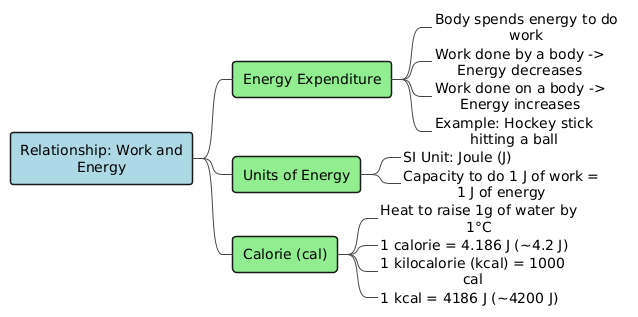
Force and Motion: When force is applied to an object, it can move the body from one place to another.Conditions for Work Done:Work is said to have been done by or on a body only if the applied force is sufficient to produce motion or displacement in the body.If the applied force does not produce any displacement or motion, no work is said to have been done.Calculating Work Done: The amount of work done is determined by the distance the body is displaced in the direction of the applied force. It is the mathematical product of the applied force and the displacement.Work = Force × Displacement
SI Unit of Work: Since the SI unit of force is the newton (N) and the SI unit of distance/displacement is the metre (m), the SI unit of work is the newton × metre (N × m).The Joule: In honour of the scientist J.P. Joule, this unit is expressed as the joule (J).1 J = 1 N × 1 mDefinition of One Joule: One joule of work is done when a force of 1 newton displaces a body through a distance of 1 metre in the direction of the force.

Energy Decrease: When work is done by a body, its energy level decreases.Energy Increase: When work is done on a body, its energy level increases.
When you swing a hockey stick, you perform work on the stick. Your body spends energy, and your energy level decreases, while the hockey stick gains energy.When the hockey stick hits the ball, the stick does work on the ball. The stick’s energy decreases, and the ball’s energy increases.The ball uses this gained energy to do work (roll against the ground). As the ball rolls against the force of friction, its energy is gradually depleted until it comes to a stop.
SI Unit: Because energy is a measure of the capacity to do work, its SI unit is also the joule (J). A body possesses exactly one joule of energy if it has the capacity to do one joule of work.Common Unit (Calorie): Another widely used unit of heat energy is the calorie (cal).Definition of 1 Calorie: The amount of heat energy required to raise the temperature of 1 gram of water by 1°C.
Joule to Calorie conversion:1 calorie = 4.186 joules (or approximately 4.2 joules)Kilocalories (kcal) conversion:1000 calories = 1 kilocalorie (kcal)1 kcal = 4186 joules (or approximately 4200 joules)
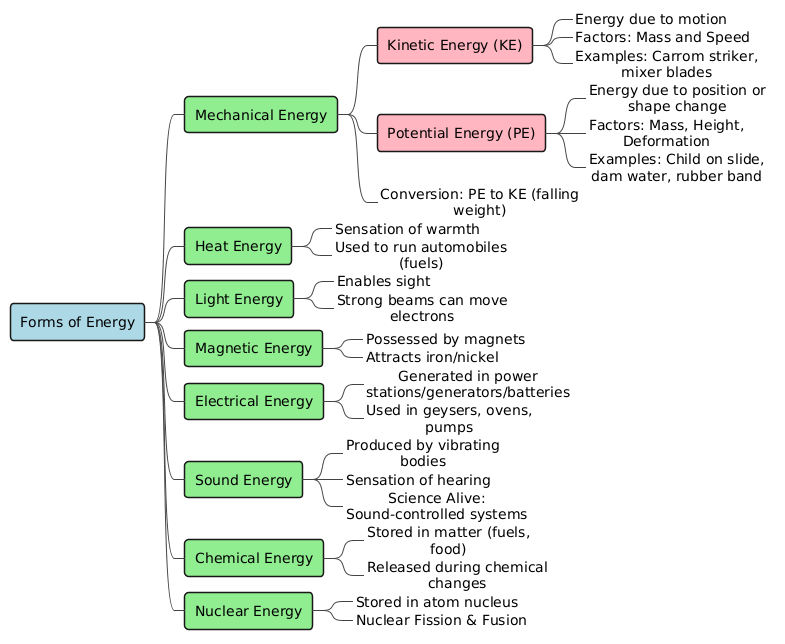
"Origin of Name: Derived from the Greek word “kinesis”, which means motion.Definition: The" energy possessed by an object by virtue of its motion. It is equal to the work done in bringing the body from a state of rest to its current state of motion.Factors Influencing Kinetic Energy:Mass of the object: Kinetic energy is directly proportional to mass. An object with greater mass has more kinetic energy.Example: It hurts more to be hit by a cricket ball than a tennis ball moving at the identical speed because the cricket ball has more mass and thus more kinetic energy.Speed of the object: Kinetic energy increases as the speed of the object increases.Example: A fast-moving tennis ball hurts more than a slow-moving one due to its higher kinetic energy.Everyday Examples:A moving carrom striker possesses kinetic energy, which is transferred to move a coin upon impact.The rapidly rotating blades of a mixer grinder use kinetic energy to move and crush food ingredients.
Definition: The energy stored in an object by virtue of its position above the ground or due to a change in its physical shape (deformation). It is equal to the work done in bringing the body to its current position of rest.Factors Influencing Potential Energy:Mass of the object: Lifting a heavier mass requires more work than lifting a lighter mass to the same height. Therefore, at any given height, a larger mass possesses greater potential energy.Height above the ground: More work is required to lift an object to a greater height. Thus, potential energy increases as height increases.Deformation/Stretching: The more an object is stretched or compressed, the more work is done on it, and the greater its potential energy becomes.Everyday Examples:A child sitting at the top of a slide possesses potential energy due to climbing up against gravity.Water stored behind a dam at a height possesses potential energy.A stone lifted to a height.A stretched rubber band storing energy due to its changed shape.
Definition: The form of energy that gives us the physical sensation of warmth.Capacity for Work: Heat energy is highly capable of doing work.Application: Burning fuels like wood, petrol, diesel, Compressed Natural Gas (CNG), or Liquid Petroleum Gas (LPG) produces heat energy. This heat energy is used to power automobiles, trains, ships, and aeroplanes.
Definition: The form of energy that enables us to see objects around us.Sources: The sun, glowing electrical light bulbs, and illuminated palaces.Interaction with Matter: While light energy does not usually move large everyday objects, a highly concentrated and strong beam of light is capable of moving tiny subatomic particles like electrons.
Definition: The energy possessed by a magnet.Properties: Magnetic energy can attract and move magnetic metals such as iron and nickel.Applications: Used in refrigerator doors, pencil boxes, and electric motors found in household gadgets like fans and juicer-grinders.
Definition: One of the most convenient and useful forms of energy.Generation: Generated in hydroelectric power stations near dams, as well as by generators and chemical batteries.Conversion: While electrical energy cannot move objects on its own, it easily converts to magnetic or heat energy, which can do mechanical work.Applications: Used in heating and cooking devices (geysers, ovens), lightning devices (bulbs), sound systems (music systems, bells), and farming motors to pump water.
Definition: The energy produced by vibrating bodies that causes the sensation of hearing in our ears.How We Hear: Vibrating strings (like a sitar or violin) or membranes (like a dholak) set air molecules into vibration. When these sound waves reach our ears, the ear membrane starts vibrating, which we perceive as sound. Because vibration is a form of motion, sound energy is capable of doing work.
Definition: The energy stored within the molecular bonds of matter. It is released only when matter undergoes a chemical change.Sources: Matchsticks, wood, kerosene, petrol, diesel, and food.Releases: When matchsticks or fuels burn, chemical energy is released as heat and light. In firecrackers, chemicals react rapidly to release heat, light, and a powerful sound wave that displaces the surrounding air.Muscular Energy: The food we eat contains chemical energy. Our body breaks this food down through chemical reactions and stores it in our muscles as muscular energy.
Definition: The massive energy stored inside the nucleus of atoms.Release Methods:Nuclear Fission: Splitting of a heavy atomic nucleus.Nuclear Fusion: Combining of light atomic nuclei.Applications: Releases energy as radiation waves. It is used to generate intensive heat, producing steam that turns massive turbine blades to generate electricity.
Myth: Plugged-in appliances that are turned off do not consume energy.Fact: Many plugged-in appliances continue to consume standby energy (vampire power) even when switched off.
When a ball is thrown vertically upwards, it has maximum kinetic energy and zero potential energy at the moment of release.As it rises, it loses speed (kinetic energy decreases) but gains height (potential energy increases).At its maximum height, the ball momentarily stops. Here, kinetic energy is zero, and potential energy is at its maximum.As the ball falls back down, its potential energy decreases while its kinetic energy increases.Just before touching the ground, the kinetic energy reaches its maximum while potential energy is zero.Throughout this entire process (assuming no energy is lost to air resistance/friction), the sum of potential and kinetic energy remains constant at every single point.
On a roller coaster ride, energy continuously shifts.At the top of a hill, potential energy is at its maximum. As the coaster drops into a valley, this potential energy is fully converted into kinetic energy.As it climbs the next hill, the kinetic energy converts back into potential energy.Assuming no friction, the total mechanical energy of the roller coaster remains exactly the same at every point of the track.
At Highest Positions (Extreme Ends): The bob momentarily stops, meaning its kinetic energy is zero, and its potential energy is at its maximum.At Lowest Position (Mean Center): The bob moves at its maximum speed, meaning its potential energy is zero, and its kinetic energy is at its maximum.During Swing: Energy continuously oscillates between potential and kinetic forms, but the total energy remains constant at any point.
Profile: James Prescott Joule was an English physicist born in Salford, England.Key Contribution: He studied the nature of heat deeply and successfully established that heat is a form of energy.Legacy: The SI unit of both work and energy (the joule) was named in his honour.

Share
Explore
 Self Study
Prepared by: learnloophq@gmail.com
Chapter: 03. Energy
SECTION 1: WORK AND ENERGY FOUNDATIONS
Concept of Energy
Understanding Work
Units of Work
Connect: Daily Sources of Energy
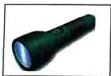
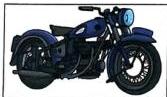
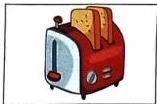
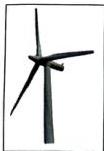
To understand how energy powers our world, consider the following everyday items and their specific energy sources:
Object
Image
Source of Energy
1. Flashlight
Battery / Cell
2. Motorcycle
Petrol
3. Smartphone
Battery / Cell
4. Toaster
Electricity
5. Wind Turbine
Wind

SECTION 2: RELATIONSHIP BETWEEN WORK AND ENERGY
The Direct Relationship
There is a direct correlation between work and energy. A body must spend energy to do work, resulting in physical tiredness after a hard day’s labor.
Case Study: Swinging a Hockey Stick

Fig. 3.1: Energy is the capacity to do work (as seen in field hockey).
Fig. 3.1: Energy is the capacity to do work (as seen in field hockey).
Units of Energy
Mathematical Relationship Between Joule and Calorie
SECTION 3: DIFFERENT FORMS OF ENERGY
Energy exists in various forms in nature, each possessing unique characteristics and properties.
1. Mechanical Energy
Mechanical energy is the energy acquired by an object by virtue of its position or its state of motion. It gives an object the immediate ability to do work. It exists as two distinct forms, and its total value is their sum:
Mechanical energy = Kinetic energy + Potential energy
A. Kinetic Energy
B. Potential Energy
Conversion of Potential Energy into Kinetic Energy
The two forms of mechanical energy can easily convert into one another. When a heavy object is raised and held at a height, it possesses 100% potential energy. As it falls, its potential energy is progressively converted into kinetic energy due to its downward motion. Just before hitting the ground, the potential energy becomes zero, and the mechanical energy is 100% kinetic energy.
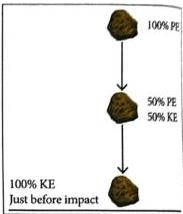
Fig. 3.2: Conversion of potential energy to kinetic energy during a fall.
Fig. 3.2: Conversion of potential energy to kinetic energy during a fall.
2. Heat Energy
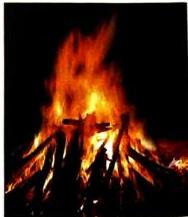
Fig. 3.3: Heat energy produced by burning wood.
Fig. 3.3: Heat energy produced by burning wood.
3. Light Energy

Fig. 3.4: Light energy illuminating the Ambavilas Palace in Mysuru.
Fig. 3.4: Light energy illuminating the Ambavilas Palace in Mysuru.
4. Magnetic Energy
5. Electrical Energy
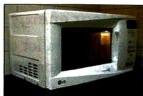
Fig. 3.5: Electrical energy operating a microwave oven.
Fig. 3.5: Electrical energy operating a microwave oven.
6. Sound Energy

Fig. 3.6: Vibrations of strings on musical instruments producing sound.
Fig. 3.6: Vibrations of strings on musical instruments producing sound.
⚡ SCIENCE ALIVE: Sound-Controlled Technology
Scientists have harnessed sound energy to create remote sound-controlled systems. Devices like lights, radios, fans, and televisions can now be turned on or off using specific sound signals.
7. Chemical Energy
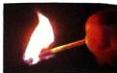
Fig. 3.7: Matchsticks storing chemical energy.
Fig. 3.7: Matchsticks storing chemical energy.
8. Nuclear Energy
🔍 MYTH VS FACT
SECTION 4: INTER-CONVERSION OF ENERGY
Energy in our daily life is constantly changing from one form to another. This is known as the transformation of energy or inter-conversion of energy.
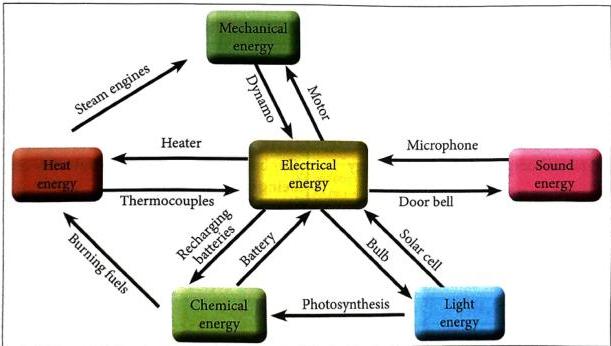
Fig. 3.8: Continuous inter-conversion pathways between multiple forms of energy.
Fig. 3.8: Continuous inter-conversion pathways between multiple forms of energy.
Common Examples of Inter-conversion of Energy
Type of Inter-conversion
Practical Examples
Heat energy into electrical energy
Thermal power stations
Heat energy into chemical energy
Preparation of certain chemical compounds
Heat energy into mechanical energy
Steam engines, steam turbines
Mechanical energy into electrical energy
Generators and dynamos
Mechanical energy into heat energy
Electric drills, friction between two rubbing objects
Electrical energy into heat energy
Heaters, irons, geysers, and electric kettles
Electrical energy into chemical energy
Chemical batteries while they are being charged
Electrical energy into mechanical energy
Fans, motors, washing machines, grinders, lifts, and electric trains
Electrical energy into sound energy
Loudspeakers, electric bells, music systems, and telephone speakers
Electrical energy into magnetic energy
Electromagnets
Electrical energy into light energy
Bulbs, tube lights, and CFLs
Chemical energy into mechanical energy
Vehicles, machines driven by the combustion of fuels
Chemical energy into heat energy
Burning of fuels like petrol, bursting of crackers
Chemical energy into electrical energy
Car batteries and dry cells while they are being used
Sound energy into electrical energy
Microphones
Light energy into chemical energy
Photosynthesis
Solar energy into heat energy
Solar cookers and solar water heaters
Solar energy into electrical energy
Solar cells

SECTION 5: LAW OF CONSERVATION OF ENERGY
Statement of the Law
According to the law of conservation of energy, energy can neither be created nor be destroyed. The total amount of energy in an isolated system always remains constant. It can only be transformed from one form to another.
Example 1: A Vertically Thrown Ball
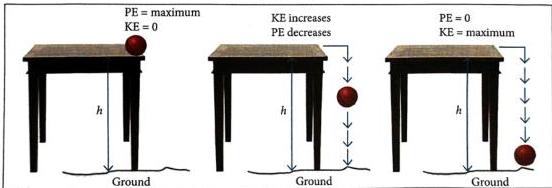
Fig. 3.9: Total mechanical energy (PE + KE) of a falling ball remains constant at all points.
Fig. 3.9: Total mechanical energy (PE + KE) of a falling ball remains constant at all points.
Example 2: A Roller Coaster
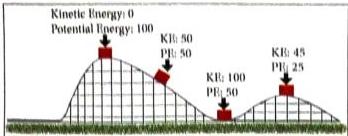
Fig. 3.10: Conservation of energy along a roller coaster track.
Fig. 3.10: Conservation of energy along a roller coaster track.
Example 3: A Simple Pendulum
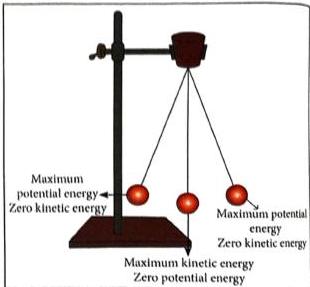
Fig. 3.11: Conservation of mechanical energy in a swinging simple pendulum.
Fig. 3.11: Conservation of mechanical energy in a swinging simple pendulum.

SECTION 6: SCIENCE AND SCIENTISTS
James Prescott Joule (1818–1889)
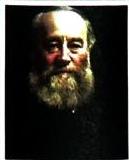
Portrait of James Prescott Joule.
Portrait of James Prescott Joule.
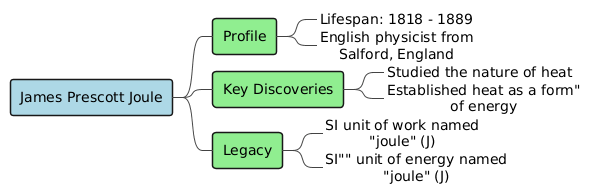
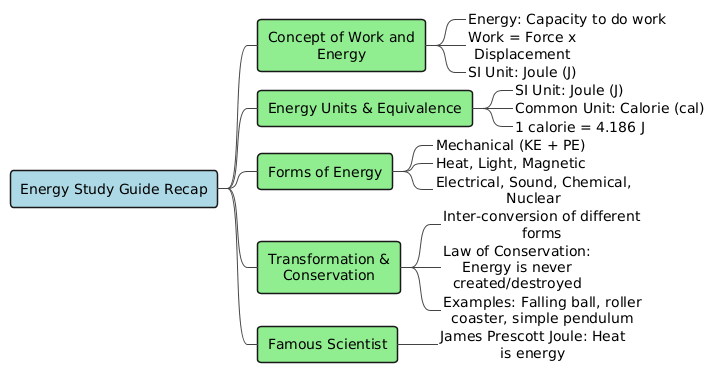
OVERALL" SUMMARY & VISUAL RECAP
Want to print your doc?
This is not the way.
This is not the way.

Try clicking the ··· in the right corner or using a keyboard shortcut (
CtrlP
) instead.