Skip to content
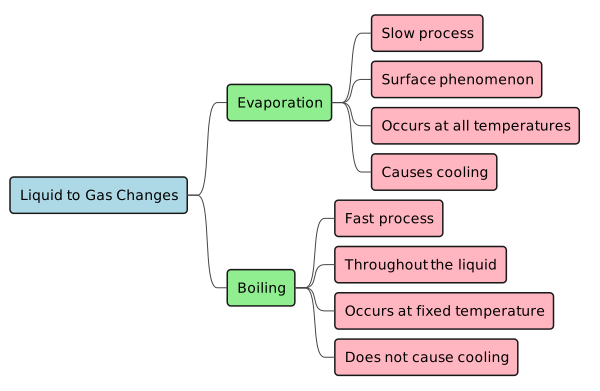
Compare evaporation and boiling, highlighting their key differences as physical changes.Evaporation and boiling are both physical changes where a liquid converts into a gaseous state, but they differ significantly in their characteristics. Evaporation is a slow process that takes place only from the surface of the liquid and occurs at all temperatures. In contrast, boiling is a fast process that occurs throughout the entire bulk of the liquid at a specific, fixed temperature. Additionally, evaporation absorbs heat from its surroundings and causes a cooling effect, whereas boiling does not produce any cooling. Finally, while both processes can be reversed to obtain the liquid through condensation, boiling represents an extreme and rapid form of evaporation.
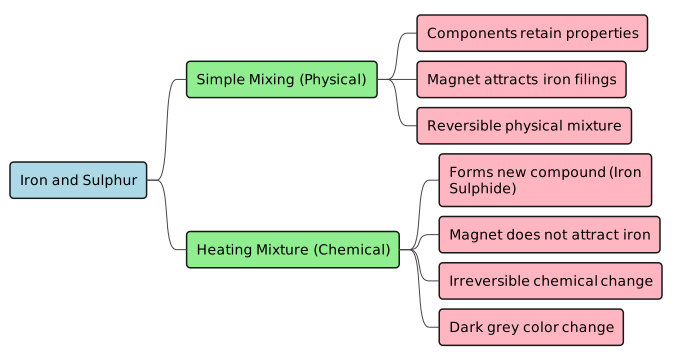
 Describe the experiments with iron and sulphur that differentiate a physical mixture from a chemical compound.Simply mixing iron filings and sulphur powder together creates a physical mixture where both components retain their original properties. When a magnet is brought near this physical mixture, the iron filings are easily attracted to it because they have not changed chemically. However, when the mixture of iron and sulphur is strongly heated, it undergoes a chemical change to form a new substance called iron sulphide. Iron sulphide has entirely different properties from its constituent elements, and its iron component is no longer attracted to a magnet. Therefore, simple mixing is a temporary physical change, whereas heating the components leads to a permanent and irreversible chemical change.
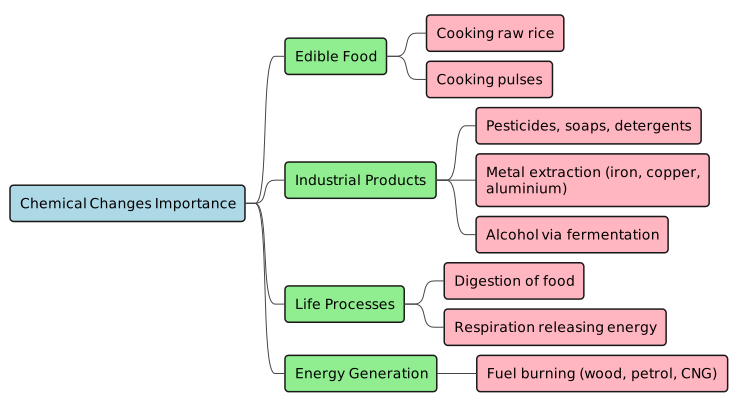
 What is the importance of chemical changes in our daily lives and industries?Chemical changes are essential for preparing daily food items because raw materials like rice and pulses only become edible after being cooked. Many useful industrial products such as pesticides, soaps, detergents, and even alcohol are manufactured through various chemical processes. Additionally, key metals like iron, copper, and aluminium must be extracted from their ores using chemical methods. Furthermore, vital life-sustaining processes like digestion and respiration inside living organisms rely completely on chemical changes to release energy. Finally, the burning of fuels to produce energy for cooking and moving vehicles is also a crucial chemical change.
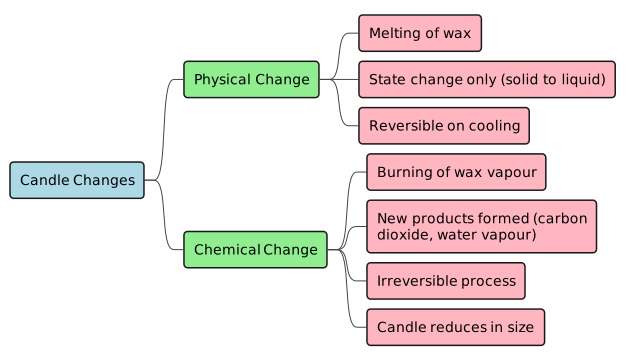
 Explain how the burning of a candle involves both a physical and a chemical change simultaneously.When a candle is lit, the heat melts the solid wax into liquid wax, which then changes back into solid wax upon cooling. This transformation is a temporary and reversible process where no new substance is formed, making the melting of wax a physical change. Simultaneously, some of the molten wax rises up the wick and vaporises before burning in the flame. This burning process produces entirely new substances, namely carbon dioxide and water vapour, while causing the candle to gradually decrease in size. Since these new substances cannot be converted back into wax, the burning of candle wax represents a permanent chemical change.

Share
Explore
 Answer key
Chapter: 02. Physical And Chemical Changes
Want to print your doc?
This is not the way.
This is not the way.

Try clicking the ··· in the right corner or using a keyboard shortcut (
CtrlP
) instead.