Skip to content
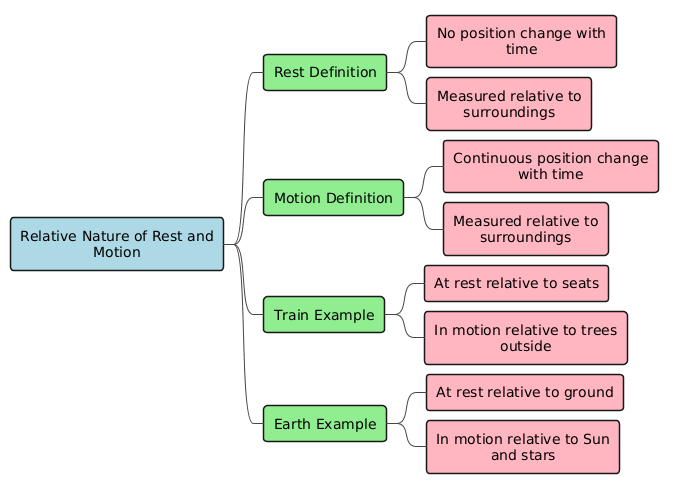
Why are rest and motion described as relative terms? Explain with appropriate examples.Rest and motion are relative terms because an object can be at rest with respect to one observer while being in motion with respect to another at the exact same time. For example, a person sitting inside a moving train is at rest relative to the train’s seats and roof because their position does not change with respect to them. However, the same person is in motion relative to trees and houses outside because their position continuously changes with respect to the surroundings outside. Similarly, a person sitting on the ground is at rest relative to the Earth but is in motion relative to the Sun and stars because the Earth is constantly rotating and revolving.
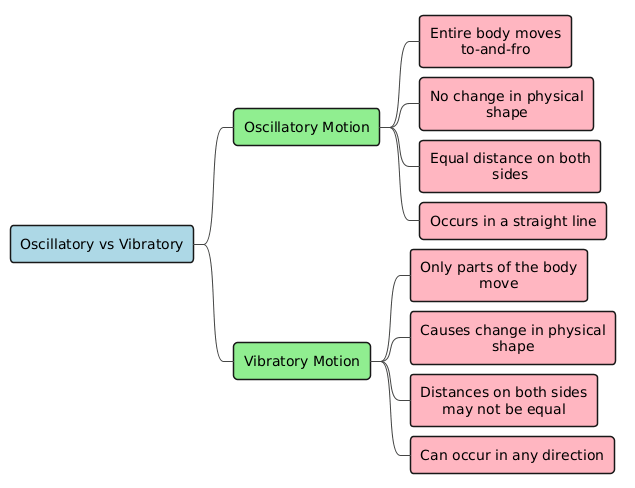
 Differentiate between oscillatory motion and vibratory motion based on their characteristics.Oscillatory motion involves the to-and-fro or back-and-forth movement of an entire body about its mean position, while vibratory motion is the motion of only parts of a body about their mean positions. In oscillatory motion, there is no physical change in the shape of the body, whereas vibratory motion causes a physical change in the shape of the body. Additionally, the distance traversed by the body on either side of the mean position is always equal in oscillatory motion, but it may not be equal in vibratory motion. Finally, oscillatory motion always takes place in a straight line, while vibratory motion can occur in any direction.
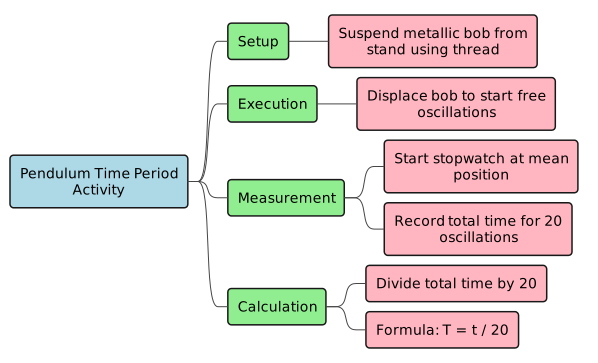
 Describe how you can determine the time period of a simple pendulum through a simple laboratory activity.To determine the time period, set up a simple pendulum by suspending a metallic bob from a stand using a thread. Next, gently displace the bob from its mean position and let it oscillate freely without touching any surrounding objects. Using a stopwatch, measure the total time taken for the bob to complete twenty full oscillations. Finally, divide this recorded total time by twenty to calculate the constant time period of the pendulum.
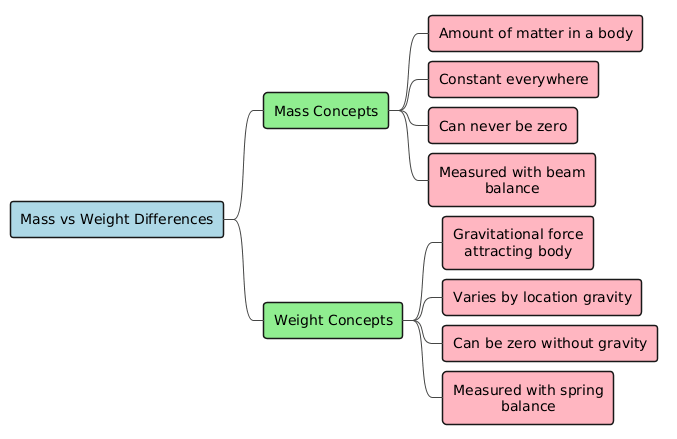
 Explain the concepts of mass and weight and why they are different from each other.Mass is the actual quantity of matter contained within a body, whereas weight is the force of gravity with which the Earth attracts that body toward its center. While the mass of an object remains constant and never changes from place to place, its weight varies depending on the local gravitational force. For instance, weight is maximum at the poles and minimum at the equator because the Earth’s gravitational force varies across these regions. Furthermore, mass can never be zero, but weight can become zero if there is no gravitational force acting on the body.
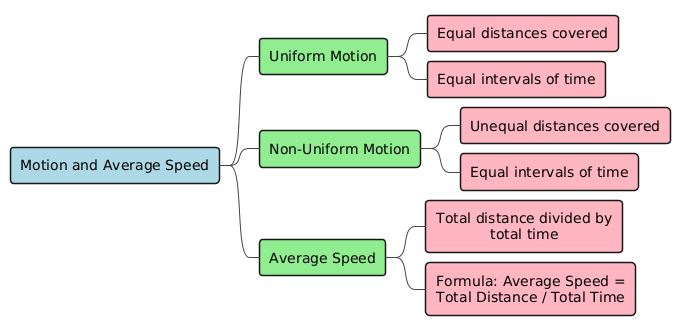
 Define uniform and non-uniform motion and explain how average speed is calculated.An object is said to be in uniform motion when it covers equal distances in equal intervals of time, indicating a constant speed. Conversely, non-uniform motion occurs when an object covers unequal distances in equal intervals of time, resulting in variable speed. When an object exhibits non-uniform speed, we describe its overall motion by calculating its average speed. This value is determined by dividing the total distance travelled by the moving object by the total time taken to complete the entire journey.

Share
Explore
 Long Answers
Prepared by: learnloophq@gmail.com
Chapter: 02. Motion
Want to print your doc?
This is not the way.
This is not the way.

Try clicking the ··· in the right corner or using a keyboard shortcut (
CtrlP
) instead.