Skip to content
Who was the elected Chairman of the Constituent Assembly that framed the Constitution of India?(a) Dr. B. R. Ambedkar(b) Jawaharlal Nehru© Dr. Rajendra Prasad(d) Maulana AzadIn which year were the terms “Socialist” and “Secular” added to the Preamble through the 42nd Amendment Act?(a) 1947(b) 1950© 1949(d) 1976The historical origin of the world’s first written constitution outlining the rights of the ruled is traced back to which document?(a) The Preamble(b) The Magna Carta© The 42nd Amendment Act(d) The Draft ConstitutionWhere is the original 1950 copy of the Constitution of India safely preserved today?(a) In the National Archives of India(b) In a helium-filled case in the Library of the Parliament of India© In the Supreme Court of India(d) In the President’s HouseWhat is the fixed term of office for the President of India?(a) 4 years(b) 5 years© 6 years(d) Permanent until retirement
The first meeting of the Constituent Assembly of India was held on _ _ _ _ _ _ _ _ _ _ _ _ _ _.The Constituent Assembly took 2 years, _ _ _ _ _ _ _ _ _ _ _ _ _ _ months, and 18 days to complete the task of framing the Constitution.The Preamble begins with the powerful opening phrase, “We, the _ _ _ _ _ _ _ _ _ _ _ _ _ _”.A _ _ _ _ _ _ _ _ _ _ _ _ _ _ state does not have an official or state religion and does not discriminate against anyone based on their religion.The Magna Carta was signed on 15 June 1215 CE by King John of _ _ _ _ _ _ _ _ _ _ _ _ _ _.
The Constitution of India was passed by the Constituent Assembly on 26 January 1950.Sarojini Naidu was a member of the Constituent Assembly.In a republic, the position of the head of state is hereditary.The Constitution of India is the longest written constitution of any sovereign state in the world.The concept of “Fraternity” refers to the promotion of a spirit of brotherhood and oneness among all sections of society.
ConstitutionAmendmentSovereign
Differentiate between a Democratic government and a Republic based on the definition of their leadership/governance structure.Differentiate between the objectives of Liberty and Equality as promised in the Constitution.
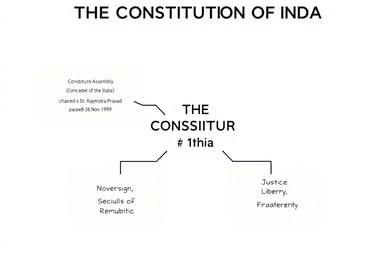
According to the diagram, what is defined as the “introduction to the constitution”?Which branch of the diagram lists “Justice, Liberty, Equality, Fraternity”? What do these terms represent in relation to the Constitution?
Why is the original copy of the Constitution of India kept in a special helium-filled case?Who is known as the “Father of the Indian Constitution” and what did he hope to achieve for India’s oppressed classes?How do the concepts of fraternity and being “one people” help in overcoming social evils in Indian society?
Explain what it means for India to be a “Socialist” state. How does this concept work to bridge the gap between the rich and the poor?Describe the role of the Constituent Assembly in framing the Constitution of India. Highlight the key members, the time taken, and the dates of its passage and enforcement.

Share
Explore
 Question Paper
Prepared by: learnloophq@gmail.com
Chapter: 12. The Constitution And The Preamble
Class Assessment: The Constitution and the Preamble
Subject: Civics / Social Studies
Grade Level: Elementary/Middle School
Total Marks: 50
Time Allowed: 1.5 Hours
Section A: Multiple Choice Questions (5 Marks)
Choose the correct option for each of the following questions.
Section B: Fill in the Blanks (5 Marks)
Fill in the blanks using the exact terms. Use the space provided.
Section C: True or False Questions (5 Marks)
State whether the following statements are True or False. If False, rewrite the statement correctly.
Section D: Explanation of Terms (6 Marks)
Explain the following terms in one or two sentences based on the chapter:
Section E: Differentiating Concepts (6 Marks)
Answer the following questions to distinguish between the key concepts:
Section F: Diagram-Based Questions (4 Marks)
Refer to the diagram below to answer the questions.
A concept map illustrating the organization, features, and key branches of the Constitution of India.
Section G: Short Answer Questions (9 Marks)
Answer the following questions briefly in 2 to 3 sentences:
Section H: Long Answer Questions (10 Marks)
Answer the following questions in detail:
Want to print your doc?
This is not the way.
This is not the way.

Try clicking the ··· in the right corner or using a keyboard shortcut (
CtrlP
) instead.