Skip to content
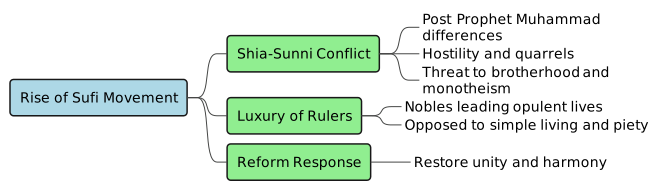
What were the main causes for the rise of the Sufi Movement in Muslim society?After the death of Prophet Muhammad, religious differences arose between the Shia and Sunni sects of the Muslim community. These differences led to prolonged mutual hostility and bitter quarrels, posing a serious threat to Islamic principles of brotherhood and monotheism. Additionally, Muslim rulers and nobles increasingly led lives of luxury, opulence, and indulgence. This decadent lifestyle directly opposed the core Islamic principles of simple living and piety. Consequently, Sufism arose as a liberal reform movement to restore unity, harmony, and simple devotion within Muslim society.
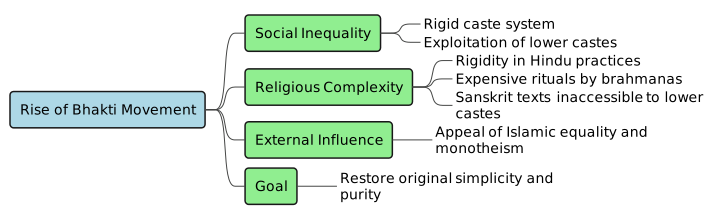
 Explain the social and religious causes that led to the birth of the Bhakti Movement in Hinduism.Over time, Hindu religious practices became rigid and complex, and many evil beliefs crept into society. The rigid caste system created severe social inequality, leading to the exploitation and oppression of the lower castes by the higher castes. Furthermore, expensive and meaningless rituals prescribed by the brahmanas imposed a heavy financial burden on the poor. Lower castes were also forbidden from studying Sanskrit religious texts, keeping them from understanding hymns and mantras. These conditions, combined with the appealing Islamic principles of equality and monotheism, necessitated a reform movement to restore Hinduism to its original simplicity.
 Discuss the key teachings of Guru Nanak and explain how the holy scripture of the Sikhs became their ultimate guide.Guru Nanak taught that there is only one God who is the creator of the entire universe. He rejected the caste system, advocated for universal brotherhood, and urged people to lead pure lives based on truth and kindness while discarding rituals and idol worship. He also emphasized that true spiritual knowledge can only be gained under the guidance of a guru. The succession of living gurus ended with the tenth guru, Guru Gobind Singh, who transferred the authority of the guru to the holy scripture, the Adi Granth. This holy book, known as the Guru Granth Sahib, contains the teachings of all the gurus and serves as the ultimate spiritual guide for all Sikhs.
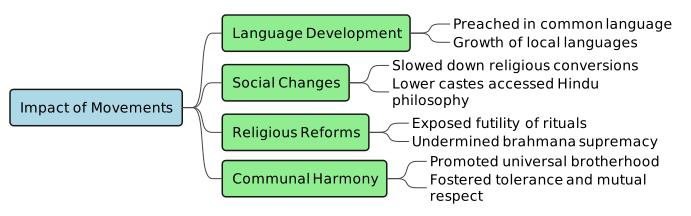
 What was the impact of the Bhakti and Sufi movements on medieval Indian society?The Bhakti and Sufi saints preached in the local languages of the common people, which greatly accelerated the development of regional literature. By providing the lower castes with free access to the core truths of Hindu philosophy, these movements successfully slowed down religious conversions. They exposed the futility of expensive rites and rituals while directly undermining the supremacy and domination of the brahmanas. Their strong emphasis on universal brotherhood and one God fostered an environment of religious tolerance, mutual respect, and communal harmony. Ultimately, these liberal movements brought Hindus and Muslims closer together, paving the way for a composite culture.

Share
Explore
 Long Answers
Prepared by: learnloophq@gmail.com
Chapter: 11. Bhakti And Sufi Movements
Want to print your doc?
This is not the way.
This is not the way.

Try clicking the ··· in the right corner or using a keyboard shortcut (
CtrlP
) instead.