Skip to content
Founder: Captured the throne from the last Mamluk ruler.Character: Mild, pious, and generous; forgave rebellious nobles.Downfall: His leniency led to lawlessness. He was treacherously murdered by his ambitious nephew, Alauddin.
Rise to Power: Secured the throne by bribing nobles with rich gifts and killing or blinding Jalaluddin’s descendants. Later, he executed or blinded the very nobles who had betrayed Jalaluddin for him.Significance: A brilliant general and shrewd administrator; the first Turkish sultan to build an empire in India extending south of the Vindhyas.Gujarat: Annexed by Alauddin’s forces. Malik Kafur (a slave bought for 1,000 dinars) was acquired here and rose to become his chief military general.Rajasthan: Captured the fort of Ranthambore and Chittor (the capital of Mewar, where Queen Padmini and palace women committed jauhar). Conquered Malwa cities (Mandu, Ujjain, Dhar, Chanderi). By 1305 CE, he controlled all of North India.The Deccan Campaigns: Led by Malik Kafur, targeting Devagiri, Warangal, Dwarasamudra, and Madurai.Deccan Policy: Alauddin did not annex the Deccan because of administrative difficulties from Delhi. Instead, he forced southern rulers to accept his suzerainty and pay heavy annual tributes to fund his massive standing army.Mongol Defense: Repulsed 5 Mongol invasions by repairing frontier forts, stationing top generals, enlarging the army, and executing captured Mongol leaders. He massacred the “New Muslims” (Mongols settled in Delhi under Jalaluddin).Measures Against Nobles: To prevent conspiracies, nobles could not organize parties or intermarry without royal permission. An extensive spy system was introduced. Feudal land grants were confiscated, and no additional taxes could be levied on peasants by landholders.Army Reorganization: Established a permanent standing army. Introduced the branding of horses (dagh) and descriptive rolls of soldiers (chehra). Kept spies in units and fixed/reduced soldier salaries.Revenue Reforms: Measured land, fixed the state’s share, appointed special collectors, and increased land tax to half (1/2) of the harvest, payable strictly in cash.Market Control Policy: Set up three distinct markets in Delhi (food grains; luxury goods/cloth; horses/cattle/slaves) under officials called shahnaras. Prices were fixed and kept low. Cheating or under-weighing was brutally punished (flesh equal to the weight deficit was carved from the trader’s body). State warehouses stockpiled grain for emergencies.Art and Architecture: Patron of Persian poet Amir Khusrau. Built the Alai Darwaza (entrance to Qutb Minar), a madrasa in the Qutb complex, Siri Fort, and the Palace of Thousand Pillars.
Efficient military leader and administrator.Restored peace and stability, but died in a suspected engineered accident. Succeeded by his son, Jauna Khan (Muhammad bin Tughlaq).
Highly learned scholar in logic, math, astronomy, philosophy, and sciences.Termed by historians as the “wisest fool”, a “madman”, or a “visionary” because his projects were brilliantly conceived but poorly executed.Taxation in the Doab: Increased land tax in the fertile Ganga-Yamuna Doab to raise army funds. Coincided with a severe famine. Tax collectors collected rigorously, causing peasants to flee to the jungles and abandon agriculture. Relief measures were introduced too late.Transfer of the Capital (1326-1328 CE): Shifted the capital 1,250 km from Delhi to Devagiri (renamed Daulatabad) to have a central administrative location and safety from Mongols. Ordered a mass exodus of the population. Countless died on the arduous journey. Due to Mongol vulnerabilities in the north, he ordered everyone back to Delhi after 2 years, leaving the treasury depleted and Daulatabad deserted.Token Currency (1329–1330 CE): Introduced copper coins with the same value as silver and gold to solve financial strains. He failed to make minting a government monopoly. Massive counterfeiting occurred, trade collapsed, and foreign traders refused the currency. The project was withdrawn, heavily draining the treasury.Expansionist Schemes: Maintained a massive army to conquer Persia, Khurasan, and Iraq, paying them a year’s salary in advance. The plan was abandoned due to geographical hurdles. An expedition to the Himachal region resulted in near-total annihilation of his army (only 10 soldiers returned).Consequences of Failures: Extensive revolts broke out. The Hindu kingdom of Vijayanagar and the Muslim Bahmani kingdom were established in the South. Bengal, Mewar, and Sind asserted independence, leaving the Sultanate in decay by his death in 1351 CE.
Nominated by ulemas and nobles; peace-loving and benevolent. Focused heavily on public welfare.Economic: Reduced Doab land taxes, cancelled all famine loans, built/repaired canals, dams, and dug hundreds of wells to boost agriculture.Public Utility: Established rest houses, free hospitals, an employment bureau, a charity department for widows/orphans, and a separate department for slaves.Judicial: Abolished brutal torture systems and gave mild punishments to criminals.Architecture & Education: Founded new towns like Firozabad (Firoz Shah Kotla), Jaunpur, Hisar, and Firozpur. Laid out 1,200 orchards around Delhi, generating massive state revenue. Promoted translation of Sanskrit texts to Persian.Weak Foreign Policy: Incompetent military leader; failed to recover Bengal and lost control over the independent southern provinces. Made the iqta system hereditary to appease nobles, which eventually undermined royal power.
Amir Timur (Mongol ruler of Samarkand) invaded India, plundering Delhi and massacring its population. He looted its wealth and appointed Khizr Khan as his viceroy before returning.
Established by Khizr Khan. Ruled Delhi for 38 years.
An Afghan dynasty founded by Bahlul Lodi.Sikandar Lodi was the greatest ruler.Ibrahim Lodi was the last, highly unpopular ruler.
Babur (a descendant of Timur) invaded India, defeated, and killed Ibrahim Lodi.Significance: Ended the Delhi Sultanate and marked the beginning of the Mughal Empire.

Share
Explore
 Recap Hub
Prepared by: learnloophq@gmail.com
Chapter: 05. Expansion Of The Delhi Sultanate The Khilji And The Tughlaq Dynasties
CRASH COURSE REVISION MATERIAL: THE DELHI SULTANATE (KHILJI & TUGHLAQ DYNASTIES)
1. THE KHILJI DYNASTY (1290–1320 CE)
The Mamluk dynasty ended in 1290 CE, handing control over to the Khilji Dynasty.
Jalaluddin Khilji (1290–1296 CE)
Alauddin Khilji (1296–1316 CE)
Key Conquests
Administrative and Military Reforms
2. THE TUGHLAQ DYNASTY (1320–1414 CE)
Founded in 1320 CE after Ghiyasuddin Tughlaq killed the last Khilji ruler.
Ghiyasuddin Tughlaq (1320–1324 CE)
Muhammad bin Tughlaq (1324–1351 CE)
Failed Projects and Schemes
Firoz Shah Tughlaq (1351–1388 CE)
Key Reforms and Achievements
3. DECLINE AND LATER DYNASTIES
Invasion of Timur (1398–1399 CE)
The Sayyid Dynasty (1414–1451 CE)
The Lodi Dynasty (1451–1526 CE)
First Battle of Panipat (1526 CE)
4. COMPARATIVE SUMMARY: KHILJIS VS. TUGHLAQS
Feature
Alauddin Khilji
Muhammad bin / Firoz Shah Tughlaq
Empire Building
Built a highly successful, centralized empire across North and parts of South India.
Highly ambitious but failed schemes (Muhammad); weak military leadership leading to disintegration (Firoz).
Army Reforms
Permanent standing army, branding of horses (dagh), descriptive rolls (chehra).
Firoz Shah reintroduced hereditary iqtas and weakened military standards.
Control of Nobles
Strict regulations, spy networks, banned social gatherings, seized land grants.
Firoz Shah used conciliation, raised salaries, and made offices hereditary to please nobles.
Religion & Politics
Strictly separated religion from politics; defied the authority of the ulemas.
Firoz Shah ruled by the shariah and allowed the ulemas to guide administrative matters.
Mongol Policy
Established robust military fortifications and repulsed five major invasions.
Muhammad bin Tughlaq shifted the capital to Daulatabad to avoid Mongol threats.
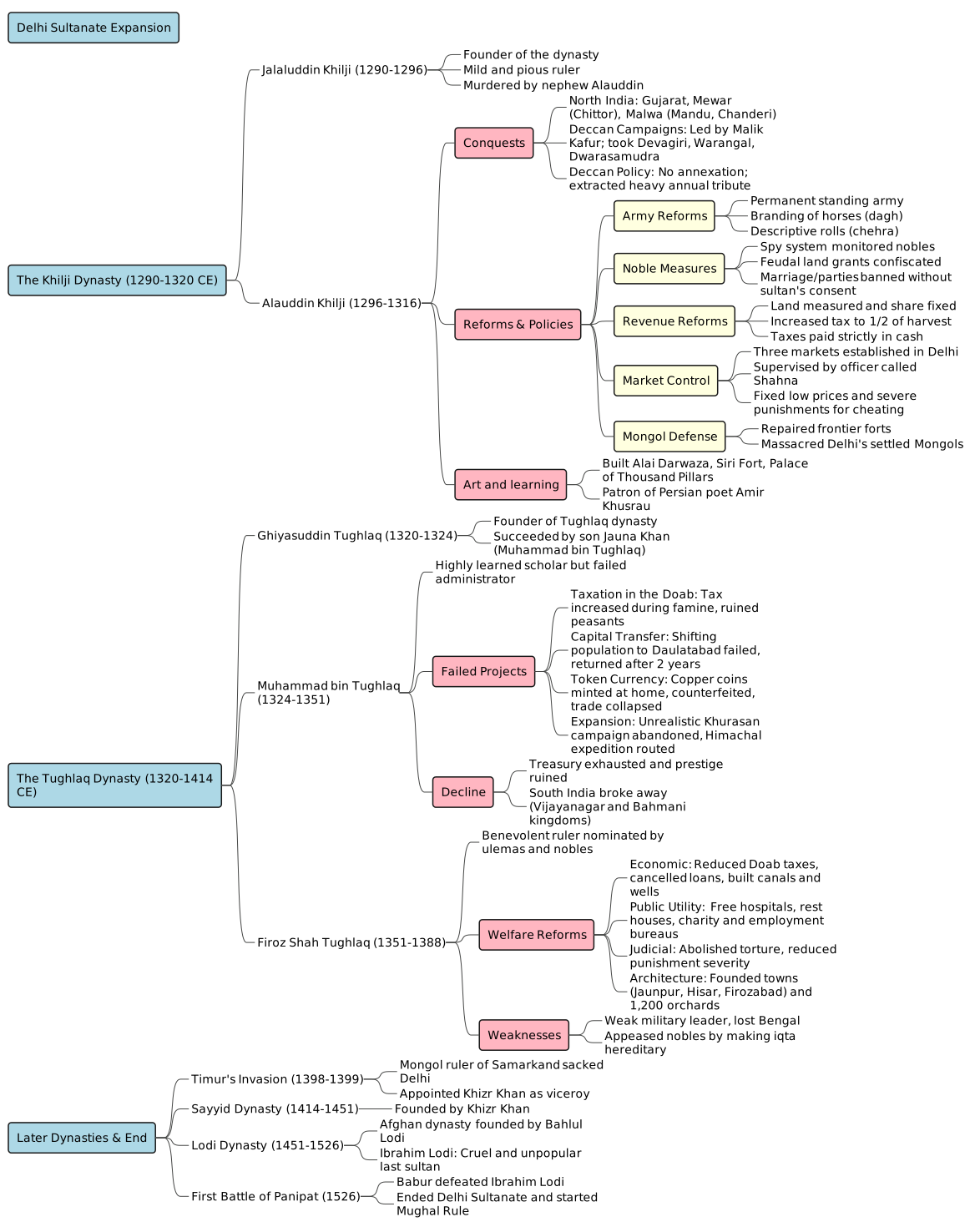
5. CHAPTER MINDMAP (PLANTUML)
Want to print your doc?
This is not the way.
This is not the way.

Try clicking the ··· in the right corner or using a keyboard shortcut (
CtrlP
) instead.