Skip to content
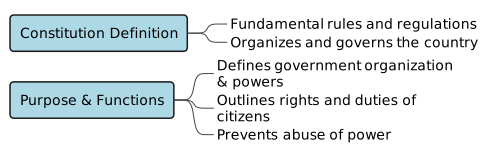
A constitution is defined as a body of fundamental rules and regulations according to which a country is organized and governed. These rules and regulations clearly define and mention the organization, powers, and functions of the government. Additionally, it outlines the fundamental rights and duties of the citizens to ensure fair governance. By establishing these boundaries, a constitution prevents the abuse of power and helps maintain order in the state. Thus, it serves as the ultimate guiding document for a nation’s legal and political structure.
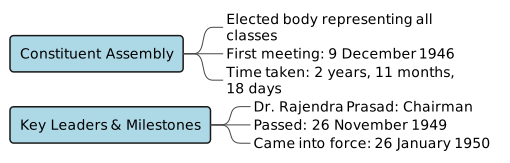
The Constitution of India was framed by a Constituent Assembly, which was an elected body representing all communities, classes, and shades of opinion in India. This Assembly was chaired by Dr. Rajendra Prasad and included other important members like Dr. B. R. Ambedkar, Maulana Azad, and Sarojini Naidu. The Assembly held its first meeting on 9 December 1946 and took 2 years, 11 months, and 18 days to complete its task. Finally, the Constitution was passed on 26 November 1949 and came into force on 26 January 1950, marking India’s journey as a sovereign, democratic republic.
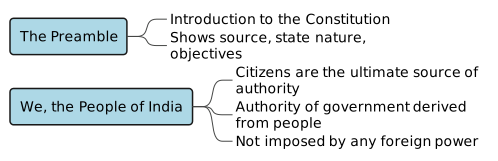
The Preamble is an introduction to the Constitution that highlights its source, the nature of the state, and its main objectives. The opening phrase “We, the people of India” signifies that the ultimate source of authority for the Constitution lies with the citizens of India. This implies that the government derives its power directly from the people and not from any external or foreign rule. Consequently, the Constitution reflects the true wishes, aspirations, and collective resolve of the Indian citizens. By starting with this phrase, it establishes a democratic foundation where the people are the ultimate sovereign.
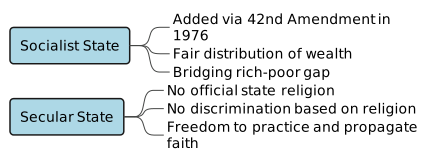
The terms socialist and secular were both added to the Preamble of the Indian Constitution in 1976 through the 42nd Amendment Act. A socialist state aims to promote social welfare by ensuring a fair distribution of the country’s wealth and bridging the gap between the rich and the poor through equal opportunities. On the other hand, a secular state has no official or state religion and guarantees every individual the freedom to profess, practice, and propagate their faith. Furthermore, a secular government does not discriminate against anyone or favor any particular religion over others.
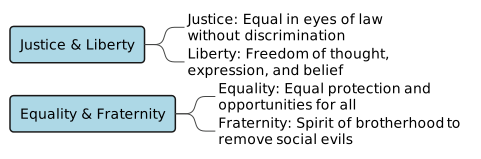
The Constitution outlines key objectives to ensure a fair and unified society, starting with justice which guarantees that all citizens are equal in the eyes of the law regardless of their background. Liberty ensures that every citizen enjoys fundamental rights, such as freedom of thought, expression, and the freedom to follow their chosen religion. Equality guarantees that all individuals are protected equally by the law and are free from state-sponsored discrimination based on race, caste, sex, or religion. Finally, fraternity promotes a spirit of brotherhood and oneness among diverse social groups to eliminate social evils like untouchability and communalism.

Share
Explore
 Long Answers
Prepared by: learnloophq@gmail.com
Chapter: 12. The Constitution And The Preamble
Question 1: What is a constitution, and what purpose does it serve in a country?
Question 2: Discuss the role and key details of the Constituent Assembly in framing the Constitution of India.
Question 3: Explain the significance of the Preamble and the meaning of its opening phrase, “We, the people of India”.
Question 4: Describe how the Constitution of India defines a secular state and a socialist state under the nature of the state.
Question 5: Elaborate on the objectives of Justice, Liberty, Equality, and Fraternity as outlined in the Constitution.
Want to print your doc?
This is not the way.
This is not the way.

Try clicking the ··· in the right corner or using a keyboard shortcut (
CtrlP
) instead.