Skip to content
Definition of Atmosphere: The envelope of air surrounding the Earth, extending many kilometers above its surface.Necessity for Life: Essential for all living organisms to breathe and survive.Presence in Water: Air also exists in a dissolved state in water, supporting aquatic life.Historical Context: Up until the 18th century, air was believed to be a single substance. Experiments by French scientist Antoine Lavoisier proved it is a mixture of gases.
A red-coloured powder, mercuric oxide (  ), formed on the surface of the heated mercury.The level of mercury in the bell jar rose by one-fifth (
  ) of the jar’s total volume.Reheating the red oxide strongly released the active portion of air again, which supported burning. Lavoisier named this oxygen.


Active Air (Oxygen): Constitutes of the air’s volume; supports combustion.Inactive Air (Nitrogen / Azote): Constitutes  of the air’s volume; does not support combustion or life.Volume Ratio: The volume ratio of Nitrogen to Oxygen in air is approximately
  .
.
No Fixed Formula: It cannot be represented by a single chemical formula.Variable Composition: Its composition differs by location and time (e.g., higher humidity during monsoons, more  and dust in industrial cities, higher water vapour in coastal areas).Retention of Individual Properties: Components like oxygen (supports burning) and nitrogen (does not support burning) keep their distinct properties.Physical Separation: Its components can be separated by simple physical methods (e.g., fractional distillation of liquid air).No Energy Change: No heat or light energy is absorbed or released when the components are mixed together.
Abundance: Most abundant gas in the atmosphere (78% by volume).
Colourless, odourless, tasteless, and non-poisonous gas.Slightly lighter than air.Non-combustible and does not support combustion.Slightly soluble in water (less soluble than oxygen).
Food Preservation: Used to flush food packaging (e.g., potato chips, snacks) to displace oxygen. This prevents bacteria growth and food oxidation, keeping food fresh.Biological Importance: An essential constituent of proteins, vitamins, and nucleic acids required for the growth of plants and animals.Chemical Manufacturing: Used to manufacture nitric acid (  ) and ammonia (
  ), which is further processed into nitrogenous fertilizers like urea and ammonium sulphate.Refrigerant: Liquid nitrogen is used to freeze food items.Combustion Control: Dilutes oxygen in the atmosphere to moderate and control the rate of burning.Explosives: Used to manufacture TNT (trinitrotoluene) and TNG (trinitroglycerine).
Nitrogen Fixation: Atmospheric nitrogen is converted into soluble nitrates.Biological Fixation: Rhizobium bacteria in the root nodules of leguminous plants convert free nitrogen into soluble nitrates.Atmospheric Fixation (Lightning): At high temperatures (  ) during lightning, nitrogen and oxygen react to form nitric oxide (
  ), which oxidizes to nitrogen dioxide (
  ), reacts with water vapour to form nitric acid ( ), and reaches the soil to form metal nitrates.


 Nitrate Assimilation: Plants absorb nitrates from the soil via roots and convert them into plant proteins, which are then consumed by animals.Ammonification: Fungi and putrefying bacteria in the soil decompose animal wastes (urea, uric acid) and dead organic matter into ammonium compounds.Nitrification: Ammonium salts in the soil are converted first into nitrites, and then into nitrates by soil bacteria.Denitrification: Pseudomonas bacteria in the soil convert a portion of soil nitrates back into gaseous nitrogen, which escapes into the atmosphere.
Abundance: Second most abundant gas (21% by volume, 23.2% by mass).Discovery: First prepared by Carl Wilhelm Scheele (1772) by heating mercuric oxide. Independently prepared and discovered by Joseph Priestley (1774) using sunlight focused on mercuric oxide; he called it “dephlogisticated air”. Named oxygen by Antoine Lavoisier in 1789.
Free State: 21% by volume in the atmosphere.Combined State: Found in water (89% by weight), plants (60% by weight), human body (65% by weight), and the Earth’s crust (approx. 50% by weight, as sand (  ), silicates, carbonates, and sulphates).
From Air: Fractional distillation of liquefied air. Nitrogen boils off first at  , leaving liquid oxygen which boils at
  .From Water: Electrolysis of acidulated water (water containing a small amount of acid).
 Laboratory Preparation (From Hydrogen Peroxide): Decomposition of
  Hydrogen Peroxide (
  ) using Manganese Dioxide (
  ) as a catalyst.
 Collection Method: Collected by downward displacement of water because it is slightly soluble in water and heavier than air.Why is preferred over
  : It does not require heating, is safer, and the reaction rate is highly controlled.Other Compounds: Thermal decomposition of compounds like Potassium Nitrate (
  ), Red Lead (
  ), and Potassium Chlorate ( ).
Burning of Non-metals (Form Acidic Oxides): Turn blue litmus red.Carbon:  (Produces toxic carbon monoxide
  if oxygen is insufficient).Sulphur:
  (Pungent smell, burns with blue flame).Phosphorus:
  (Dense white fumes, dazzling flame).Hydrogen:
  .Burning of Metals (Form Basic Oxides): Turn red litmus blue.Magnesium:
  (Dazzling white flame, white powder product).Sodium:
  (Golden yellow flame).Iron:
  (Bright sparks, no flame, black particles).Calcium:
  (Brick red flame).Burning of Metal Sulphides: Produces metal oxides and sulphur dioxide gas (e.g., burning of
  ,
,  ,
,  ).Weight Gain: Substances gain weight on burning because they combine with oxygen from the air to form solid oxides (e.g., magnesium ribbon gains weight when converted to magnesium oxide).Rusting: Slow oxidation of iron in the presence of both oxygen and moisture (
  ), forming hydrated ferric oxide (rust).
 Prevention: Painting, oiling, greasing, plastic coating, or coating with metals like zinc (galvanisation), chromium, or tin.Respiration: Biological breakdown of digested food (glucose) to release energy, occurring at body temperature (
  ).
).

Glowing Splinter: A glowing wooden splinter bursts into a bright flame when introduced to oxygen.Litmus Test: Neutral; does not change the colour of moist red or blue litmus paper.Alkaline Pyrogallol: Turns brown when oxygen is bubbled through it.Nitric Oxide Gas: Reacts with colourless nitric oxide ( ) to form reddish-brown nitrogen dioxide gas ( ).
Concentration: Approx 0.03% in the air.Properties: Colourless and odourless.Occurrence: Free state in the atmosphere; combined state as carbonates and bicarbonates (e.g., limestone  , dolomite).Test: Turns limewater (
  ) milky due to the formation of insoluble calcium carbonate ( ).

Photosynthesis: Used by plants to produce glucose and oxygen in the presence of sunlight and chlorophyll.
 Fire Extinguishers: Non-combustible and does not support combustion.Temperature Regulation: A vital greenhouse gas that traps solar radiation to keep the Earth warm.Refrigeration: Solid carbon dioxide (dry ice) is used to preserve fish, meat, ice cream, and vegetables.Baking Industry: Used to manufacture baking soda (
  ) and baking powder, which release gas to make cakes and bread soft.
Noble Gases (Inert Gases): Helium (  ), Neon (
  ), Argon (
  ), Krypton (
  ), Xenon (
  ), and Radon (
  ). Present in trace amounts (0.9% by volume). Argon is the most abundant. They do not react chemically.Water Vapour: Expressed as humidity. Vital for the water cycle, controlling evaporation rates, plant growth, and causing precipitation (rain, snow, hail).Dust Particles: Soil particles that act as condensation nuclei for water vapour, initiating cloud formation.
Sulphur dioxide (  ): From burning fossil fuels, volcanic eruptions, and oil refineries; causes respiratory disorders and acid rain.Oxides of Nitrogen (
  ): From automobile exhausts and fossil fuels; causes respiratory issues and acid rain.Excess Carbon dioxide ( ): Causes global warming.Carbon monoxide ( ): From incomplete combustion of fuels; causes headaches, dizziness, and death.Chlorofluorocarbons (CFCs): From refrigerators, ACs, spray cans; causes ozone layer depletion and global warming.Lead compounds: From vehicle exhaust; causes brain damage and paralysis.Mercury particles: Cause Minamata disease (brain hemorrhage and paralysis).Dust, soot, and ash: Cause bronchitis and asthma.Pollen grains: Cause allergic reactions.


 Corrodes buildings, monuments, and statues made of marble (calcium carbonate).
 Increases soil acidity, reducing soil fertility and damaging vegetation.Kills fish and other aquatic organisms by making water bodies acidic.Corrodes metal structures like bridges and railway lines.
Planting more trees (afforestation) to absorb excess .Installing tall chimneys with electrostatic filters in industries.Using cleaner fuels like CNG (Compressed Natural Gas) and LPG.Using catalytic converters in vehicles to convert toxic gases into harmless ones.Shifting to renewable energy sources (solar energy, wind energy).Regular emissions checks and using lead-free petrol.

Share
Explore
 Recap Hub
Chapter: 07. Air And Atmosphere
Air and Atmosphere: Comprehensive Revision Crash Course
1. Overview of Air and Atmosphere
Composition of Air
The general composition of clean, dry air is as follows:
Component
Percentage (Approximate by Volume)
Nitrogen (  )
)
78%
Oxygen (  )
)
21%
Carbon dioxide ( )
0.03%
Inert/Noble gases
0.9%
Water vapour
Variable (depends on season and location)
Dust particles & impurities
Variable
2. Antoine Lavoisier’s Landmark Experiment
Lavoisier heated pure mercury in a swan-necked retort connected to an inverted bell jar (containing air) placed in a mercury trough.
Key Observations
Chemical Equations
Conclusions
3. Why Air is Classified as a Mixture
4. Nitrogen ( )
Physical Properties
Major Uses
The Nitrogen Cycle
The continuous cyclic circulation of nitrogen through living and non-living components of the biosphere.
5. Oxygen ( )
Occurrence
Preparation of Oxygen
Chemical Properties of Oxygen
Oxygen is highly reactive and forms oxides through oxidation.
A. Fast Oxidation (Burning / Combustion)
A rapid reaction combining a substance with oxygen, releasing both heat and light. Occurs at or above the ignition temperature.
B. Slow Oxidation
A slow combination of a substance with oxygen over time. Releases a very small amount of heat, with no light energy.
Comparison: Combustion vs. Respiration
Parameter
Combustion
Respiration
Nature of reaction
Fast artificial process
Slow natural, self-regulated process
Energy Release
More energy released as heat and light
Less energy released as heat and chemical energy
Temperature
Occurs at high temperatures
Occurs at body temperature ( )
Identification Tests for Oxygen
6. Carbon Dioxide ( )
Key Uses
7. Other Minor Components of Air
8. Air Pollution and Acid Rain
Air Pollution is the contamination of air with harmful, unwanted substances (air pollutants).
Major Air Pollutants & Effects
Acid Rain
Formed when acidic oxides ( ,  , ,
, ,  ) react with water vapour, oxygen, and other gases in the air to produce sulphurous (
  ), sulphuric (
  ), nitrous (
  ), and nitric ( ) acids.
Key Chemical Reactions
Harmful Effects
Prevention of Air Pollution
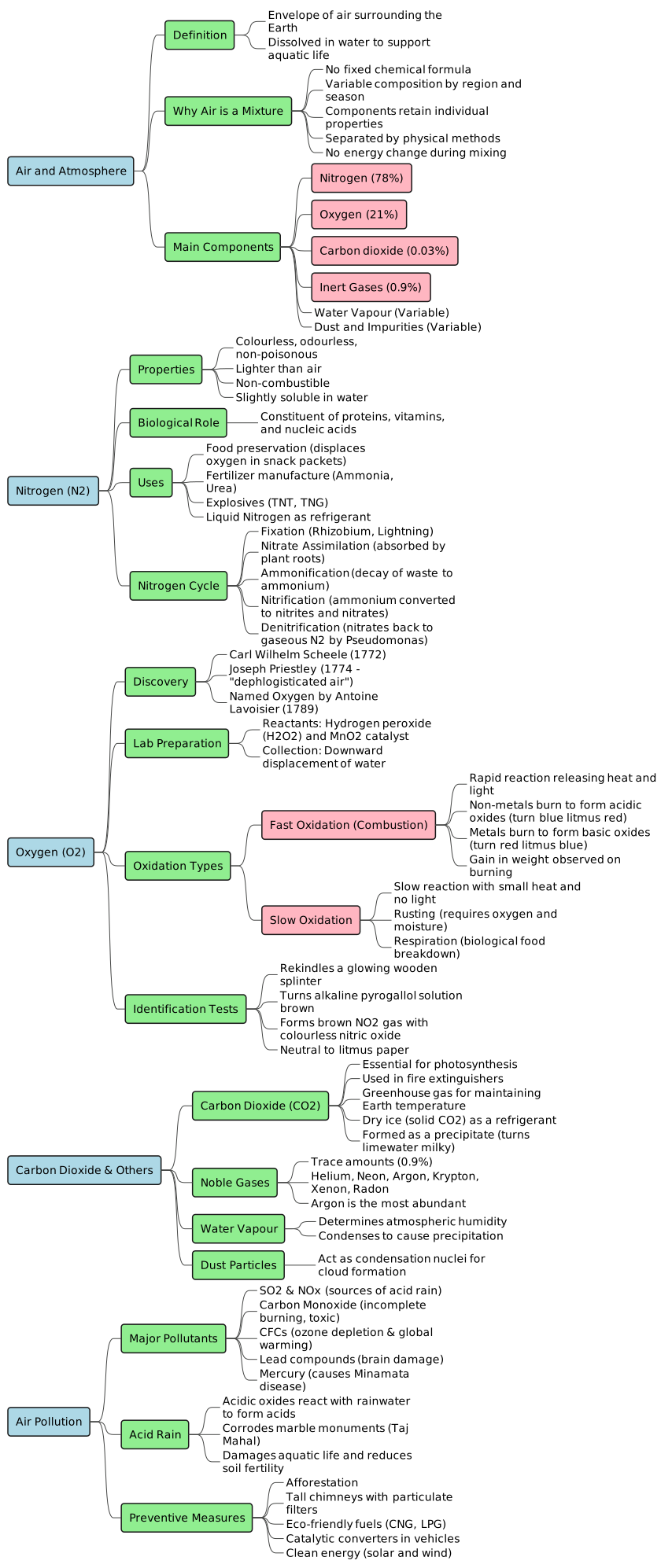
9. Comprehensive Mindmap
Want to print your doc?
This is not the way.
This is not the way.

Try clicking the ··· in the right corner or using a keyboard shortcut (
CtrlP
) instead.