Skip to content
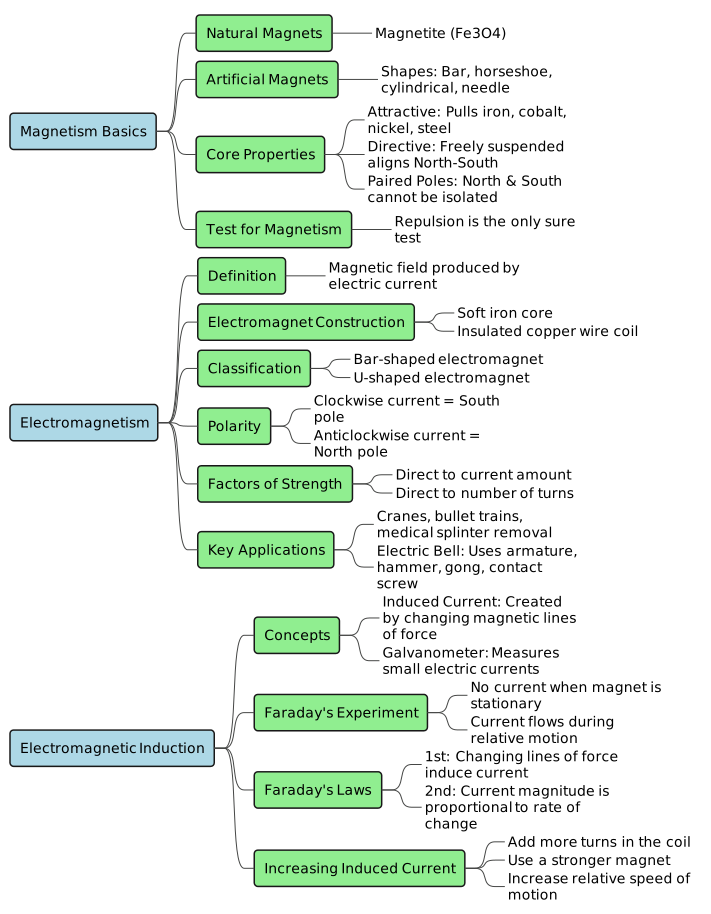
Natural Magnets: Magnets that occur naturally in the Earth.Example: Magnetite (Fe₃O₄).Artificial Magnets: Magnets where magnetic properties are artificially imparted. They come in various shapes:Magnetic needlesBar magnetsHorseshoe magnetsCylindrical magnets
Attractive Property: A magnet attracts certain metals (magnetic materials).Magnetic Materials: Metals like iron, cobalt, steel, and nickel.Non-magnetic Materials: Materials not attracted by a magnet (e.g., glass, wood, plastic, aluminium, copper, and brass).Note: The magnetic force of a magnet is always maximum at its poles.Directive Property: A freely suspended magnet always aligns itself in the north-south direction.North Pole: The end pointing towards the geographic north pole.South Pole: The end pointing towards the geographic south pole.Magnetic Poles Exist in Pairs: Poles can never be separated. A magnet with only one pole (monopole) cannot exist. If a bar magnet is broken repeatedly, each smaller piece becomes a complete magnet with both north and south poles.
Core Law: Like poles of two magnets repel each other, while unlike poles attract each other.North (N) + North (N)  RepulsionSouth (S) + South (S) RepulsionNorth (N) + South (S) Attraction
Repulsion is the Surest Test of Magnetism:An unmagnetized magnetic material (like a simple iron bar) will be attracted to both poles of a magnet.A magnet will show attraction at one end (unlike pole) and repulsion at the other end (like pole) when tested with another magnet.Therefore, attraction can occur between a magnet and a non-magnetized magnetic substance, but repulsion can only occur between two magnets.
Definition: The branch of physics dealing with the magnetic effects of electric current.Electromagnet: A temporary magnet in which a magnetic field is produced when an electric current flows through its coil.Construction: It consists of a soft iron piece called the core wrapped in a coil of insulated copper wire.Temporary Nature: It behaves as a magnet only as long as electric current passes through the coil. Once current stops, the core loses its magnetism.
Bar-shaped Electromagnet: Insulated copper wire wrapped around a straight bar-shaped soft iron core.U-shaped Electromagnet: Insulated copper wire wrapped around a U-shaped soft iron core.
The end of the electromagnet where current flows in a clockwise direction acts as the South Pole.The end of the electromagnet where current flows in an anticlockwise direction acts as the North Pole.
Amount of Current: The strength of the electromagnet is directly proportional to the amount of electric current flowing through the coil.Number of Turns per Unit Length: The strength of the electromagnet is directly proportional to the number of turns in the coil.
In electrical appliances such as telephones, electric motors, and electric bells.In cranes to lift heavy loads of scrap iron and steel.In bullet trains.For separating iron ore from its impurities.To remove steel splinters from a patient’s wounds.For loading furnaces with iron.In the preparation of permanent magnets.In audio and video tapes.
Electromagnet: A U-shaped electromagnet.Armature: A soft iron bar positioned near the poles of the electromagnet.Hammer & Gong: Hammer attached to the armature to strike the metallic gong.Contact Screw & Contact Spring: Maintain and break the electrical connection.Terminals (T₁ & T₂): To connect the circuit to a battery and push button switch.
Circuit Complete: When the push button switch is pressed, current flows through the electromagnet, the contact screw, and back to the battery.Attraction: The electromagnet becomes magnetized and attracts the soft iron armature.Strike: The hammer attached to the moving armature hits the gong, producing a ring.Circuit Break: As the armature moves towards the electromagnet, it loses contact with the contact screw, breaking the circuit.Demagnetization: Current stops, the electromagnet loses its magnetism, and the contact spring pulls the armature back to its original position.Repetition: Contact with the screw is restored, completing the circuit again. This cycle repeats continuously as long as the button remains pressed.
Electromagnetic Induction: The phenomenon of producing an electric current in a conductor due to a change in the magnetic lines of force associated with that conductor.Induced Current: The current produced via electromagnetic induction.
Stationary magnet outside the coil: Galvanometer reads zero (no current).Magnet moving towards the coil: Galvanometer needle deflects (current flows).Magnet stationary inside the coil: Galvanometer reads zero (no current).Magnet moving away from the coil: Galvanometer needle deflects in the opposite direction (current flows in reverse).Continuous motion: Produces continuous deflection of the needle.Conclusion: Induced current is produced due to the relative motion between the coil and the magnet, which causes a continuous change in the magnetic lines of force.
First Law: A current is induced in a coil when the number of magnetic lines of force associated with the coil changes.Second Law: The magnitude of the induced current is directly proportional to the rate at which the magnetic lines of force change.
Increase the number of turns in the coil.Increase the strength of the magnet.Increase the relative speed of motion between the magnet and the coil.

Share
Explore
 Recap Hub
Prepared by: learnloophq@gmail.com
Chapter: 08. Magnetism
CHAPTER 8: MAGNETISM — REVISION CRASH COURSE
1. INTRODUCTION TO MAGNETISM
Natural vs. Artificial Magnets
Fundamental Properties of Magnets
2. THE LAW OF MAGNETISM
3. TEST FOR A MAGNET
4. ELECTROMAGNETISM
Differences Between Permanent and Temporary Magnets
Permanent Magnets
Temporary Magnets
Retain magnetic properties even without an external magnetic field.
Behave as magnets only in the presence of a strong magnetic field / electric current.
Usually made of hard materials.
Usually made of soft materials.
Examples: Bar magnets, horseshoe magnets.
Example: Electromagnets.
5. TYPES AND POLARITY OF ELECTROMAGNETS
Types
Determining Polarity
6. FACTORS AFFECTING ELECTROMAGNET STRENGTH
7. USES OF ELECTROMAGNETS
8. APPLICATION OF AN ELECTROMAGNET: THE ELECTRIC BELL
Construction
Working Sequence
9. ELECTROMAGNETIC INDUCTION
Core Concepts
Faraday’s Experiment & Observations
Using a coil of insulated copper wire connected to a sensitive galvanometer (used to measure small currents) and a bar magnet:
Faraday’s Laws of Electromagnetic Induction
Methods to Increase the Magnitude of Induced Current
Want to print your doc?
This is not the way.
This is not the way.

Try clicking the ··· in the right corner or using a keyboard shortcut (
CtrlP
) instead.