Skip to content
The device that displays the distance in kilometres travelled by a vehicle is called an _ _ _ _ _ _ _ _ _ _ _ _ _ _.The motion of a body about a fixed axis is known as _ _ _ _ _ _ _ _ _ _ _ _ _ _ motion.One complete to and fro motion of a simple pendulum about its mean position is called one _ _ _ _ _ _ _ _ _ _ _ _ _ _.The SI unit of weight is _ _ _ _ _ _ _ _ _ _ _ _ _ _.Distance travelled by light in one year is called a _ _ _ _ _ _ _ _ _ _ _ _ _ _.
Rest and motion are relative terms. [ ]The mass of a body can be zero if no force of gravity acts on it. [ ]A body moving along a curved line exhibits rectilinear motion. [ ]Speed is always positive because distance is always positive. [ ]The weight of an object increases as we go higher above the Earth’s surface. [ ]
Translatory motionWeightlessnessAverage speed
Why do we say a person sitting in a moving train is both at rest and in motion at the same time?A boy runs at a constant speed of 5 m/s. Calculate the time taken by him to cover a distance of 150 m.Is the motion of the hands of a clock periodic or non-periodic? Explain why.
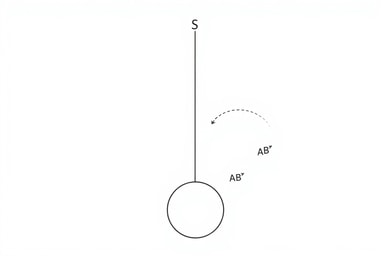
Identify the mean position and the extreme positions using the labels provided in the diagram.Define one complete oscillation using the path letters from the diagram.
Describe an activity to determine the time period of a simple pendulum. Include the materials required, step-by-step procedure, and how the final time period is calculated.What is rolling (complex) motion? Explain with two daily life examples how an object can perform both rotatory and translatory motion simultaneously.
Tyres of vehicles wear out frequently over time. What causes this wear and tear, and why is it important to focus on recycling or reusing old tyres?

Share
Explore
 Question Paper
Prepared by: learnloophq@gmail.com
Chapter: 02. Motion
Practice Exam Paper: Motion
Section A: Multiple Choice Questions (MCQs)
1. Which of the following instruments is used to measure the weight of an object?
a. Beam balance
b. Spring balance
c. Odometer
d. Speedometer
2. A car traveling on a busy road where brakes are applied frequently is an example of:
a. Periodic motion
b. Uniform motion
c. Non-periodic motion
d. Rectilinear motion
3. The actual length of the path covered by a moving object, irrespective of the direction in which it moves, is called:
a. Speed
b. Velocity
c. Distance
d. Average speed
4. What is the value of 1 kilogram force (1 kgf) in Newtons?
a. 1 N
b. 9.8 N
c. 100 N
d. 980 N
5. The motion of a flying mosquito or a flying kite is best described as:
a. Random motion
b. Oscillatory motion
c. Curvilinear motion
d. Rotatory motion
Section B: Fill in the Blanks
Section C: True or False Questions
Section D: Explanations of Terms
Define the following terms in one or two sentences:
Section E: Differentiate the Concepts
Provide two points of distinction for each of the following pairs:
1. Mass and Weight
Mass
Weight
1.
1.
2.
2.
2. Oscillatory Motion and Vibratory Motion
Oscillatory Motion
Vibratory Motion
1.
1.
2.
2.
Section F: Short Answer Questions
Section G: Diagram-Based Questions
Look at the diagram of the simple pendulum below and answer the questions that follow.
A diagram of a simple pendulum showing a bob suspended from a support, with marked mean and extreme positions.
Section H: Long Answer Questions
Section I: Environmental Awareness & Everyday Use
Want to print your doc?
This is not the way.
This is not the way.

Try clicking the ··· in the right corner or using a keyboard shortcut (
CtrlP
) instead.