Skip to content
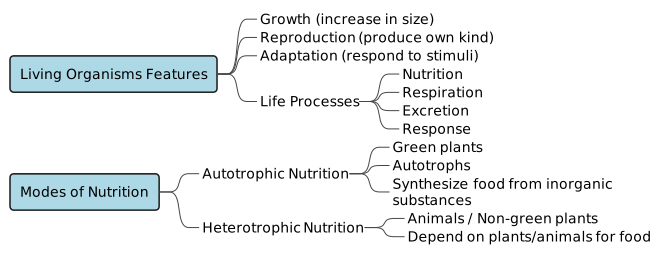
Growth: All living organisms grow in size over time.Reproduction: Organisms multiply in number, meaning they produce their own kind to continue their species.Adaptation: Living beings respond to stimuli and adjust to changes in their surrounding environment.Energy Requirement: To perform growth, reproduction, and adaptation, organisms require energy. This energy is derived from food.Life Processes: All living organisms carry out fundamental life processes, including:NutritionRespirationExcretionResponse to stimuliReproduction
Autotrophic Nutrition:This is the process of nutrition in which organic compounds are synthesized from simple inorganic substances.Green plants manufacture their own food through this process and are therefore called autotrophs.Heterotrophic Nutrition:This is the process of obtaining readymade food from plants, animals, or both.Animals and non-green plants cannot make their own food and must consume organic matter, making them heterotrophs.


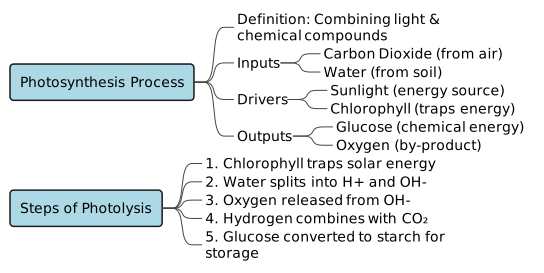
Light Absorption: Chlorophyll traps solar energy and becomes energized.Photolysis of Water: The trapped solar energy is utilized to split water molecules into hydrogen (  ) and hydroxyl (
  ) radicals. This light-driven splitting is called the photolysis of water:
 Oxygen Release: Oxygen is formed and released into the atmosphere from the hydroxyl ( ) radicals:
 Glucose Synthesis: Hydrogen ( ) radicals combine with carbon dioxide (
  ) to form glucose.Storage of Energy: Glucose is used by cells as an immediate source of energy. Any extra glucose is converted and stored as insoluble starch in different parts of the plant.
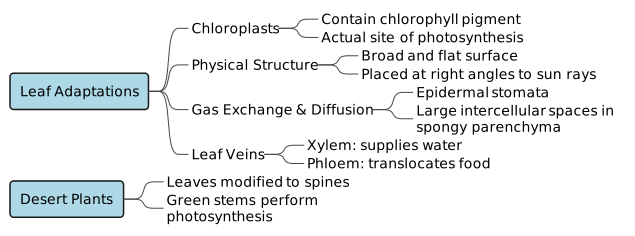
Presence of Chlorophyll: All green cells contain chlorophyll, the pigment that traps solar energy.Chloroplasts: Chlorophyll is housed inside cellular organelles called chloroplasts, which are the actual sites of photosynthesis.Broad and Flat Surface: Leaves have wide, flat blades (lamina) to absorb maximum sunlight and carbon dioxide.Orientation: Leaves are arranged at right angles to solar rays to ensure maximum surface area is exposed to light.Stomata: Microscopic pores on the leaf surface allow carbon dioxide to enter and oxygen to exit.Spongy Parenchyma: The leaf interior contains a layer of cells with large intercellular spaces, helping carbon dioxide diffuse easily to every photosynthetic cell.Veins (Vascular Bundles): Veins contain:Xylem: Distributes water and minerals from the roots to every leaf cell.Phloem: Translocates the synthesized food (glucose) from the leaves to other parts of the plant.
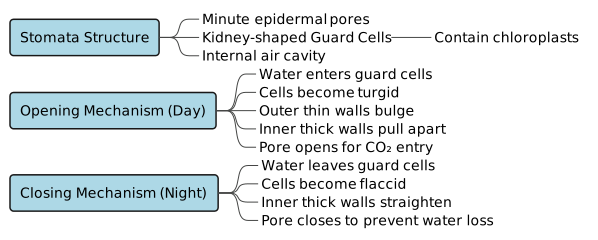
Each stoma consists of a central pore surrounded by two kidney-shaped guard cells.Unlike regular epidermal cells, guard cells contain chloroplasts.Every stoma opens internally into a small air cavity inside the leaf tissues.
Opening (During Daytime):In the presence of sunlight, water from surrounding epidermal cells enters the guard cells.The guard cells swell up and become turgid.Their outer thin walls bulge outward, which pulls the inner thick walls apart.This widens the stomatal opening, allowing to diffuse inside for photosynthesis.Closing (At Night):In the absence of light, photosynthesis stops.Water moves out of the guard cells, making them flaccid (shrunken).Their inner thick walls straighten out, closing the stomatal pore. This prevents unnecessary water loss through transpiration when photosynthesis is not taking place.
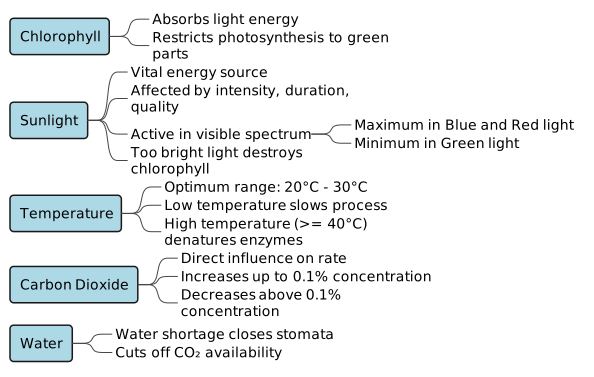
Chlorophyll:This green pigment absorbs solar energy. Because it is found inside chloroplasts in the green parts of the plant, photosynthesis is restricted only to these green areas.Sunlight:Sunlight provides the energy required for the process.Its duration, intensity, and quality directly affect the rate. Low light intensities slow down photosynthesis. However, excessively bright light can destroy chlorophyll and halt the process.Spectral Efficiency: Photosynthesis occurs only in the visible part of the light spectrum. It is maximum in blue and red light and minimum in green light.Temperature:The optimum temperature range for photosynthesis is 20°C to 30°C.The rate slows down at low temperatures.At temperatures of 40°C and above, the rate drops sharply because the photosynthetic enzymes (which are proteins) get denatured (destroyed) by heat.Carbon Dioxide ( ): concentration in the atmosphere directly regulates photosynthesis.The rate of photosynthesis increases with an increase in concentration up to 0.1%. Beyond this concentration limit, the rate begins to decrease.Water:Adequate water is required to keep leaf cells hydrated and functional.A reduction in water availability causes the guard cells to lose turgor, leading to the closure of stomata. This restricts the entry of carbon dioxide, causing a sharp drop in the rate of photosynthesis.
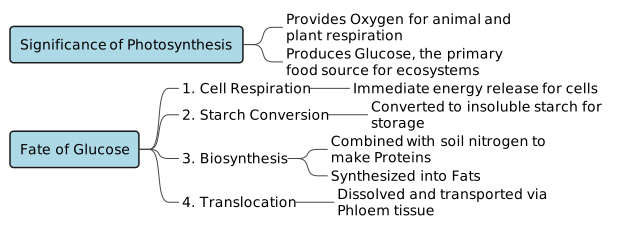
Respiration: It is the primary natural source of oxygen (  ) in the atmosphere, which is essential for the respiration of all living plants and animals.Food Supply: It converts solar energy into chemical energy, creating food (glucose) that forms the foundation of all food chains on Earth.
Immediate Energy Release: A portion of glucose is immediately broken down during respiration by plant cells to release energy for vital metabolic activities.Storage as Starch: Excess glucose, which is soluble in water, is converted into insoluble starch and other complex sugars. This starch is stored in different parts of the plant (like roots, stems, and seeds) as reserve food.Synthesis of Other Nutrients:Proteins & Amino Acids: Plant cells synthesize amino acids and proteins by combining glucose with nitrogen compounds absorbed from the soil by the roots.Fats: Fats are also synthesized from glucose for energy storage.Translocation: Glucose is highly soluble in water. It is transported in a dissolved form from the leaves to all other parts of the plant through the phloem tissue. This process of transporting manufactured food is called translocation.
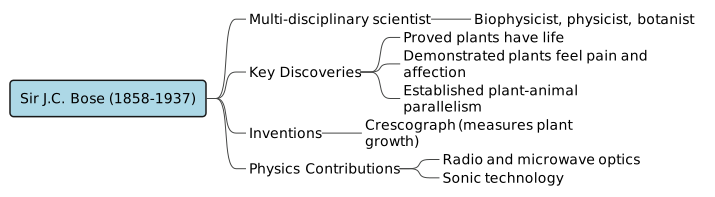
Optics & Radio Technology: He pioneered the investigation of radio waves, microwave optics, and sonic technology.Proof of Plant Life: He experimentally proved that plants are living entities that experience physiological processes similar to animals.The Crescograph: He invented the crescograph, an extremely sensitive instrument used to measure the minute growth rates of plants.Sensitivity to Stimuli: He proved that plants feel pain, understand affection, and respond to environmental changes.Parallelism: He established an developmental and functional parallelism between plant and animal tissues.
is necessary for photosynthesis.

Share
Explore
 Self Study
Prepared by: learnloophq@gmail.com
Chapter: 04. Photosynthesis
Chapter 4: Photosynthesis — Self-Study Notes
1. Introduction to Life Processes and Nutrition
Basic Features of Living Organisms
Modes of Nutrition
2. Photosynthesis: Process and Mechanism
Definition
Photosynthesis (derived from the Greek words photo meaning light and synthesis meaning combining) is the process by which green parts of plants manufacture food (glucose) from carbon dioxide (CO₂) and water (H₂O) in the presence of sunlight and chlorophyll.
Chemical Equation of Photosynthesis
During photosynthesis, solar energy is trapped by chlorophyll and transformed into chemical energy in the form of glucose. The overall equation representing this process is:
Or written chemically:
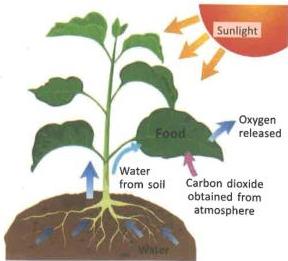
Fig 4.1: The process of photosynthesis in the leaf of a green plant
Fig 4.1: The process of photosynthesis in the leaf of a green plant

Fig: Chemical equation representing photosynthesis
Fig: Chemical equation representing photosynthesis
The Basic Process (Mechanism)
Photosynthesis occurs through the following sequential steps:
3. The Leaf: A Photosynthetic Organ
Leaves are the primary photosynthetic organs of a plant. However, photosynthesis can also take place in other green parts, such as green stems.
Structural Adaptations of Leaves for Photosynthesis
Special Adaptation: Desert Plants
In desert environments, leaves are modified into sharp spines to prevent water loss via transpiration. In these plants, the stem becomes thick, green, and fleshy to perform photosynthesis.
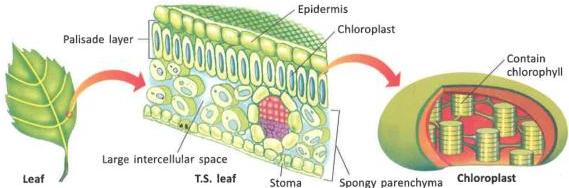
Fig 4.2: Adaptations in leaf for photosynthesis (T.S. of Leaf)
Fig 4.2: Adaptations in leaf for photosynthesis (T.S. of Leaf)
4. Stomata: The Site of Gas Exchange
Stomata (singular: stoma) are minute pores situated in the epidermis of leaves. They regulate the entry of carbon dioxide into the leaf and the exit of oxygen and water vapor.
Structure of Stomata
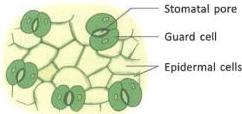
Fig: Plant epidermal cells showing stomata
Fig: Plant epidermal cells showing stomata
Mechanism of Opening and Closing of Stomata
Stomatal movement is controlled by changes in the turgor pressure of the guard cells:
Stomatal State
Guard Cell Condition
Inner Walls
Water Movement
Occurs During
Open
Turgid (Swollen)
Pulled apart / Curved
Enters guard cells
Daytime / Sunlight
Closed
Flaccid (Shrunk)
Straightened
Exits guard cells
Nighttime / Darkness
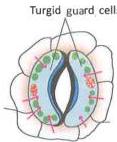
Fig 4.3 (a): Open stomata showing water movement inwards
Fig 4.3 (a): Open stomata showing water movement inwards
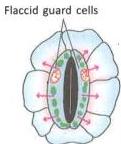
Fig 4.3 (b): Closed stomata showing water movement outwards
Fig 4.3 (b): Closed stomata showing water movement outwards
5. Factors Affecting Photosynthesis
The rate of photosynthesis is influenced by a combination of internal and environmental factors:
6. Significance of Photosynthesis and the Fate of Glucose
Significance of Photosynthesis
Photosynthesis is the ultimate life-supporting process on Earth for two main reasons:
Fate of Synthesized Glucose
Once glucose is manufactured in the green leaves, it is utilized by the plant in several ways:
7. Key Scientist: Sir Jagdish Chandra Bose (1858–1937)
Sir Jagdish Chandra Bose was a pioneering Indian physicist, biophysicist, biologist, and botanist. He is recognized as the founder of modern science in the Indian subcontinent.
Major Achievements & Discoveries:

Fig: Sir Jagdish Chandra Bose
Fig: Sir Jagdish Chandra Bose
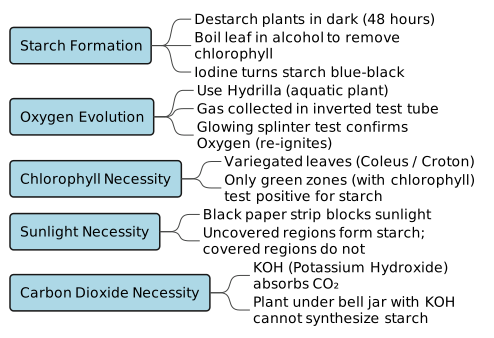
8. Experimental Demonstrations of Photosynthesis
These classic experiments demonstrate the necessity of various factors and the products formed during photosynthesis.
Summary of Experimental Demonstrations
Aim of Experiment
Materials Required
Basic Procedure
Key Observations
Inference & Conclusion
To demonstrate that starch is formed during photosynthesis
Two potted plants (A and B), beaker, test tube, alcohol, iodine solution, burner, dropper.
Place plants A and B in the dark for 48 hours to destarch them. Keep A in the dark and place B in sunlight for 4–5 hours. Pluck a leaf from each. Boil both leaves in water, then in alcohol (to remove chlorophyll). Wash in warm water and add iodine drops.
Leaf B (from the sunlight-exposed plant) turns blue-black. Leaf A (kept in the dark) does not turn blue-black.
Starch is formed during photosynthesis, which requires sunlight. Iodine turns starch blue-black.
To show that oxygen is evolved during photosynthesis
Hydrilla plant, beaker, funnel, test tube, water, glowing splinter.
Place Hydrilla stems inside an inverted funnel in a water-filled beaker. Invert a water-filled test tube over the stem of the funnel. Place the setup in sunlight for 4 hours.
Gas bubbles escape from the plant and collect at the top of the test tube. A glowing splinter inserted into the gas-filled tube bursts into a flame.
The evolved gas is oxygen, as it supports combustion and makes the splinter burst into flame.
To show that chlorophyll is necessary for photosynthesis
Potted plant with variegated leaves (Coleus or Croton), alcohol, iodine, Petri dish, burner.
Expose the variegated plant to sunlight for a few hours. Pluck a leaf and sketch its green and non-green zones on paper. Perform the starch test (boil in water, then in alcohol, and treat with iodine).
Only the areas marked as green in the initial sketch turn blue-black with iodine. The non-green zones remain unchanged.
Chlorophyll is absolutely essential for photosynthesis to take place.
To show that sunlight is necessary for photosynthesis
Potted plant, black paper strip, clips, alcohol, iodine solution, burner.
Destarch a green potted plant by keeping it in the dark for 48 hours. Cover a portion of a leaf on both sides with a strip of black paper. Put the plant in sunlight for 4 hours. Pluck the leaf, remove the paper, decolorize it in alcohol, and perform the starch test.
The part of the leaf exposed to sunlight turns blue-black, while the covered portion remains unchanged.
Sunlight is necessary for photosynthesis and starch production.
To show that carbon dioxide ( ) is necessary for photosynthesis
Two potted plants of equal size (A and B), glass plates, bell jars, potassium hydroxide (  ) solution, grease, iodine.
Destarch both plants in the dark for 2–3 days. Place each on a glass plate under a sealed bell jar. Place a dish of inside jar A (to absorb ). Leave jar B without . Keep both in sunlight for 2 hours. Pluck a leaf from each and test for starch.
Leaf from plant B turns blue-black. Leaf from plant A (where was absorbed by ) does not show the presence of starch.
Experimental Visual Setups
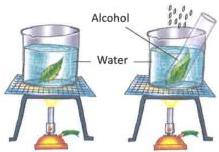
Fig: Steps in testing a leaf for starch (boiling in water and alcohol)
Fig: Steps in testing a leaf for starch (boiling in water and alcohol)
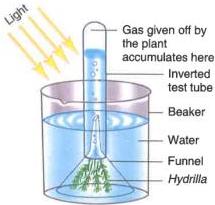
Fig: Setup showing oxygen evolution using Hydrilla plant
Fig: Setup showing oxygen evolution using Hydrilla plant
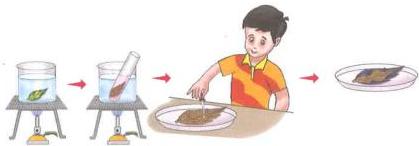
Fig: Testing a variegated leaf to show chlorophyll is necessary
Fig: Testing a variegated leaf to show chlorophyll is necessary
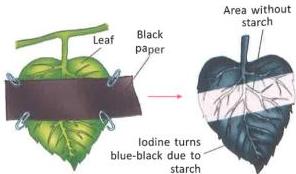
Fig: Testing sunlight necessity using a black paper strip
Fig: Testing sunlight necessity using a black paper strip
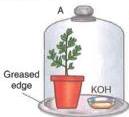
Fig: Testing CO₂ necessity with potassium hydroxide (KOH) under a bell jar
Fig: Testing CO₂ necessity with potassium hydroxide (KOH) under a bell jar
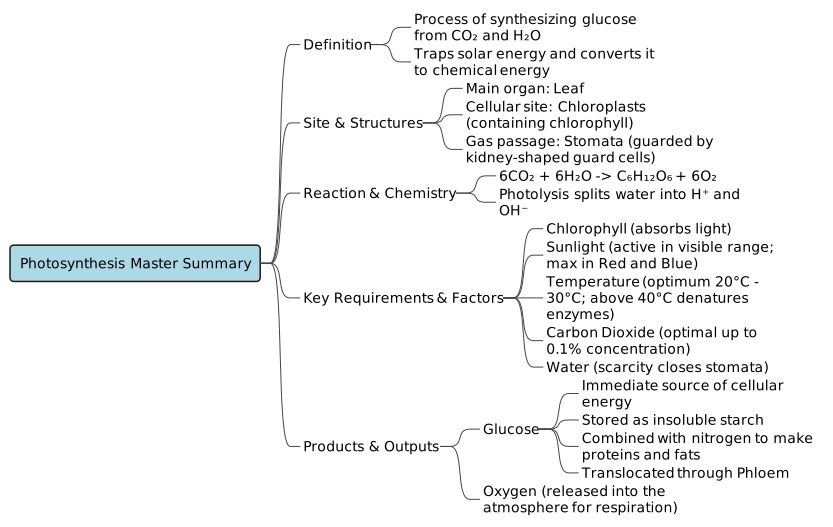
9. Master Summary of Photosynthesis
Want to print your doc?
This is not the way.
This is not the way.

Try clicking the ··· in the right corner or using a keyboard shortcut (
CtrlP
) instead.