Skip to content
Context: The Abbasid Caliphate boasted cultural vitality and brilliance during the 8th and 9th centuries CE.Decline: By the end of the 9th century CE, its political power declined, causing the empire to disintegrate.Emergence of Turkish States: Independent states emerged, ruled by the Turks who had previously served in the Caliphs’ armies.Key States: Two prominent independent states established by the Turks in Central Asia were Ghazni and Ghor.
Aims: To build a large, well-equipped army to expand and protect his Central Asian kingdom.Invasions: Conducted 17 invasions of India over 25 years (1001–1025 CE) to plunder India’s wealth to fund his military goals.Political Scenario in India: North India was politically divided and lacked unity. Rival Rajput rulers failed to unite against the foreign threat.
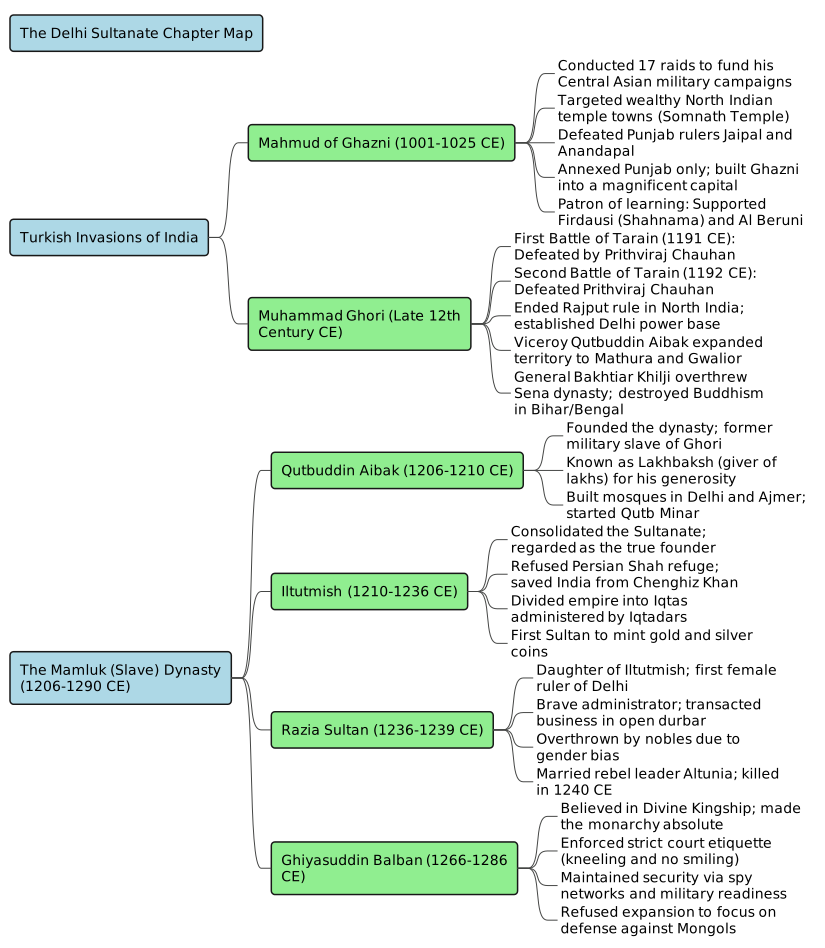
War against Jaipal: Defeated Jaipal (Hindu ruler of Punjab, extending from Punjab to Afghanistan). Forced to pay tribute, Jaipal later burnt himself to death due to the humiliation of defeat.War against Anandapal: Anandapal (Jaipal’s son) formed a defensive alliance with western and central Indian rulers. People supported the defense (women even sold jewels/melted gold). However, Anandapal was defeated, opening the interior of India to further Turkish inroads.Raid on Somnath Temple (Kathiawar): Mahmud’s most profitable and ambitious expedition. Despite stubborn defense by Hindu soldiers (where 50,000 died), Mahmud plundered the sacred temple and carried massive treasures back to Ghazni.
Annexation: Punjab was the only Indian province annexed by Mahmud; his primary territorial interest remained in Central Asia.Development of Ghazni: Used plundered wealth to transform Ghazni into a magnificent capital decorated with splendid mosques, libraries, a museum, and valuable gems.Patron of Learning: Enjoyed the company of scholars. He patronized Firdausi (author of the Persian epic Shahnama) and Al Beruni (the great Persian historian and mathematician).Impact: His raids exposed the military weaknesses of northern Indian states, paving the way for future conquests. The empire of Ghazni disintegrated quickly after his death.
Origin: Rose from the kingdom of Ghor (north-western Afghanistan) in the late 12th century CE.First Targets: Captured frontier territories including Multan, Sind, and Punjab.Five Rajput Kingdoms of the Era: Rathors of Kanauj, Chauhans of Delhi and Ajmer, Solankis of Gujarat, Paramaras of Malwa, and Chandellas of Bundelkhand.
Conquest of Kanauj: In 1194 CE, Ghori defeated and killed Raja Jaichandra of Kanauj.Appointment of Viceroy: Ghori appointed his general, Qutbuddin Aibak, as viceroy of his Indian territories before returning to Ghor.Expansion under Aibak: Qutbuddin captured strategic forts including Kalinjar (Bundelkhand) and Anhilwara (Gujarat), extending the empire to Mathura, Gwalior, and Malwa.Eastern Campaigns: Ghori’s general, Muhammad bin Bakhtiar Khilji, overthrew the Sena dynasty of Bengal and swept across Bihar. He destroyed Buddhist monasteries and libraries, dealing a permanent blow to Buddhism in India (causing surviving monks to flee to Tibet).
Rise: A former slave of Muhammad Ghori who rose to general by merit. Declared independence in 1206 CE following Ghori’s death.Character: Just and generous; known as lakhbaksh (“giver of lakhs”).Religious Actions: Treated Hindus well but demolished several ancient temples to use their building materials for mosques.Architectural Legacy: Built two mosques (one in Delhi, one in Ajmer). Began construction of the Qutb Minar in Delhi.Death: Died from an accidental fall from a horse in 1210 CE.Accession: Son-in-law of Qutbuddin Aibak; replaced Aibak’s son.Sultanate Consolidation (Why he is the “True Founder”):Suppressed challenging Turkish nobles.Crushed the revolt of the Khilji governor of Bengal.Destroyed external rivals in Ghazni and Multan.Defeated Rajput rulers of Ujjain, Ranthambore, Malwa, and Gwalior, expanding control to the Narmada River.Secured sovereign recognition from the Caliph of Baghdad.The Mongol Threat: Saved India from Mongol chief Chenghiz Khan by politely refusing to grant asylum to the fleeing Shah of Persia.Administrative Reforms:Iqta System: Divided the empire into provinces called iqtas, administered by iqtadars who collected land revenue and maintained law and order.Currency: First Sultan to mint gold and silver coins.Art and Culture: Completed the Qutb Minar, built his own tomb in red sandstone in Delhi, and sheltered exiled Asian scholars.Accession: Nominated by her father, Iltutmish, who rejected his pleasure-loving son Rukhnuddin Firoz Shah (who was deposed after a brief 7-month reign).Rule and Character: Brave, intelligent, and just. Conducted state business in open durbar, wore male attire, rode horses, and led armies into battle.Opposition and Fall: Turkish nobles and provincial governors rebelled, refusing to accept a female ruler.Imprisonment and Death: Defeated and imprisoned, she married the rebel leader Altunia in an attempt to recover her throne. The attempt failed, and both were killed in 1240 CE.Profile: Youngest son of Iltutmish. He was virtuous but weak and inexperienced.Administration: The state was effectively run by the powerful noble Ghiyasuddin Balban.Monarchy Style: Believed in the theory of divine kingship (the king as God’s representative on earth). He made the monarchy absolute.Court Etiquette: Enforced strict court rules. No smiling or joking was permitted; nobles had to kneel and touch the ground with their foreheads to show respect.Internal Administration: Set up an elaborate spy system, reorganized the infantry and cavalry, and ruthlessly suppressed banditry to ensure safety for trade and agriculture.Suppression of Rebellions: Personally marched at age 70 to crush the rebellious governor of Bengal, Tughril Khan, executing him, his family, and his supporters.Defense Against Mongols: Adopted defensive policies rather than expanding his territory:Kept the army in a permanent state of readiness.Built new frontier forts and repaired old ones.Appointed his own sons as governors of vulnerable frontier provinces.End of Dynasty: Following Balban’s death in 1286 CE, his weak successors failed to hold power. In 1290 CE, the Mamluk dynasty ended, and control of the Delhi Sultanate passed to the Khilji dynasty.

Share
Explore
 Recap Hub
Prepared by: learnloophq@gmail.com
Chapter: 04. The Turkish Invasion And The Establishment Of The Delhi Sultanate
Revision Crash Course: Theme 3 — The Delhi Sultanate
1. The Rise of the Turkish Power
Decline of the Abbasid Caliphate
2. Mahmud of Ghazni (Reign: 1001–1025 CE)
Profile and Objectives
Key Campaigns and Raids
Character and Legacy
3. Muhammad Ghori and the Foundation of Turkish Rule
Rise and Conquests
Important Battles
Battle
Year
Combatants
Outcome & Historical Significance
First Battle of Tarain
1191 CE
Muhammad Ghori vs. Prithviraj Chauhan
Prithviraj Chauhan inflicted a crushing defeat on Ghori, who fled to avenge his humiliation.
Second Battle of Tarain
1192 CE
Muhammad Ghori vs. Prithviraj Chauhan
Raja Jaichandra of Kanauj refused to help Prithviraj. Ghori routed the Rajput army. This marked the end of Rajput rule in north India and passed Delhi to Muslim rulers.
Consolidated Actions
4. The Delhi Sultanate (1206–1526 CE)
Rulers during this era were styled as “Sultans” and ruled from their capital city, Delhi.
(Note: While the chapter outlines the Mamluk and Khilji dynasties, details regarding the remaining three of the five traditional dynasties of the Delhi Sultanate are missing from the provided text).
The Mamluk (Slave) Dynasty
1. Qutbuddin Aibak (Reign: 1206–1210 CE)
2. Iltutmish (Reign: 1210–1236 CE)
3. Razia Sultan (Reign: 1236–1239 CE)
4. Nasiruddin Mahmud (Reign: 1246–1266 CE)
5. Ghiyasuddin Balban (Reign: 1266–1286 CE)
Want to print your doc?
This is not the way.
This is not the way.

Try clicking the ··· in the right corner or using a keyboard shortcut (
CtrlP
) instead.