Skip to content
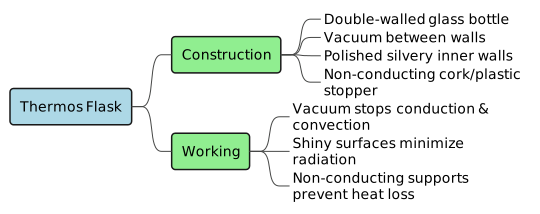
Explain the construction and working of a thermos flask.A thermos flask consists of a double-walled glass bottle made of thin glass, which is placed inside a protective metal or plastic outer case. The space between the double walls is evacuated of air to create a vacuum, preventing heat transfer by conduction or convection. To minimize heat loss or gain through radiation, the inner surfaces of both glass walls are brightly polished or silvered. Additionally, the mouth of the flask is tightly sealed with a cork or plastic stopper, and non-conducting materials are used to support the inner vessel. Consequently, heat transfer by all three modes—conduction, convection, and radiation—is successfully minimized, allowing the liquid inside to retain its temperature for a long time.
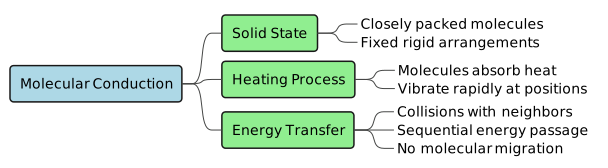
 Describe how conduction takes place at the molecular level in solids.In solids, the constituent molecules are closely packed in a fixed, rigid arrangement and cannot move freely from their positions. When one end of a solid object is heated, the molecules at that specific end absorb heat energy and begin to vibrate more rapidly. These energetic molecules collide with their immediate neighboring molecules, transferring a portion of their heat energy and causing them to vibrate faster as well. This process of energy transfer and collisions repeats sequentially from molecule to molecule along the entire length of the solid. Thus, heat travels from the region of higher temperature to the region of lower temperature without any actual movement of the molecules from their positions.
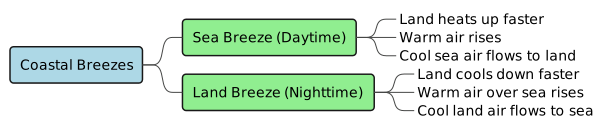
 Explain the phenomenon of sea breeze and land breeze as applications of convection.Sea breeze and land breeze are natural convection currents set up due to the unequal heating and cooling rates of land and water. During the day, the land heats up much faster than the sea, causing the air above the land to become hot, expand, rise vertically upwards, and draw cooler air from the sea toward the land. At night, the process reverses because the land cools down much faster than the sea water, leaving the air over the sea warmer and lighter. As the warm air over the sea rises, the cooler and denser air from the land rushes out toward the sea to take its place. This continuous cycle forms a sea breeze during the daylight hours and a land breeze during the night.
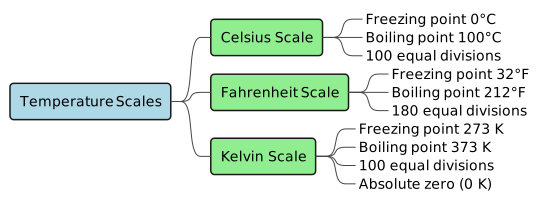
 Compare the three scales of temperature—Celsius, Fahrenheit, and Kelvin—including their standard reference points.The Celsius scale has a lower standard freezing point of water at 0°C, a higher standard boiling point of water at 100°C, and is divided into 100 equal divisions. The Fahrenheit scale marks the freezing point of water at 32°F and the boiling point of water at 212°F, dividing this interval into 180 equal parts. The Kelvin scale is the SI standard unit of temperature used in scientific measurements, featuring a lower standard point of 273 K and a higher standard point of 373 K. Unlike the other two scales, the Kelvin scale has no negative temperature readings and its lowest possible theoretical temperature is designated as absolute zero (0 K).
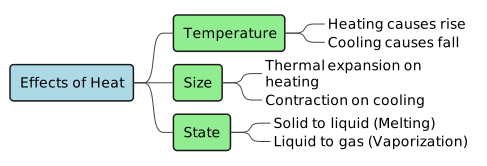
 Describe the effects of heat on matter regarding change in temperature, size, and state.When a substance absorbs heat, its molecules gain kinetic energy and move faster, which leads to a direct rise in the temperature of the substance. This increase in molecular motion also causes the average intermolecular space to increase, resulting in thermal expansion where the overall volume of the substance increases. Conversely, when a substance cools, it loses heat energy, its temperature drops, and the volume contracts. Furthermore, heat can trigger a change of state by breaking intermolecular bonds, converting a solid into a liquid through melting, or converting a liquid into a gas through vaporization.

Share
Explore
 Long Answers
Prepared by: learnloophq@gmail.com
Chapter: 05. Heat
Want to print your doc?
This is not the way.
This is not the way.

Try clicking the ··· in the right corner or using a keyboard shortcut (
CtrlP
) instead.