Skip to content
The Process: Glucose combines with oxygen, releasing energy while producing carbon dioxide and water as waste products.Chemical Equation:
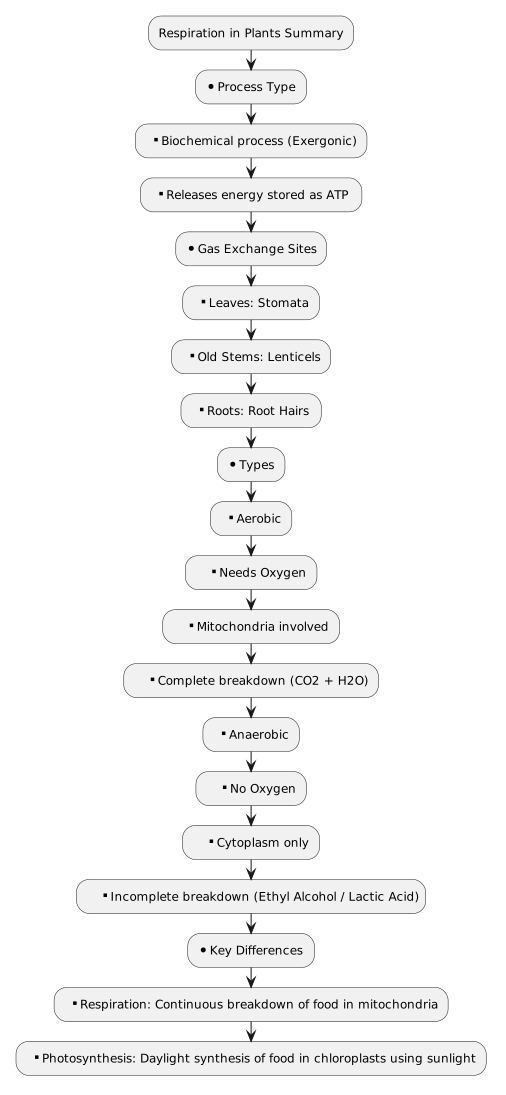
Food (Glucose) + Oxygen → Energy + Carbon Dioxide (CO₂) + WaterEnergy Storage (ATP): The energy released during the oxidation of food is trapped and stored in cells as Adenosine Triphosphate (ATP). ATP is known as the “energy currency of the cell” because it provides an immediate source of energy for cellular activities.Heat Loss: Not all energy is converted to ATP; some energy is lost as heat.
Energy Source: Food (specifically glucose) serves as the primary fuel.Oxygen Requirement: Oxygen is required to oxidise food.End-products: Carbon dioxide (CO₂) and water are produced as by-products.Energy Yield: Energy is captured in ATP molecules.
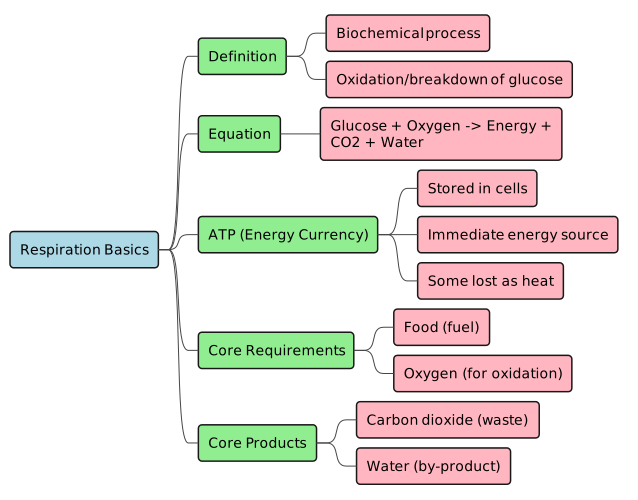
Definition: The complete breakdown of glucose into carbon dioxide and water inside cells using oxygen.Location: This process is completed inside the mitochondria of cells.Equation:
Glucose + Oxygen (in the presence of oxygen) → Carbon dioxide + Water + EnergyOrganisms: Organisms performing this process are called aerobes. This includes the majority of plants and animals.
Definition: The incomplete breakdown of glucose to release energy without using oxygen.Location: This process occurs in the cell cytoplasm. Mitochondria do not participate.Equation:
Glucose (without oxygen) → Ethyl alcohol + Carbon dioxide + EnergyEnergy Yield: Since the breakdown of glucose is incomplete, very little energy is produced.Organisms: Organisms surviving without oxygen are called anaerobes. Examples include yeast, certain bacteria, and parasitic flatworms.
Lactic Acid Fermentation:
The breakdown of glucose in the deficiency of oxygen in muscle cells is called lactic acid fermentation.Yeast Fermentation:
In yeast, the anaerobic breakdown of sugars into ethyl alcohol and carbon dioxide is called fermentation. Because yeast yields ethyl alcohol through this process, it is widely used in making wine and beer.
Nature: A physical or mechanical process.Mechanism: Involves the exchange of respiratory gases (O₂ and CO₂) between the atmosphere and cells through simple diffusion.Plant Structures: Facilitated by stomata (in leaves) and lenticels (in stems).Energy: No energy is released during this stage.
Nature: A biochemical process controlled by enzymes.Mechanism: Glucose is completely oxidized into water and carbon dioxide inside the cells in the presence of oxygen.Energy: Energy is released and trapped in the energy-rich compound ATP.
During the Day:
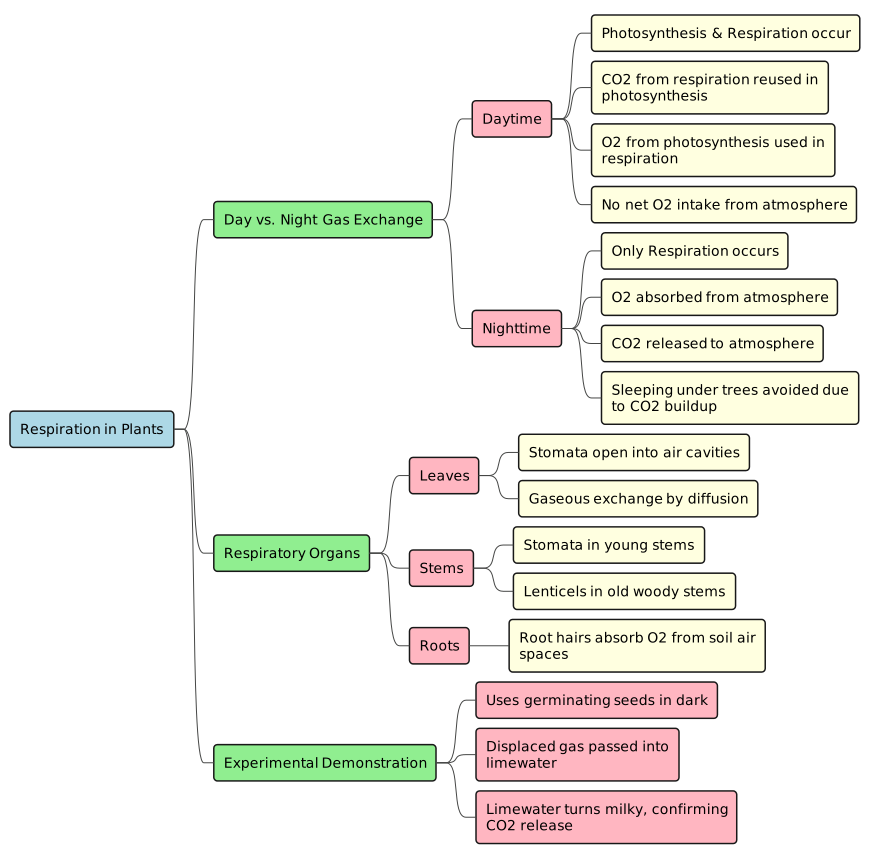
Plants perform both photosynthesis and respiration. The CO₂ released during respiration is immediately consumed by photosynthesis. A portion of the O₂ generated through photosynthesis is utilized for respiration, and the excess is released through the stomata. Consequently, plants do not take in oxygen from the atmosphere during daytime.During the Night:
Photosynthesis stops due to the absence of sunlight, but respiration continues. Plants take in O₂ from the atmosphere and release CO₂.Safety Note:
It is advised not to sleep under a tree at night because the concentration of CO₂ increases in the immediate air around the tree.
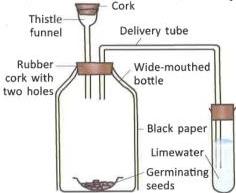
Setup: Place germinating seeds in a wide-mouthed bottle. Plug the bottle with a two-holed cork. Fix a thistle funnel through one hole (corked at the top) and a double-bent delivery tube through the second hole. Immerse the outer end of the delivery tube in water, keep the setup in a dark corner, and wrap the bottle in black paper.Testing: Replace the test tube of water with a test tube containing limewater. Pour water slowly down the thistle funnel into the bottle to displace the air.Observation: The displaced air passes into the limewater, turning it milky.Conclusion: Germinating seeds produce carbon dioxide during respiration.
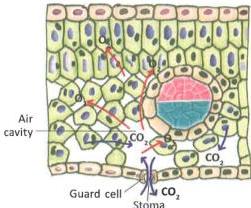
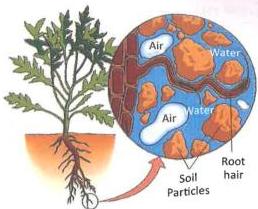
Each stoma opens into an air cavity where fresh air is held.Oxygen diffuses from the air cavity into the surrounding cells.Carbon dioxide diffuses out of the cells into the air cavity to be expelled.Young Stems: Gaseous exchange occurs through stomata.Old Woody Stems: Developed lenticels located below the bark facilitate gas exchange.Root hairs grow into the spaces between soil particles.They absorb dissolved oxygen trapped within the soil air spaces and release CO₂ via diffusion.
Photosynthesis is an endergonic process (energy-consuming).Respiration is an exergonic process (energy-releasing).

Share
Explore
 Self Study
Prepared by: learnloophq@gmail.com
Chapter: 05. Respiration In Plants
Chapter 5: Respiration in Plants
1. Respiration as an Energy-Releasing Process & Its Basics
Every living cell requires energy to carry out various life-sustaining activities. This energy is obtained by breaking down food in the presence of oxygen, a process known as the oxidation of food. Respiration is a biochemical process where glucose (a readymade source of energy) is broken down to release energy.
Key Aspects of Respiration
Basics of Respiration Checklist
2. Types of Respiration: Aerobic and Anaerobic Respiration
Respiration is classified into two types based on whether oxygen is utilized in the process:
Aerobic Respiration
Anaerobic Respiration
Special Anaerobic Processes
Differences Between Aerobic and Anaerobic Respiration
Aerobic Respiration
Anaerobic Respiration
Occurs in the presence of oxygen.
Occurs in the absence of oxygen.
Glucose is completely oxidised.
Glucose is oxidised incompletely.
Carbon dioxide and water are formed as end-products.
End-products are ethyl alcohol (in plant cells) and CO₂ or lactic acid (in animal cells).
Produces a large amount of energy.
Produces very little energy.
Occurs in most plants and animals.
Occurs in organisms like yeast, some bacteria, and parasitic flatworms.
Mitochondria are required.
Mitochondria are not required.

3. Major Steps in Aerobic Respiration
Aerobic respiration consists of two primary, distinct stages: Breathing and Cellular Respiration.
Stage 1: Breathing (External Respiration)
Stage 2: Cellular Respiration (Internal Respiration)
Differences Between Breathing and Cellular Respiration
Breathing
Cellular Respiration
Mechanical/physical process.
Biochemical process.
Involves gas exchange (O₂ and CO₂) between atmosphere and organism.
Involves oxidation of glucose and production of CO₂ and H₂O inside cells.
Takes place by simple diffusion.
Takes place with the help of enzymes.
No energy is released.
Energy is released and stored as ATP.

4. Respiration in Plants & Gas Exchange Mechanisms
Plants do not possess specialized complex respiratory systems like animals. Instead, gaseous exchange occurs independently in each part of the plant.
Gaseous Exchange in Daytime vs. Nighttime
Demonstration: Carbon Dioxide Production by Germinating Seeds
An experiment can show that germinating seeds release CO₂ during respiration:
Respiratory Organs in Plants
Plants transport gases entirely by diffusion through different organs:
1. Respiration in Leaves
Leaves possess tiny pores called stomata (singular: stoma).
2. Respiration in Stems
3. Respiration in Roots
5. Respiration vs. Photosynthesis
Photosynthesis and respiration are two opposing, interconnected biochemical processes in plants. While photosynthesis stores solar energy in glucose, respiration breaks down glucose to release energy.
Differences Between Respiration and Photosynthesis
Respiration
Photosynthesis
Takes place in all living cells of the body.
Takes place only in green parts of the plants containing chlorophyll.
Occurs continuously (both day and night).
Occurs only during daytime in the presence of sunlight.
Utilizes oxygen and releases carbon dioxide.
Utilizes carbon dioxide and releases oxygen.
Involves the breakdown of glucose (catabolic).
Involves the synthesis of glucose (anabolic).
Occurs within the mitochondria.
Occurs within the chloroplasts.
Chlorophyll is not required.
Chlorophyll is absolutely necessary.

6. Summary of Respiration in Plants
Want to print your doc?
This is not the way.
This is not the way.

Try clicking the ··· in the right corner or using a keyboard shortcut (
CtrlP
) instead.