Skip to content
Green plants are referred to as _ _ _ _ _ _ _ _ _ _ _ _ _ _ because they can synthesise their own food.Starch reacts with iodine solution to turn into a distinct _ _ _ _ _ _ _ _ _ _ _ _ _ _ colour.The optimum temperature range for photosynthesis to occur efficiently is _ _ _ _ _ _ _ _ _ _ _ _ _ _.The transport of synthesized glucose from the leaves to other parts of the plant through phloem is termed _ _ _ _ _ _ _ _ _ _ _ _ _ _.When water enters the guard cells during the daytime, they become _ _ _ _ _ _ _ _ _ _ _ _ _ _, which causes the stomatal pore to open.
Photosynthesis occurs only in the green leaves of a plant and never in any other parts like stems.During photolysis, oxygen is released into the air from the OH⁻ radicals.Stomata remain open at night when no light is available to facilitate maximum gas exchange.If the temperature rises above 40°C, the rate of photosynthesis slows down because vital enzymes get denatured.In desert plants, leaves are modified into spines, and the stems become green to carry out photosynthesis.
Autotrophic nutritionStomataPhotolysis of water
Explain why too much bright light can actually hamper or decrease the rate of photosynthesis.How does the availability of water indirectly affect the entry of carbon dioxide into a leaf?What are variegated leaves? Give one example of a plant that possesses them.Mention two fates of the glucose synthesized during photosynthesis in plants.
Identify and label the two major cell structures visible in this diagram.Describe the physical changes that occur in the guard cells’ walls when they swell up to create the open pore.Why do these structures generally close during the night?
Xylem and Phloem (Based on the substances they transport in a leaf)Turgid guard cells and Flaccid guard cells (Based on their water content and whether the stomatal pore is open or closed)Photosynthesis and Respiration (Based on gas consumed and gas released)
Describe an experiment to demonstrate that light (sunlight) is absolutely necessary for photosynthesis. Your answer must include:Materials requiredStep-by-step procedure (including how the plant is destarched)Key observationsFinal conclusionState the balanced chemical equation of photosynthesis. Explain how a leaf is anatomically adapted (at least four adaptations) to successfully carry out this life-supporting process.

Share
Explore
 Question Paper
Prepared by: learnloophq@gmail.com
Chapter: 04. Photosynthesis
PRACTICE EXAM PAPER: PHOTOSYNTHESIS (CLASS VII BIOLOGY)
Time Allowed: 1.5 Hours
Maximum Marks: 50
SECTION A: MULTIPLE CHOICE QUESTIONS (5 Marks)
1. Which of the following wavelengths of light is least effective for the process of photosynthesis?
(a) Blue light
(b) Red light
© Green light
(d) Orange light
2. The process of splitting water molecules into H⁺ and OH⁻ ions using solar energy is known as:
(a) Translocation
(b) Photolysis
© Glycolysis
(d) Respiration
3. Which instrument was invented by the Indian scientist Sir Jagdish Chandra Bose to measure the growth of plants?
(a) Crescograph
(b) Barometer
© Photometer
(d) Thermometer
4. During the iodine test experiment, a leaf is boiled in alcohol. What is the primary reason for this step?
(a) To soften the outer cell wall of the leaf
(b) To dissolve and destroy the chlorophyll so the leaf loses its green colour
© To convert stored starch back into simple glucose molecules
(d) To make the leaf absorb iodine solution more quickly
5. In the experiment demonstrating that CO₂ is necessary for photosynthesis, what is the role of the Potassium Hydroxide (KOH) solution?
(a) To release oxygen into the bell jar
(b) To absorb moisture from the surrounding air
© To absorb carbon dioxide from the air inside the bell jar
(d) To speed up the rate of food production
SECTION B: FILL IN THE BLANKS (5 Marks)
SECTION C: TRUE OR FALSE QUESTIONS (5 Marks)
State whether the following statements are True or False. If False, rewrite the statement correctly.
SECTION D: EXPLANATIONS OF TERMS (6 Marks)
Define and explain each of the following terms in 1-2 sentences:
SECTION E: SHORT ANSWER QUESTIONS (8 Marks)
SECTION F: DIAGRAM-BASED QUESTIONS (6 Marks)
A diagram of a pair of kidney-shaped guard cells containing chloroplasts surrounding an open central pore.
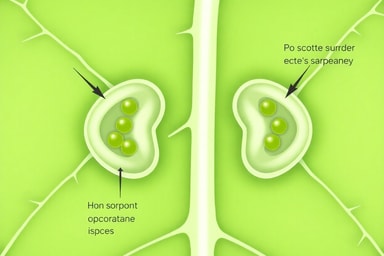
Questions based on the diagram:
SECTION G: DIFFERENTIATE BETWEEN CONCEPTS (6 Marks)
Differentiate between the following pairs based on the criteria provided in the brackets:
SECTION H: LONG ANSWER QUESTIONS (9 Marks)
Want to print your doc?
This is not the way.
This is not the way.

Try clicking the ··· in the right corner or using a keyboard shortcut (
CtrlP
) instead.