Skip to content
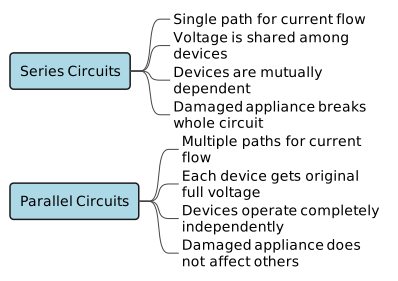
In a series circuit, there is only a single path for the flow of current, meaning all electrical appliances depend on each other to complete the circuit and must work simultaneously. In a parallel circuit, there are multiple paths, allowing each electrical appliance to operate completely independently of the others. A series circuit features a sharing of voltage among the connected components, whereas each appliance in a parallel circuit receives the original, full voltage. Furthermore, if one appliance gets damaged in a series circuit, the entire circuit is broken and all other appliances stop working. In a parallel circuit, if one appliance is damaged, the remaining ones continue to work uninterrupted, which is why household wiring uses parallel connections with separate switches.
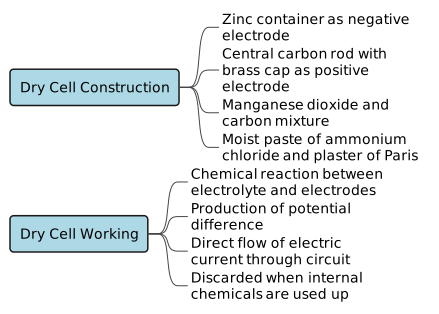
 A dry cell consists of a zinc container that acts as the negative electrode (cathode), and a central carbon rod with a brass cap that serves as the positive electrode (anode). The carbon rod is surrounded by a mixture of manganese dioxide and carbon, while the electrolyte is a moist paste of ammonium chloride and plaster of Paris. When both electrodes are connected in a circuit, a chemical reaction occurs between the electrolyte and the electrodes. This reaction produces a potential difference, causing an electric current to flow through the circuit. Once the internal chemicals are completely used up, the cell stops producing electricity and must be discarded.
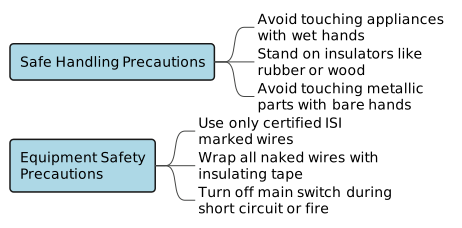
 To ensure safety, one must never touch electrical appliances or switches with wet hands, as tap water and the human body are good conductors of electricity. It is crucial to use only ISI-marked wires and cover all bare or naked wires with insulating tape to prevent accidental contact. Always stand on an insulator, such as a rubber mat or a wooden board, when performing any electrical installation or repair work. Additionally, never touch the metallic parts of appliances with bare hands while they are in use, and ensure plugs fit tightly into sockets to avoid sparking. In the event of a short circuit or fire, the main switch must be turned off immediately to cut off the power supply.
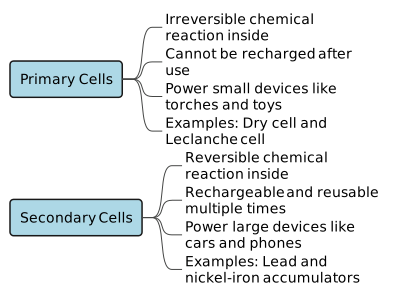
 A primary cell is a type of electrochemical cell where the chemical reaction inside is irreversible, meaning it cannot be recharged after its chemicals are used up. In contrast, the chemical reaction inside a secondary cell is reversible, which allows it to be recharged and reused multiple times. Primary cells are typically used to operate small, portable devices like torches, toys, calculators, and radios. Secondary cells, also known as storage cells or accumulators, are used in devices requiring more energy or constant reuse, such as mobile phones, cameras, computers, and automobiles. Examples of primary cells include Leclanche and dry cells, while examples of secondary cells include lead and nickel-iron accumulators.

Share
Explore
 Answer key
Prepared by: learnloophq@gmail.com
Chapter: 07. Electricity
ANSWER KEY
1. Compare and contrast series and parallel circuits in terms of current flow, voltage distribution, and device dependency.
2. Describe the construction and working of a simple dry cell.
3. State the important precautions that should be followed to avoid accidents while using electricity.
4. Differentiate between a primary cell and a secondary cell.
Want to print your doc?
This is not the way.
This is not the way.

Try clicking the ··· in the right corner or using a keyboard shortcut (
CtrlP
) instead.