Skip to content
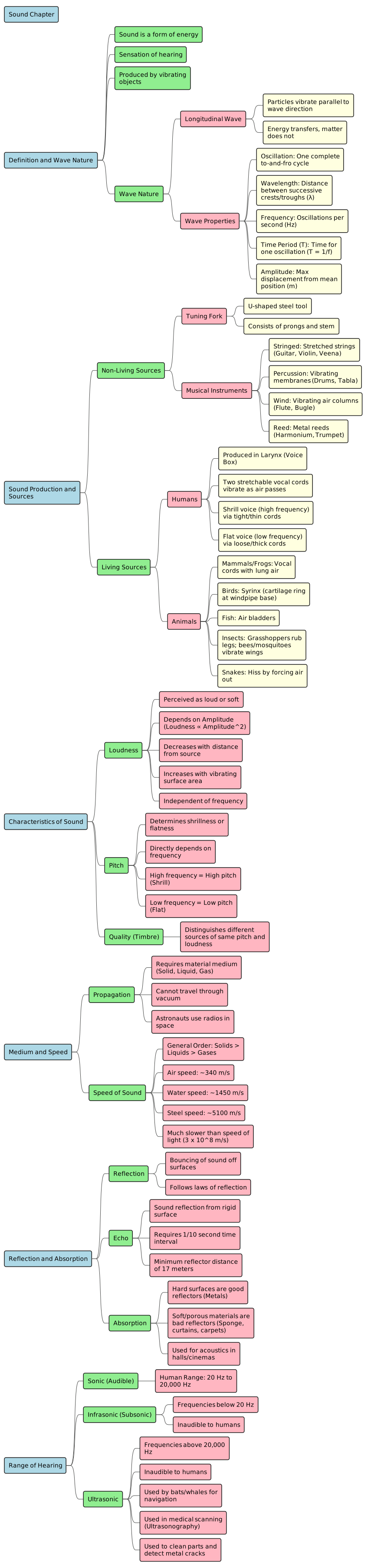
Definition: Sound is a form of energy that produces the sensation of hearing in our ears.Source of Sound: Sound is produced by a vibrating body. Sound can only be heard as long as the object vibrates.Vibratory Motion: The to-and-fro or back-and-forth motion of an object in a fixed pattern about its mean position.Key Demonstration:Flicking a plastic ruler held firmly on a table causes rapid vibrations and produces a humming sound. Once touched to stop the vibration, the sound also stops.Striking a drum causes its membrane to vibrate, which can be observed by placing ping-pong balls on the drum; they jump up and down.
A U-shaped steel instrument consisting of two arms called prongs and a handle called the stem.Striking a prong gently on a rubber pad causes it to vibrate and produce sound. Commonly used in scientific laboratories.
Larynx (Voice Box): Located between the pharynx and trachea.Vocal Cords: A pair of stretchable ligaments inside the larynx with a narrow slit between them for air passage.Mechanism: Air blown through the slit vibrates the vocal cords.Frequency Modulation:High Frequency: When muscles pull the vocal cords tight and thin (produces a shrill voice, common in females).Low Frequency: When cords are loose and thick (common in males whose larynx is typically larger).Fact: Humans have only two vocal cords. The variety of voices is due to varying tension and vibrations, not the number of cords.
Mammals and Frogs: Blow air through vocal cords from their lungs.Birds: Have a ring of cartilage called a syrinx located at the bottom of the windpipe. Some birds have a two-part voice box, allowing them to produce two notes simultaneously.Fish: Vibrate their air bladders to produce sound.Grasshoppers: Rub stiff hairs on their legs to chirp.Bees and Mosquitoes: Vibrate their wings rapidly to make a buzzing sound.Snakes: Force air out of their mouths to hiss.
Longitudinal Wave: A wave in which the particles of the medium vibrate back and forth in the same direction as the propagation of the sound wave.
Oscillation: The to-and-fro motion of the particles of a medium when one full wave is completed.Wavelength (λ): The physical distance along the propagation axis between two successive crests or troughs.Frequency (f): The number of oscillations made by a wave per unit of time.SI Unit: Hertz (Hz). 1 Hz = 1 oscillation per second.Time Period (T): The time taken by a wave to complete one single oscillation (measured in seconds).Mathematical Relationship:
 Amplitude: The maximum displacement of a wave on either side of its mean position (measured in meters, m).
Loudness: Determines how strong or faint the sound is perceived.Depends directly on the amplitude of the wave.  (If amplitude doubles, loudness increases four times).Decreases as the distance between the listener and source increases.Increases with a larger surface area of the vibrating body.Note: Loudness is completely independent of frequency.Pitch: Determines the shrillness or flatness of a sound.Depends directly on the frequency of vibrations.High-pitched/Shrill sound: High frequency.Low-pitched/Flat sound: Low frequency.Quality (Timbre): The characteristic that enables us to distinguish between two different sounds of the same pitch and loudness (e.g., identifying a friend’s voice or different instruments).
Sound requires a material medium (solid, liquid, or gas) to travel.Sound cannot travel through a vacuum because there are no particles to propagate the disturbance.Application: Space is a vacuum, so astronauts use radios (which transmit radio waves, not sound waves) to communicate.Speed in different states of matter: Sound travels fastest in solids, slower in liquids, and slowest in gases.
During thunderstorms, lightning is seen before thunder is heard because the speed of light (  ) is vastly greater than the speed of sound in air (approximately
  ).The speed of sound in air is affected by atmospheric conditions (temperature, pressure, moisture).Historical Attempts: Pierre Gassendi (17th century) made the earliest attempt. Reverend William Derham (1709) calculated it to be 1072 Parisian feet per second.
Practical Application: Railway workers put their ears to the steel track to detect an oncoming train from far away since sound travels at ~5100 m/s in steel compared to only ~340 m/s in air.
Reflection: The bouncing back of sound waves when they strike a rigid surface. Follows the laws of reflection (angle of incidence equals angle of reflection).Echo: The repeating of a sound caused by its reflection from a distant, rigid surface (like mountains or large buildings).Persistence of hearing: The human ear needs a minimum of 1/10th of a second (0.1 s) interval between two sounds to distinguish them.Minimum Distance Formula for Echo:


 Therefore, the reflecting surface must be at least 17 meters away from the sound source to hear a clear echo.
Good Reflectors: Hard and rigid surfaces (metals, non-porous walls).Bad Reflectors (Absorbers): Soft, fluffy, or porous surfaces (clothes, curtains, carpets, cork, paper, wool, wood, sponge, thermocol).Applications:Walls, ceilings, and floors of theatres and auditoriums are coated with sound-absorbing materials to prevent unwanted echoes and external sound transmission.Thick window curtains help block street noise.
Sonic (Audible) Sound: Sound frequencies that can be heard by the human ear. The human range of audibility is 20 Hz to 20,000 Hz.Infrasonic (Subsonic) Sound: Frequencies below 20 Hz. Inaudible to humans.Ultrasonic Sound: Frequencies above 20,000 Hz. Inaudible to humans but audible to certain animals (dogs, leopards, monkeys, deer).
Animal Navigation: Bats, whales, and seals emit and detect ultrasonic waves to navigate and locate prey.Medical Diagnostics: Used in ultrasonography (imaging organs/fetuses) and echocardiograms (ECGs) to analyze cardiovascular blood flow. It is safe because it does not use harmful radiation.Therapy: Used to relieve pain in joints and muscles.Industrial Testing: Detecting invisible internal cracks and defects in heavy metal blocks.Cleaning: Removing grease and dirt from machinery/utensils and dental tartar.Galton’s Whistle: Produces sounds above 20,000 Hz to train dogs.

Share
Explore
 Recap Hub
Prepared by: learnloophq@gmail.com
Chapter: 06. Sound
CRASH COURSE: CHAPTER 6 – SOUND
1. UNDERSTANDING SOUND & ITS PRODUCTION
2. SOURCES OF SOUND
A. Tuning Fork
B. Sound Produced by Humans
C. Sound Produced by Animals
D. Musical Instruments
Musical instruments produce sound through vibrations and are classified into four groups:
Instrument Category
Mechanism of Sound
Examples
Stringed Instruments
Plucking or stroking stretched strings. Hollow bodies trap an air column to enhance the sound.
Veena, santoor, guitar, harp, tanpura, violin
Percussion / Membrane
Striking a tightly stretched skin or membrane.
Tabla, drums
Wind Instruments
Vibrations of air columns when air is blown into them.
Flute, bugle
Reed Instruments
Blowing air through internal metal reeds.
Harmonium, trumpet, mouth organ
Note: In a jal tarang, sound frequency is adjusted by pouring varying amounts of water into multiple cups.
3. SOUND AS A LONGITUDINAL WAVE
Sound travels through a medium as a wave. It transfers energy from particle to particle, but there is no transfer of matter.
Key Wave Parameters
4. CHARACTERISTICS OF SOUND
Sound is distinguished by three major characteristics:
5. PROPAGATION & SPEED OF SOUND
Propagation requirements
Speed of Sound in Air vs. Light
Speed of Sound in Different Mediums (at 0°C)
Solids
Speed (m/s)
Liquids
Speed (m/s)
Gases
Speed (m/s)
Glass
5500
Water
1450
Hydrogen
1270
Steel
5100
Turpentine
1325
Air
340
Copper
3560
Alcohol
1210
Carbon dioxide
260
6. REFLECTION AND ABSORPTION OF SOUND
Reflective Properties of Materials
7. AUDIBLE AND INAUDIBLE SOUNDS
Medical and Industrial Uses of Ultrasonics
Want to print your doc?
This is not the way.
This is not the way.

Try clicking the ··· in the right corner or using a keyboard shortcut (
CtrlP
) instead.