Skip to content
Common Features of Living Organisms: All living beings exhibit growth (increase in size), reproduction (producing their own kind), and adaptation (responding to stimuli and adjusting to environmental changes).Need for Energy: All living activities require energy, which comes from food. This is sustained through life processes like nutrition, respiration, excretion, response, and reproduction.Autotrophic Nutrition: Green plants synthesize their own food using inorganic substances. They are called autotrophs, and this mode of nutrition is autotrophic nutrition.Heterotrophic Nutrition: The process of obtaining readymade food from plants, animals, or both (found in non-green plants and animals).

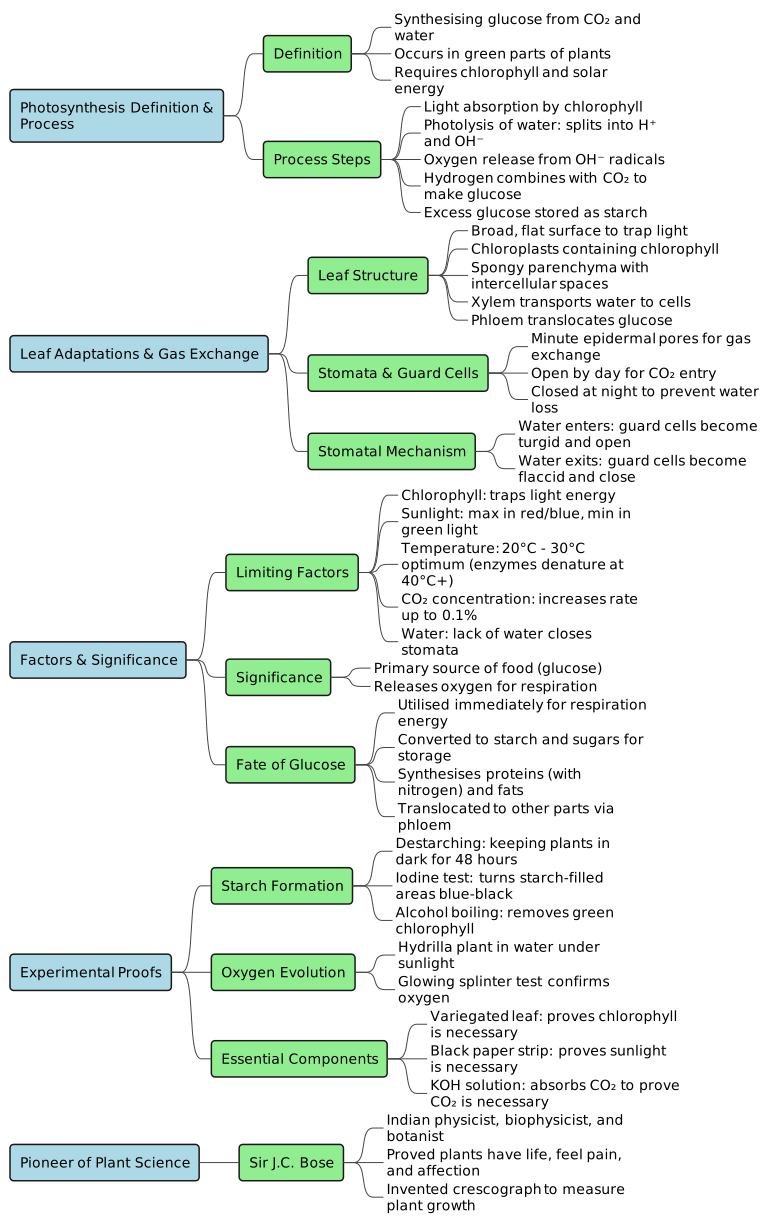
Light Absorption: Chlorophyll absorbs light energy and becomes energized.Photolysis of Water: Energized chlorophyll splits water molecules into hydrogen (  ) and hydroxyl (
  ) radicals:
 Oxygen Release: Oxygen is released into the air from the hydroxyl radicals:
 Glucose Synthesis: Hydrogen combines with carbon dioxide (
  ) to form glucose.Starch Storage: Glucose is used by cells for energy, and any excess glucose is converted and stored as starch in different plant parts.
Chloroplasts: These cell organelles contain the green pigment chlorophyll and are the actual sites of photosynthesis.Broad, Flat Surfaces: Maximizes absorption of sunlight and carbon dioxide.Arrangement: Leaves are positioned at right angles to solar rays to receive maximum exposure.Intercellular Spaces: Large spaces in the spongy parenchyma allow easy diffusion of carbon dioxide to every cell.Vein Structure: Contains xylem (transports water to leaf cells) and phloem (translocates manufactured food to other plant parts).Alternative Organs: Photosynthesis can also occur in green stems. In desert plants, where leaves are modified into spines, the green stem takes over photosynthesis.
Structure: Each stoma is guarded by two kidney-shaped guard cells and opens into an internal air cavity.Day vs. Night Activity: Stomata remain open during the day to allow carbon dioxide inside. At night, they close to prevent water loss via transpiration.Mechanism of Opening and Closing:Opening: In sunlight, water from surrounding cells enters the guard cells, making them turgid (swollen). Their outer thin walls bulge outward, pulling the inner thick walls apart and widening the pore.Closing: At night, water leaves the guard cells, making them flaccid (shrunk). The inner thick walls straighten, closing the pore.
Chlorophyll: Essential green pigment that traps light. Photosynthesis occurs only in green plant tissues containing chloroplasts.Sunlight:Occurs only in the visible spectrum.Rate is maximum in blue and red light and minimum in green light.Too much bright light destroys chlorophyll, which slows down the process.Temperature:Optimum temperature range is 20°C to 30°C.Slower at low temperatures.Slowing down occurs at 40°C and above because enzymes (being proteins) get denatured.Carbon Dioxide: Rate increases with higher concentration up to 0.1%, after which the rate decreases.Water: Reduced water availability causes stomata to close, restricting entry and decreasing photosynthesis.
Significance: Photosynthesis is life-supporting as it produces food (glucose) for all organisms and releases oxygen necessary for respiration. It maintains the balance of carbon dioxide and oxygen in the atmosphere.Fate of Glucose:Immediate Energy: A portion is used during respiration to release energy.Starch Storage: Converted into insoluble starch and sugars for long-term storage.Synthesis of Proteins and Fats: Amino acids and proteins are synthesised from glucose along with nitrogen compounds absorbed by roots. Fats are also synthesised from glucose.Translocation: Glucose is soluble in water and is translocated to other parts of the plant through the phloem.
Testing for Starch (Activity 2): Leaves are boiled in water and then in alcohol (to destroy chlorophyll and make the leaf colourless). When iodine solution is added, starch-containing areas turn blue-black.Oxygen Evolution (Activity 3): An aquatic plant (Hydrilla) kept under an inverted funnel in a beaker of water under sunlight produces gas bubbles. A glowing splinter inserted into the collected gas bursts into flame, confirming the gas is oxygen.Chlorophyll is Necessary (Activity 4): A variegated leaf (Coleus or Croton) is tested for starch. Only the green areas (containing chlorophyll) turn blue-black with iodine.Sunlight is Necessary (Activity 5): Partially covering a leaf with black paper prevents starch formation in the covered section, proving sunlight is required.Carbon Dioxide is Necessary (Activity 6): A plant kept in a bell jar with Potassium Hydroxide (KOH) solution (which absorbs ) fails to produce starch, proving is essential.
Pioneering Indian physicist, biophysicist, biologist, and botanist.Invented the crescograph to measure plant growth.Proved that plants have life, feel pain, understand affection, and established parallelisms between plants and animals.

Share
Explore
 Recap Hub
Prepared by: learnloophq@gmail.com
Chapter: 04. Photosynthesis
Photosynthesis: Crash Course Revision Material
1. Introduction to Basic Life Processes & Nutrition
2. The Photosynthesis Process
Photosynthesis (from Greek photo = light + synthesis = combining) is the process by which green parts of plants manufacture food (glucose) from carbon dioxide and water, using solar energy trapped by chlorophyll, and releasing oxygen.
The Chemical Pathway
Solar energy is trapped by chlorophyll and converted into chemical energy (stored in glucose).
Steps of the Basic Process:
3. Leaf: The Photosynthetic Organ
Leaves are uniquely adapted to perform photosynthesis:
4. Stomata and Gas Exchange
Stomata are microscopic pores in the epidermis of leaves that act as pathways for carbon dioxide entry and oxygen exit.
5. Factors Affecting Photosynthesis
6. Significance & The Fate of Glucose
7. Experimental Demonstrations
8. Know Your Scientist: Sir Jagdish Chandra Bose (1858-1937)
Want to print your doc?
This is not the way.
This is not the way.

Try clicking the ··· in the right corner or using a keyboard shortcut (
CtrlP
) instead.