Skip to content
Measurement: The comparison of an unknown quantity with a known fixed quantity of similar nature.
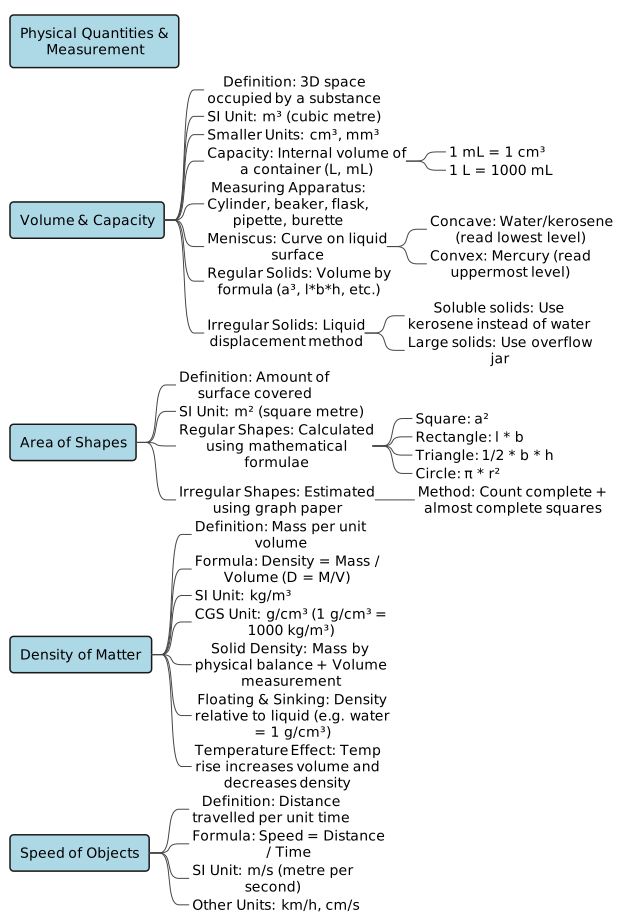
Volume: The three-dimensional space occupied by a substance (solid, liquid, or gas).SI Unit of Volume: Cubic metre (m³). It is the volume of a cube with each side of length 1 m.Smaller Units: Cubic centimetre (cm³) and cubic millimetre (mm³).1 m³ = 100 cm × 100 cm × 100 cm = 1,000,000 cm³.Unit Cube: A cube whose sides are 1 unit long (e.g., volume of 1 cm³). Volume of shapes made of unit cubes can be found by counting the cubes.
Definition: The internal volume of a container, representing the maximum volume of liquid it can hold.Units: Litres (L) and millilitres (mL).Key Unit Relations:1 mL = 1 cm³1 L = 1000 mL = 1000 cm³1000 L = 1,000,000 cm³ = 1 m³Apparatus for Measuring Liquid Volume: Graduated cylinders (measuring cylinders), graduated beakers, flasks, pipettes, and burettes.
Concave Meniscus:Formed by liquids that wet the sides of the container (e.g., water, kerosene).The curve points downwards.Reading must be taken at the lowest level of the meniscus.Convex Meniscus:Formed by liquids that do not stick to the sides of the container (e.g., mercury).The curve points upwards.Reading must be taken at the uppermost level of the meniscus.


Liquid Displacement Method: When a solid is completely immersed in a liquid, it displaces a volume of liquid equal to its own volume.  Solids Soluble in Water: Use kerosene instead of water (e.g., for a lump of copper sulphate).Large Irregular Solids: Measured using an overflow jar (a metal/glass jar with an overflow outlet). The displaced water overflows into a measuring cylinder to give the exact volume.
Area: The amount of surface covered by an object or a place.SI Unit of Area: Square metre or metre square (m²). It is the area of a square in which the length of each side is 1 metre.


Cannot be determined using standard mathematical formulae (e.g., leaf, feather).Graph Paper Method:Draw the outline of the irregular object on a graph paper (divided into 1 cm and 1 mm squares).Count the number of complete squares.Count the number of almost complete squares.Add both counts together to find the approximate area in square centimetres (cm²).
Concept: Equal volumes of different substances can have different masses (e.g., water has a greater mass than kerosene for the same volume because water molecules are more closely packed).Density: The quantity of mass per unit volume of a substance.Formula:
 Units:SI Unit:
  (or
(or  )CGS Unit:
  (or
(or  or
or  )Conversion:
Regular Solids: Mass is measured using a physical balance; volume is calculated using mathematical formulae.Irregular Solids: Mass is measured using a physical balance; volume is determined using the liquid displacement method.Purity and Engineering Applications:Engineers/architects use density to design bridges and calculate the required strength of pillars.Chemists use density to verify the purity of substances.
Floating/Sinking Rules: Objects with a density greater than water (  ) will sink; those with a lower density will float.Temperature Effect:Heating: Molecules speed up and spread apart
  Volume increases Density decreases. (e.g., warm water floats on room-temperature water).Cooling: Molecules slow down and get closer Volume decreases Density increases.
Speed: The distance travelled by an object per unit time.Formula:
 Units:SI Unit: metre per second (m/s).Other Units: kilometre per hour (km/h) or centimetre per second (cm/s).
Problem: A box has dimensions  . Find its volume in SI units.Solution:


Problem: A stone of mass  is lowered into a cylinder. The water level rises from
  to
to  . Calculate its density.Solution:


Problem: A train takes 4 hours to travel a distance at a uniform speed of  . Calculate the distance.Solution:


Share
Explore
 Recap Hub
Prepared by: learnloophq@gmail.com
Chapter: 01. Physical Quantities And Measurement
CRASH COURSE: PHYSICAL QUANTITIES AND MEASUREMENT
1. INTRODUCTION TO MEASUREMENT
2. MEASUREMENT OF VOLUME
Capacity
Understanding the Meniscus
When a liquid is poured into a cylinder, its surface forms a curve called a meniscus:
Volume of Regular Solids
Regular Solid
Formula
Cube (with sides  )
)
Cuboid (length  , breadth
  , height
  )
)
Sphere (radius  )
)
Cylinder (radius , height )
Volume of Irregular Solids
3. MEASUREMENT OF AREA
Area of Regular Shapes
Regular Shape
Formula
Square (side )
Rectangle (length , breadth )
Triangle (base , height )
Circle (radius )
Area of Irregular Shapes
4. MEASUREMENT OF DENSITY
Densities of Common Substances
Substance
Density in
Air
1.20
Ice
920
Water
1000
Aluminium
2700
Brass
8400
Copper
8900
Gold
19300
Density Determinations
Floating and Sinking (Temperature Effects)
5. MEASUREMENT OF SPEED
6. SOLVED REFERENCE NUMERICALS
Volume Conversion Example
Density Calculation Example
Speed Calculation Example
Want to print your doc?
This is not the way.
This is not the way.

Try clicking the ··· in the right corner or using a keyboard shortcut (
CtrlP
) instead.