Skip to content
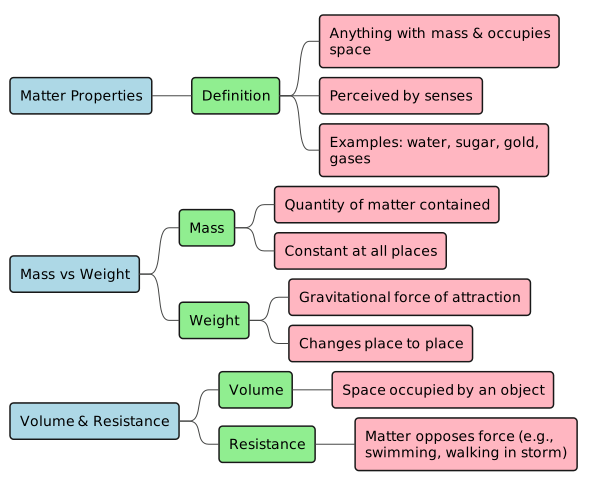
Definition: Matter is defined as anything that has mass and occupies space.Perception: Matter can be perceived and recognized by our five senses. We can see, touch, smell, or feel it.Examples: Water, sugar, milk, gold, oxygen, and carbon dioxide.
Matter Has Mass:Mass is the actual quantity or amount of matter contained within an object.Matter has a definite mass.Mass vs. Weight: Mass is different from weight. While mass is the absolute ‘quantity of matter contained in an object’ and remains the same at all places, weight is ‘the force with which the earth attracts an object towards itself’ and changes from place to place.Matter Occupies Space (Volume):The actual space occupied by any object is called its volume.Air is a classic example of matter that occupies space. When you blow air into a balloon, the balloon’s size increases because the air occupies space inside it. When the air is released, the balloon’s size decreases.Matter Offers Resistance:Matter offers resistance when we try to move through it or displace it.For example, it is difficult to swim in fast-flowing water due to the physical resistance offered by the water. Similarly, when walking during a heavy storm, we experience resistance from the moving air.
Aim: To show that matter has mass and occupies space.Method:Fill a glass tumbler one-third with water, mark the water level, and weigh the tumbler.Add marbles one by one into the tumbler.Mark the new water level and weigh the tumbler again.Observation: The water level rises (proving marbles occupy space) and the total weight increases (proving marbles have mass).
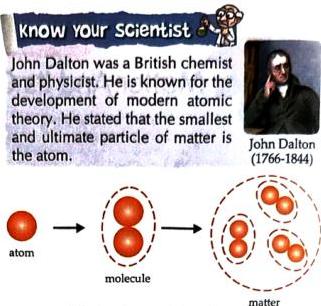
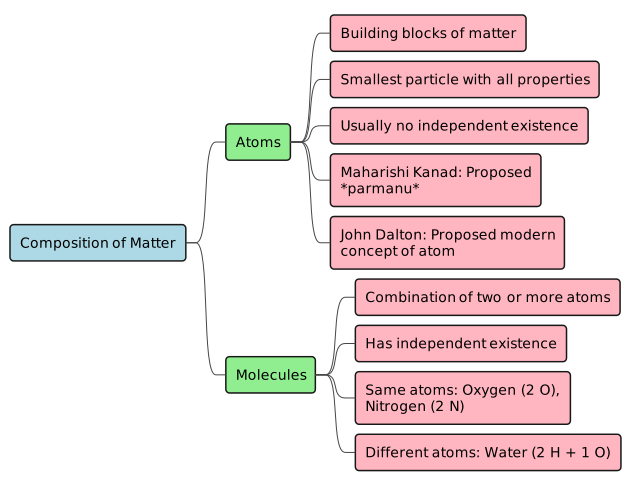
Definition: An atom is the basic building block or the smallest unit of matter that exhibits all the properties of that matter.Existence: Atoms usually do not have an independent existence.Historical Evolution:Earlier, ancient beliefs suggested everything in the universe was composed of five elements: air, water, earth, sky, and fire.An Indian philosopher, Maharishi Kanad, proposed that matter is actually composed of very small particles called parmanu.Later, British chemist and physicist John Dalton (1766–1844) proposed the modern scientific concept of the atom.
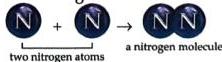
Definition: A molecule is the smallest particle of matter that exhibits all the properties of matter and has an independent existence.Composition: Each molecule is formed when two or more atoms join together. Molecules can be made up of the same kind or different kinds of atoms:Oxygen Molecule: Made of two atoms of oxygen.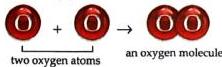 Nitrogen Molecule: Made of two atoms of nitrogen.
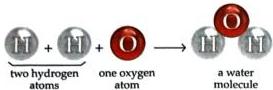
 Water Molecule: Made of two atoms of hydrogen and one atom of oxygen.
 Scale: Both atoms and molecules are incredibly tiny and cannot be seen with the naked eye or even under an ordinary microscope.
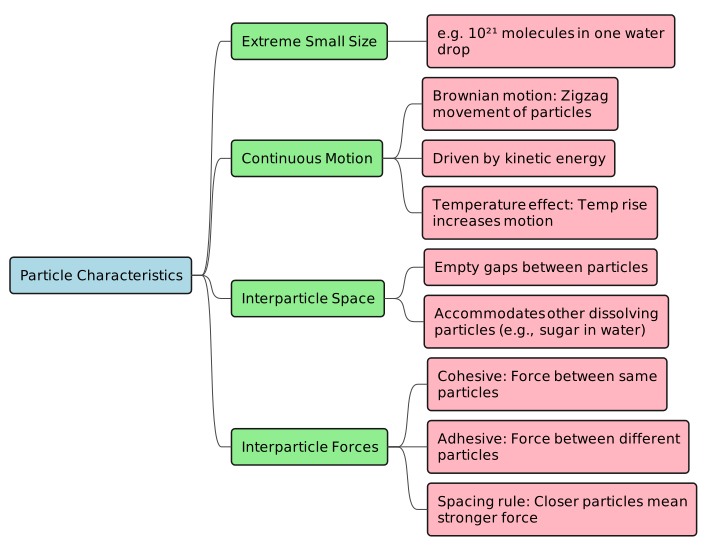
Particles of matter are extremely tiny.To put this in perspective, a single tiny drop of water contains approximately 10²¹ molecules of water.
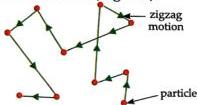
Particles of matter are in a state of continuous, random motion in a zigzag path.Brownian Motion: The continuous zigzag motion of the particles of matter is defined as Brownian motion.Experiential Learning (Ink Diffusion): Adding a few drops of blue ink to a tumbler of water shows that the ink slowly spreads and mixes uniformly without stirring. This happens because the moving particles of ink disperse through the spaces between the water particles.Impact of Temperature: Particles move because they possess kinetic energy.Heating (increase in temperature) increases the kinetic energy, making the particles move faster.Cooling (decrease in temperature) decreases kinetic energy, slowing down the movement of particles.
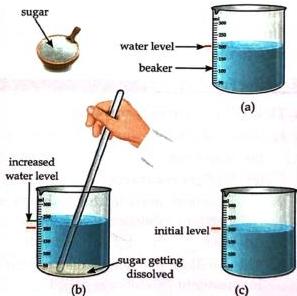
There are gaps or spaces between individual particles of matter. This space is called interparticle space or intermolecular space.Experiential Learning (Sugar Dissolution): Adding a teaspoon of sugar to a marked level of water initially increases the level. However, after stirring and fully dissolving the sugar, the water level recedes back to the initial mark. This is because the sugar breaks down into tiny particles that position themselves within the empty intermolecular spaces of the water molecules.
A force of attraction exists between particles that holds them together. This is called the interparticle or intermolecular force of attraction.The intermolecular force of attraction depends on the intermolecular space:Less space = Stronger intermolecular force of attraction.More space = Weaker intermolecular force of attraction.There are two types of attraction forces:Cohesive Force: The force of attraction between the same kind of particles (e.g., water-water attraction).Adhesive Force: The force of attraction between different kinds of particles (e.g., water-glass attraction).Experiential Learning (Wood vs. Chalk): Trying to break a piece of wood and a piece of chalk reveals that chalk breaks easily while wood does not. This is because the cohesive intermolecular force of attraction holding the molecules of wood together is much stronger than that of chalk.
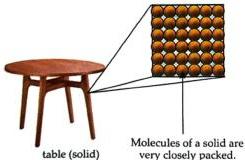
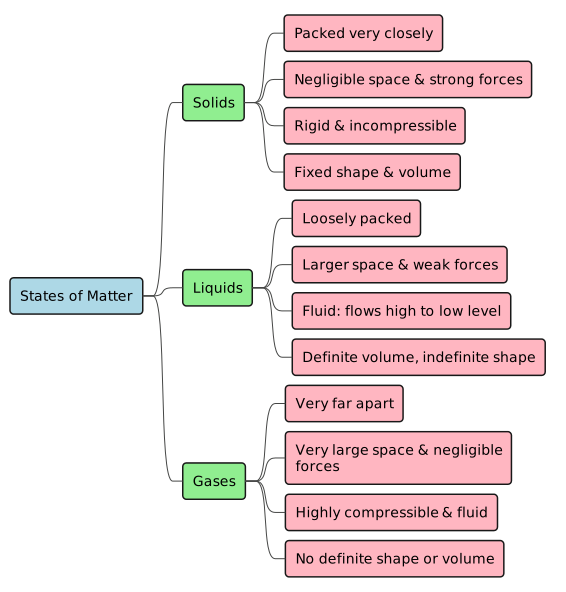
Molecular Arrangement: Molecules are very closely packed. The intermolecular space is negligible, and the intermolecular force of attraction is extremely strong.Movement: Molecules are not free to move around; they can only vibrate about their fixed mean positions.Characteristics: Rigid, incompressible, definite shape, and definite volume.Examples: Sugar, wood, rock, plastic, ice, wax, silver, gold, iron, and aluminium.
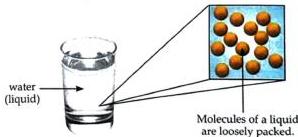
Molecular Arrangement: Molecules are loosely packed compared to solids. The intermolecular space is larger, and the intermolecular force of attraction is weak.Movement: Molecules are free to move, but only within the physical boundaries of the liquid.Characteristics: Not rigid, slightly compressible, definite volume, but no definite shape (takes the shape of its container).Examples: Water, milk, petrol, alcohol, oil, honey, and glycerine.
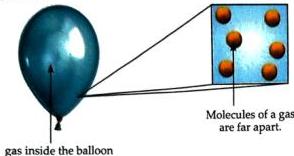
Molecular Arrangement: Molecules are far apart. The intermolecular space is very large, and the intermolecular force of attraction is very weak or negligible.Movement: Molecules are entirely free to move in all directions and occupy all available space.Characteristics: Not rigid, highly compressible, no definite shape, and no definite volume.Examples: Air, water vapour, oxygen, nitrogen, ammonia, helium, and argon.Fluids: Liquids and gases are collectively called fluids because they have the tendency to flow.
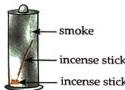
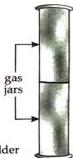
Aim: To show that a gas has neither a definite shape nor a definite volume.Method:Light an incense stick inside a gas jar and let smoke fill it.Invert another gas jar over its mouth.Observation: The smoke fills the first jar, taking its shape. Once the second jar is placed over it, the smoke quickly spreads to fill the entire volume of both jars, proving gas expands to occupy all available space.
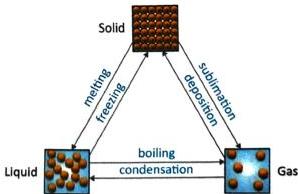
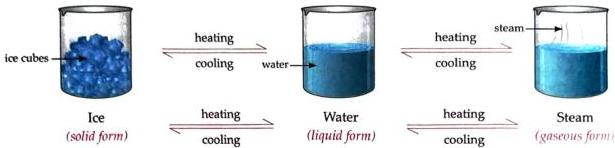
Melting (Heating): Solid changes into a liquid.Boiling / Evaporation (Heating): Liquid changes into a gas/vapour.Condensation (Cooling): Gas/vapour changes into a liquid.Freezing (Cooling): Liquid changes into a solid.Water is liquid at room temperature.Heating to 100°C: Liquid water boils and changes into steam (gas).Cooling Steam: Condenses back into liquid water.Cooling to 0°C: Liquid water freezes into solid ice.Room Temperature: Ice melts back into liquid water.Solid wax melts into liquid wax upon heating, and converts to wax vapour upon further heating. On cooling, liquid wax solidifies back to solid wax.
Applying pressure forces gaseous molecules closer together, increasing their intermolecular forces and converting them into a liquid.Examples: Liquid oxygen, liquid nitrogen, and Liquefied Petroleum Gas (LPG).LPG Cylinder Action: Cooking gas (LPG) is stored under very high pressure inside cylinders as a liquid. When the regulator valve is opened, the pressure is released, converting the liquid back into a gas as it exits.
Sublimation: The process where a solid changes directly into a gas upon heating, without passing through the liquid state.Deposition: The process where a gas changes directly into a solid upon cooling.Subliming Substances: Camphor, naphthalene, and ammonium chloride.

Share
Explore
 Self Study
Prepared by: learnloophq@gmail.com
Chapter: 01. Matter And Its Composition
Matter and Its Properties
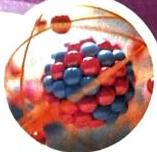
Matter is the fundamental substance that makes up everything in the universe around us. Whether living like plants and animals, or non-living like stones and books, natural like water and soil, or human-made like pens and shoes—all these things are composed of matter.
What is Matter?
Essential Properties of Matter
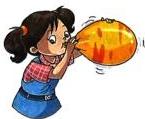
(a) The size of the balloon increases when we blow air into it.
(a) The size of the balloon increases when we blow air into it.

(b) The size of the balloon decreases when air is released from it.
(b) The size of the balloon decreases when air is released from it.
Experiential Learning: Demonstrating Mass and Space
Composition of Matter
All matter is made of extremely tiny particles that are invisible to the naked eye.
The Concept of the Atom
The Concept of the Molecule
Characteristics of Particles of Matter
The microscopic particles (atoms and molecules) that make up matter exhibit distinct characteristics:
1. Incredibly Small Size
2. Continuous Random Motion (Brownian Motion)
3. Presence of Interparticle Space
4. Interparticle Force of Attraction
States of Matter
Matter exists in three physical states: solids, liquids, and gases. The state of any substance is decided by three properties: its intermolecular space, its intermolecular force of attraction, and the movement of its molecules.
Solids
Liquids
Gases
Experiential Learning: Gas Volume and Shape
Summary Comparison of States of Matter
S. No.
Parameters
Solid
Liquid
Gas
1
Shape
Definite shape
No definite shape; takes the shape of the container.
No definite shape
2
Volume
Definite volume
Definite volume
No definite volume; occupies all available space.
3
Arrangement of Molecules
Molecules are very closely packed.
Molecules are loosely packed.
Molecules are far apart.
4
Intermolecular Space
Almost negligible
Larger than solids
Very large
5
Intermolecular Force
Very strong
Weak
Weakest (negligible)
6
Position of Molecules
Fixed; molecules only vibrate about their mean positions.
Not fixed; move within the boundary of the liquid.
Not fixed; free to move in all directions.
7
Rigidity
Rigid
Not rigid
Not rigid
8
Compressibility
Incompressible
Slightly compressible
Highly compressible
9
Fluidity (Tendency to flow)
Does not flow
Flows from a higher level to a lower level.
Flows in all directions.
10
Solubility in water
Many are insoluble (sand, wood); some are soluble (sugar, salt).
Miscible liquids dissolve (vinegar, alcohol); immiscible do not (oil, diesel).
Highly soluble (ammonia, chlorine) to insoluble (hydrogen).
11
Diffusion
Does not diffuse
Diffuses slowly
Diffuses very fast
Interconversion of States of Matter
Interconversion of states of matter is the process by which matter changes from one physical state to another and back to its original state without any change in its chemical composition. This transition is achieved by changing the temperature or applying pressure.
1. Interconversion by Temperature Change
When thermal energy (heat) is added or removed, the kinetic energy of the molecules changes, resulting in a state transition:
Example: Water Transitions
Example: Wax Transitions
2. Interconversion by Pressure Change
3. Sublimation and Deposition
Concept Summary Flowchart
Below is the visual map of how matter, its states, particles, and physical interconversions link together.
Want to print your doc?
This is not the way.
This is not the way.

Try clicking the ··· in the right corner or using a keyboard shortcut (
CtrlP
) instead.