Skip to content
Which of the following is a homogeneous solid mixture of copper and tin?(a) Steel(b) Brass(c) Bronze(d) Iron sulphideIn a molecule of water (H₂O), the constituent elements hydrogen and oxygen are present in a fixed proportion by mass of:(a) 1 : 8(b) 8 : 1(c) 1 : 2(d) 2 : 1The symbol of which of the following elements is derived from its Latin name Plumbum?(a) Potassium(b) Mercury(c) Tin(d) LeadWhich separation method is most suitable when one component of a solid-solid mixture is heavier than water and the other is lighter than water (e.g., sand and sawdust)?(a) Sublimation(b) Gravitation(c) Winnowing(d) FiltrationRectified spirit is a mixture obtained from the fractional distillation of ethanol and water. It consists of:(a) 95% water and 5% alcohol(b) 50% water and 50% alcohol(c) 95% alcohol and 5% water(d) 100% pure alcohol
The chemical breakdown of a compound due to its reaction with water is known as _ _ _ _ _ _ _ _ _ _ _ _ _ _.Gaseous elements that do not react chemically with other elements are called _ _ _ _ _ _ _ _ _ _ _ _ _ _.A homogeneous solid mixture of two or more metals, or a metal and a small amount of non-metal, is called an _ _ _ _ _ _ _ _ _ _ _ _ _ _.In paper chromatography, a specially designed paper made of cellulose called _ _ _ _ _ _ _ _ _ _ _ _ _ _ filter paper is used as the stationary phase.The process during which a vapour or gas directly changes into its solid state on cooling is called _ _ _ _ _ _ _ _ _ _ _ _ _ _.
Generally, energy is either released or absorbed during the physical formation of a mixture. (________)Non-metals are generally soft, non-lustrous, brittle, and are bad conductors of heat and electricity. (________)The constituent elements of a compound can be easily separated using simple physical methods. (________)Brass is an alloy made of a homogeneous mixture of copper and zinc. (________)Chromatography is used in sports to test athletes for performance-enhancing drugs. (________)
MetalloidsDistillateEmulsion
Sodium : Natrium :: Potassium : _ _ _ _ _ _ _ _ _ _ _ _ _ _Sand in water : Heterogeneous mixture :: Salt in water : _ _ _ _ _ _ _ _ _ _ _ _ _ _Iron filings and sand : Magnetic separation :: Ammonium chloride and common salt : _ _ _ _ _ _ _ _ _ _ _ _ _ _
Pure Substance vs. Impure Substance (Mixture) (On the basis of Composition and Melting/Boiling Points)Miscible Liquids vs. Immiscible Liquids (On the basis of Solubility/Layers formed and Separation Method)
Why does steel rust less readily than pure iron? Explain its composition.State any two characteristics of a compound.Why does mustard oil form a separate layer on top of water when mixed?What is the fundamental principle behind using the method of Centrifugation?
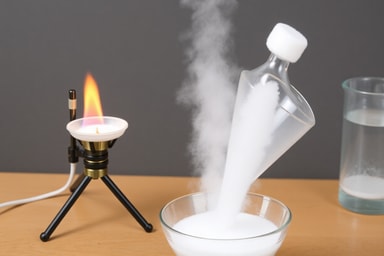
Identify the separation process shown in the diagram. (1 Mark)What is the purpose of blocking the nozzle of the inverted funnel with a cotton plug? (1 Mark)Which substance out of the mixture remains behind in the china dish after heating is complete? (1 Mark)
Observation: A student heats a mixture of iron filings and sulphur powder in a test tube. A dark grey substance is formed.(a) What is the chemical name of this dark grey substance?(b) Will this dark grey substance be attracted to a magnet? Explain why or why not.Everyday Use: Suppose you accidentally spill water into a container of kerosene oil. Explain step-by-step how you can safely separate the kerosene oil from the water in a laboratory.Environmental/Health: A doctor advises a patient to consume milk with a lower fat content. Which separation technique is used in dairies to separate cream (fat) from milk? Briefly explain how it works.
Explain the process of separating a three-component mixture of sand, sawdust, and common salt using a flowchart or step-by-step description. Highlight the physical properties utilized at each step.What is Paper Chromatography? Describe how you would separate the different colors of ink from a marker pen using this technique in a laboratory, explaining the principle of different solubilities.

Share
Explore
 Question Paper
Chapter: 03. Elements Compounds And Mixtures
Grade 7 Science Practice Exam Paper
Chapter: Elements, Compounds and Mixtures
Time Allowed: 2 Hours
Maximum Marks: 50
Section A: Multiple Choice Questions (MCQs)
Choose the correct option for each of the following questions. (5 × 1 = 5 Marks)
Section B: Fill in the Blanks
Fill in the blanks with appropriate words. Use the exact blank format specified. (5 × 1 = 5 Marks)
Section C: True or False Questions
State whether the following statements are True or False. (5 × 1 = 5 Marks)
Section D: Explanations of Terms
Define and explain the following terms in one or two sentences. (3 × 2 = 6 Marks)
Section E: Complete the Series
Analyze the relationship in the first pair and complete the second pair. (3 × 1 = 3 Marks)
Section F: Differentiate Between Concepts
Differentiate between the following pairs based on the parameters provided. (2 × 3 = 6 Marks)
Section G: Short Answer Questions
Answer the following questions briefly. (4 × 2 = 8 Marks)
Section H: Diagram-Based Questions
Observe the diagram below and answer the questions that follow.
A laboratory setup depicting the sublimation of ammonium chloride.
Section I: Observation-Based & Everyday Use Questions
Apply your knowledge of chemistry to answer these real-life scenarios. (3 × 2 = 6 Marks)
Section J: Long Answer Questions
Answer the following questions in detail. (2 × 2.5 = 5 Marks)
Want to print your doc?
This is not the way.
This is not the way.

Try clicking the ··· in the right corner or using a keyboard shortcut (
CtrlP
) instead.