Skip to content
Explain why living cells need to perform the process of excretion.Numerous biochemical reactions occur round the clock in all living cells, breaking down sugars, fats, and proteins. These reactions produce a variety of waste products, such as carbon dioxide, ammonia, and other nitrogenous compounds. Carbon dioxide and ammonia are toxic to the cells and can prove highly harmful if allowed to accumulate. Accumulation of these wastes changes the internal environment of the cells and disturbs the ionic balance. Therefore, these toxic metabolic wastes must be removed from the body as soon as they are formed.
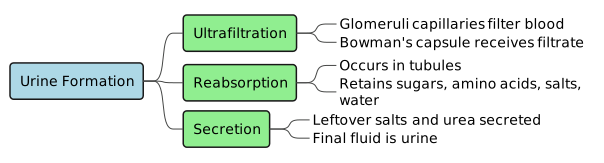
 Describe the processes involved in the formation of urine in the kidneys.The formation of urine in the kidneys occurs due to three distinct processes called ultrafiltration, reabsorption, and secretion. During ultrafiltration, nitrogenous wastes and water are filtered from the blood as it passes through the capillaries of the glomeruli into the Bowman’s capsules. As the filtrate moves down the tubules, useful substances like sugars, amino acids, salts, and water are reabsorbed back into the blood. Meanwhile, some remaining salts and urea are secreted from the blood capillaries into the tubules to form urine. The resulting urine is collected in the urinary bladder and is finally disposed of through the urethra.
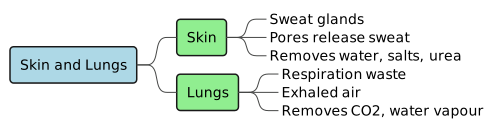
 Explain how the skin and lungs function as excretory organs in the human body.The skin and lungs function as important excretory organs in the human body alongside the kidneys. Sweat glands in the skin remove excess water, salts like sodium chloride, and urea from the blood flowing through skin capillaries. This fluid is excreted onto the skin surface as sweat through tiny pores, which also helps cool the body. On the other hand, the lungs are responsible for removing gaseous waste produced during cellular respiration. They eliminate carbon dioxide and water vapour from the body with the air we exhale.
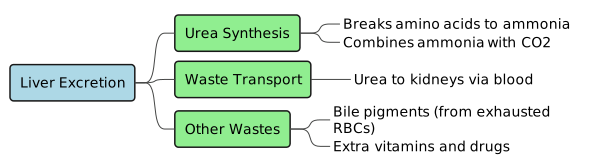
 What is the excretory function of the liver in human beings?The liver plays a vital role in excretion by managing the breakdown of amino acids and synthesizing urea. Liver cells remove toxic ammonia from extra amino acids and combine it with carbon dioxide to form urea. This urea is then carried by the blood to the kidneys to be excreted in the urine. Additionally, the liver helps in the removal of bile pigments, which are formed by the breakdown of exhausted red blood cells. It also assists in eliminating extra vitamins and drugs from the body.
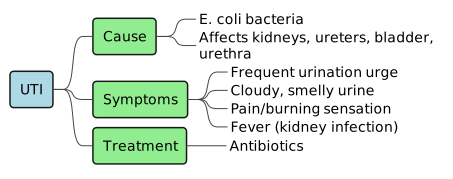
 Describe the causes, symptoms, and treatment of Urinary Tract Infections (UTI).Urinary tract infection (UTI) is a bacterial infection of the urinary tract, which includes the kidneys, ureters, bladder, and urethra. This infection is commonly caused by the bacteria E. coli. The key symptoms are a strong and frequent urge to urinate, cloudy and strange-smelling urine, and a painful burning sensation during urination. Patients may also experience a fever-like feeling if the infection spreads up to the kidneys. Once diagnosed, a UTI is typically treated with antibiotics to eliminate the bacteria.

Share
Explore
 Long Answers
Prepared by: learnloophq@gmail.com
Chapter: 06. Excretory System
Want to print your doc?
This is not the way.
This is not the way.

Try clicking the ··· in the right corner or using a keyboard shortcut (
CtrlP
) instead.