Skip to content
Density is defined as the quantity of mass contained in a given volume of a substance, or mass per unit volume. To determine the density of an irregular solid, its mass is first measured using a physical balance. Next, the volume of the irregular solid is found using a measuring cylinder through the liquid displacement method. Finally, the measured mass is divided by the determined volume using the formula: Density = Mass / Volume. This allows the density of any irregular solid to be expressed in proper units such as g/cm³ or kg/m³.
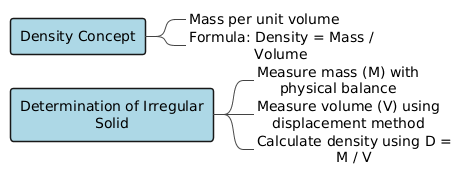
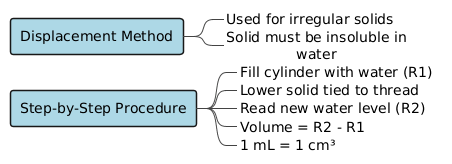
First, pour a suitable quantity of water into a measuring cylinder and note the initial water level reading as R₁. Next, tie the irregular solid to a thread and completely immerse it into the water. Observe the rise in the water level and note the new reading as R₂. The difference between the two readings (R₂ - R₁) gives the volume of the irregular solid. Since 1 mL is equal to 1 cm³, this difference is easily converted and expressed in cubic centimetres.
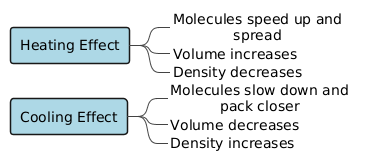
The density of a substance is directly affected by its temperature, and they have an inverse relationship. When the temperature of a substance increases, its density decreases and vice versa. This is because when a substance is heated, its molecules speed up and spread apart, which increases its volume and decreases its density. Conversely, when a substance is cooled, its molecules slow down and get closer together, decreasing its volume. Since the molecules now occupy less space, the density of the substance increases during cooling. This temperature-dependent density change determines whether a heated substance will float or sink compared to its cooler counterpart.
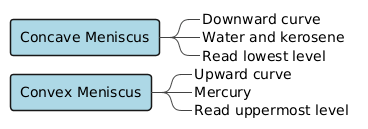
A meniscus is the curve formed on the surface of liquids when they are poured into a measuring cylinder. Liquids that wet the sides of the cylinder, such as water or kerosene, form a curve downwards called a concave meniscus. For liquids with a concave meniscus, the reading must be taken at the lowest level of the curve. Conversely, liquids that do not stick to the cylinder’s sides, such as mercury, form an upward curve called a convex meniscus. For liquids with a convex meniscus, the volume reading must be taken at the uppermost level of the curve.
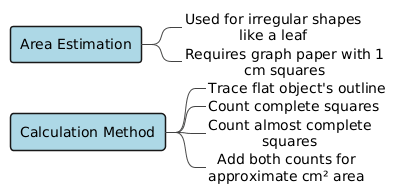
First, place the irregular flat leaf on a graph paper and draw its outline using a pencil. Next, count the total number of complete squares enclosed within the drawn outline of the leaf. Then, count the number of almost complete squares contained within the same outline. Add the number of complete squares and almost complete squares together. This sum provides the approximate surface area of the irregular leaf in square centimetres.

Share
Explore
 Answer key
Prepared by: learnloophq@gmail.com
Chapter: 01. Physical Quantities And Measurement
1. What is density, and how can the density of an irregular solid be determined?
2. Explain how the volume of an irregular solid that is insoluble and heavier than water is measured using a graduated cylinder.
3. Describe the relationship between temperature and the density of a substance.
4. Differentiate between concave meniscus and convex meniscus formed by liquids in a measuring cylinder.
5. Explain how the approximate area of an irregular flat object, such as a leaf, is estimated using a graph paper.
Want to print your doc?
This is not the way.
This is not the way.

Try clicking the ··· in the right corner or using a keyboard shortcut (
CtrlP
) instead.