Skip to content
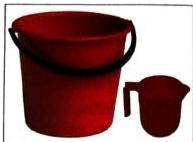
Definition: Volume is the three-dimensional space occupied by a solid, liquid, or gas.Concept of Space: Larger objects occupy more space and thus have a higher volume. For example, a bucket occupies more space than a mug, and an auditorium contains a greater volume of air than a classroom.
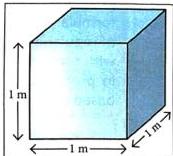
SI Standard Unit: The standard SI unit of volume is the cubic metre (m³). It is defined as the volume of a cube with each side measuring exactly 1 metre.Unit Cube: A cube whose sides are exactly 1 unit long is called a unit cube.Volume of a Cube: Side × Side × Side = 1 m × 1 m × 1 m = 1 m³Sub-units: For smaller items like notebooks or matchboxes, smaller units such as the cubic centimetre (cm³) or cubic millimetre (mm³) are used.Key Unit Conversions:1 m³ = 100 cm × 100 cm × 100 cm = 1,000,000 cm³1 mL = 1 cm³1 L = 1000 mL = 1000 cm³1000 L = 1,000,000 cm³ = 1 m³
Definition: Capacity is the internal volume of a container, representing the maximum volume of liquid it can hold.Units: Capacity is measured in litres (L) or millilitres (mL).
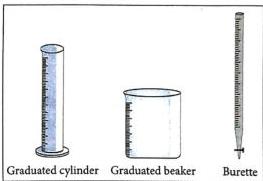
Graduated Cylinder (Measuring Cylinder): A tall, narrow container with a marked scale on the side for precise volume measurements.Graduated Beaker: A wide-mouthed container with spout and volume markings.Burette, Pipette, and Flasks: High-precision laboratory glassware used for measuring and delivering liquids.
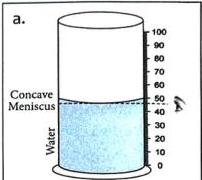
Formed by: Liquids that wet the sides of the container (e.g., water, kerosene).Shape: Curves downwards.Reading Method: Take the reading at the lowest level of the curve.Example: In a measuring cylinder with water, reading the lowest point ensures accuracy (e.g., identifying 46 mL instead of 50 mL).
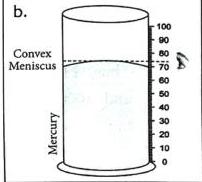
Formed by: Liquids that do not stick to the container walls (e.g., mercury).Shape: Curves upwards.Reading Method: Take the reading at the uppermost level of the curve.Example: In a cylinder filled with mercury, the reading at the top of the curve indicates the correct volume (e.g., 74 mL instead of 70 mL).
The Displacement Principle: When a solid is completely immersed in a liquid, it displaces a volume of liquid exactly equal to its own volume.
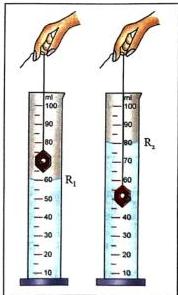
Pour a sufficient quantity of water into a measuring cylinder and note the initial volume (R₁).Tie the irregular solid (e.g., a stone) to a thread and gently lower it until it is completely submerged.Note the new, elevated water level reading (R₂).Calculate the volume of the solid using the formula:

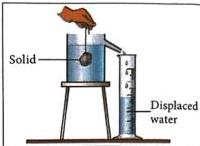
Soluble Solids: If the solid dissolves in water (e.g., a lump of copper sulphate), substitute water with a liquid in which the solid does not dissolve, such as kerosene.Large Solids: If the solid is too large for a standard cylinder, use an overflow jar (a metal or glass jar with an overflow spout). Immerse the solid, catch the displaced overflowing water in a measuring cylinder, and measure its volume.Improving Accuracy for Small Objects: To find the volume of a very small object (like a coin) more accurately, measure the total volume of several identical objects (e.g., 10 coins) together, and divide the total volume by the quantity (10).
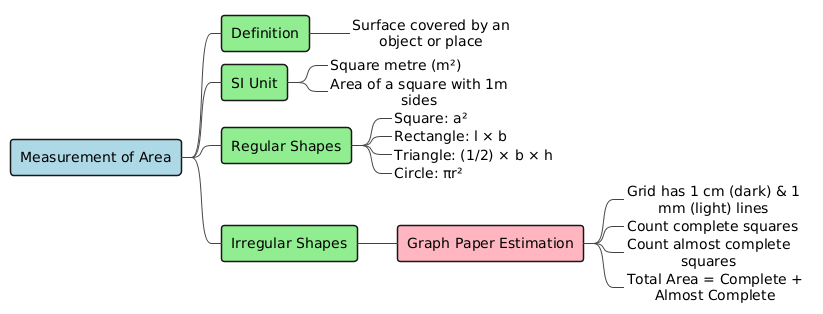
Definition: Area is the amount of surface covered by a flat object or a place.SI Standard Unit: The standard SI unit of area is the square metre (m²), which is the area of a square with each side measuring 1 metre.
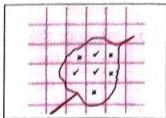
Graph Paper Grid Layout:Divided into 1 cm squares marked by dark lines.Divided into 1 mm squares marked by lighter lines.
Place the irregular object flat on the graph paper.Carefully trace its outline with a pencil.Count the number of complete squares inside the outline.Count the number of almost complete squares (squares that are mostly filled inside the outline).Add the two counts together to find the estimated surface area in square centimetres (cm²).
 Note: This graph paper method only provides an approximate surface area, not an exact measurement.
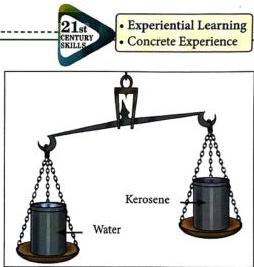
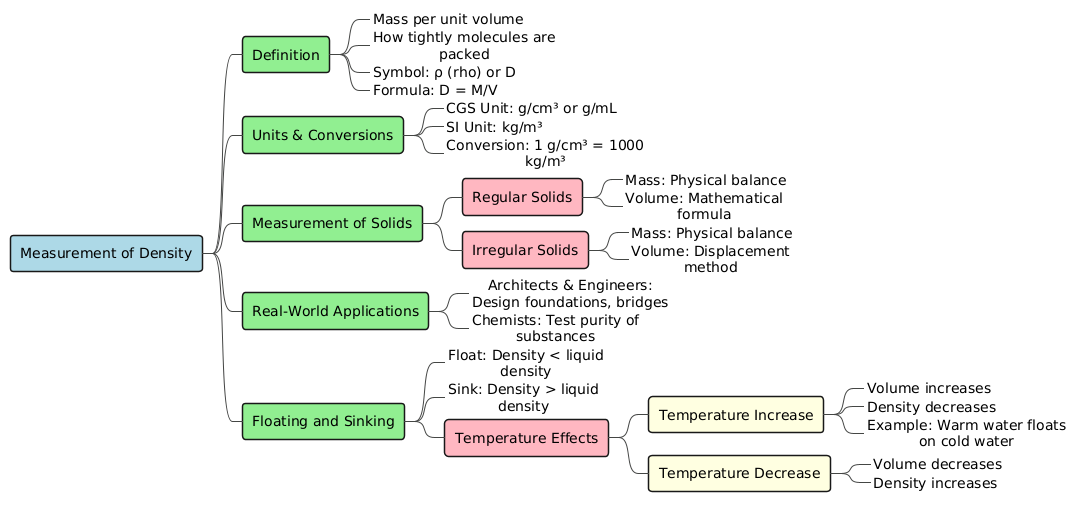
Example 1: 1 kg of iron contains the same mass of matter as 1 kg of peas, but the iron occupies far less volume.Example 2 (Water vs. Kerosene): Two identical glasses filled to the exact same level with water and kerosene will show that the glass of water weighs more. This is because molecules in water are more closely packed than those in kerosene.Definition: Density is defined as the quantity of mass per unit volume of a substance. It depends on how tightly molecules of matter are packed within a given volume.
Symbol: Density is represented by the Greek letter  (rho) or simply
  .Formula:

CGS Unit: grams per cubic centimetre (g/cm³ or g cm⁻³) or grams per millilitre (g/mL).SI Unit: kilograms per cubic metre (kg/m³ or kg m⁻³).Unit Conversion Factor:

Mass (M): Measured using a physical balance.Volume (V): Derived using the geometric formula for that shape (e.g.,  for a cuboid).Calculation: Apply
  .
.
Mass (M): Measured using a physical balance.Volume (V): Found using the liquid displacement method with a graduated cylinder.Calculation: Apply . Use kerosene instead of water if the solid is soluble in water.
Structural Engineering & Architecture: Engineers and architects must understand the density of building materials to design bridges, flyovers, and secure foundations/pillars capable of carrying heavy loads.Purity Testing: Chemists analyze the density of a substance to test its level of purity against standard known densities.
General Rule: Whether an object floats or sinks depends entirely on its density compared to the liquid it is immersed in.An object with a density greater than water ( ) will sink.An object with a density less than water () will float.
Heating (Temperature Increase): When a substance is heated, its molecules move faster and spread apart. This causes its volume to increase, which in turn decreases its overall density.Application: Warm water floats on top of room temperature water because the warm water has a lower density.Cooling (Temperature Decrease): When a substance is cooled, its molecules slow down and get closer together. This causes its volume to decrease, which increases its density.Relative Densities Example: If we have three identical beakers of water at different temperatures:  (Beaker A),
  (Beaker B), and
  (Beaker C):The descending order of their densities is A, C, B (A is the coldest and densest; B is the warmest and least dense).
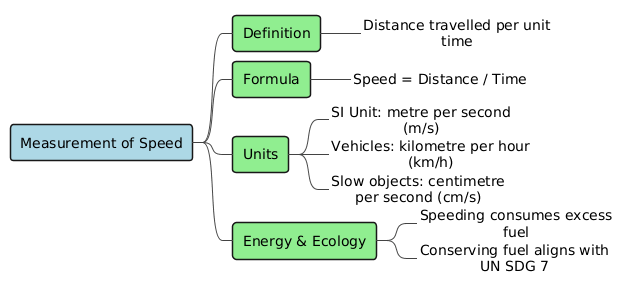
Core Concept: Speed describes how fast an object moves. If two people move for 25 seconds, and the first covers 50 m while the second covers 20 m, the second person moved slower because they covered less distance in the same time.Definition: Speed is defined as the distance travelled by an object per unit time.
SI Standard Unit: Metres per second (m/s).Other Common Units:Kilometre per hour (km/h) - commonly used for vehicles like cars and trains.Centimentre per second (cm/s) - commonly used to express the speed of very slow-moving things.

Share
Explore
 Self Study
Prepared by: learnloophq@gmail.com
Chapter: 01. Physical Quantities And Measurement
PHYSICAL QUANTITIES AND MEASUREMENT
Measurement is defined as the comparison of an unknown physical quantity with a known fixed quantity of a similar nature. This chapter covers the fundamental principles of volume, capacity, area, density, and speed.
1. MEASUREMENT OF VOLUME & CAPACITY
Understanding Volume
Units of Volume and Conversions
Concept of Capacity
Laboratory Apparatus for Measuring Liquid Volume
Various graduated containers of known capacities are used to measure liquid volumes:
Understanding the Meniscus
When a liquid is poured into a container, its surface forms a curved boundary called a meniscus. The method for reading this curve depends on the nature of the liquid:
Concave Meniscus
Convex Meniscus
Volume of Regular Solids
Regular solids have defined geometric shapes, allowing their volume to be calculated using standard mathematical formulae:
Regular Solid
Dimensions Involved
Volume Formula
Cube
Side length (a)
a³
Cuboid
Length (l), Breadth (b), Height (h)
l × b × h
Sphere
Radius (r)
(4/3) × π × r³
Cylinder
Radius (r), Height (h)
π × r² × h
Volume of Irregular Solids (Displacement of Liquid Method)
The volume of irregular solids cannot be calculated using formulas. Instead, the displacement of liquid method is used.
Measurement Procedure (Insoluble Solids)
Special Cases and Practical Tips
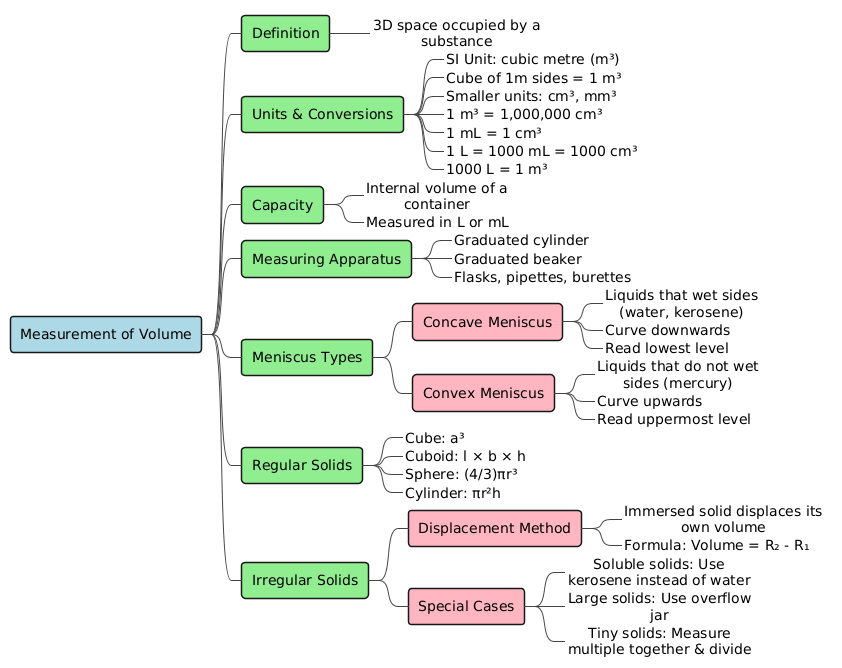
Section 1 Mindmap
2. MEASUREMENT OF AREA
Understanding Area
Area of Regular Shapes
The area of standard geometric shapes is determined using specific mathematical formulas:
Shape
Dimensions Involved
Area Formula
Square
Side (a)
a²
Rectangle
Length (l), Breadth (b)
l × b
Triangle
Base (b), Height (h)
(1/2) × b × h
Circle
Radius (r)
π × r²
Area of Irregular Shapes
Flat objects with irregular borders (e.g., a leaf or a feather) cannot be evaluated using formulas. Instead, their area is estimated using graph paper.
Measurement Procedure
Section 2 Mindmap
3. MEASUREMENT OF DENSITY
Core Concept of Density
Different substances may contain different amounts of matter (mass) even if they occupy the same space, or they may occupy different volumes even if they weigh the same.
Formulas and Symbols
Units of Density and Conversions
Densities of Common Substances (at Standard Conditions)
Substance
Density in kg/m³
Equivalent Density in g/cm³
Gold
19,300
19.3
Copper
8,900
8.9
Brass
8,400
8.4
Aluminium
2,700
2.7
Water
1,000
1.0
Ice
920
0.92
Air
1.20
0.0012
Practical Measurement of Density
To calculate the density of any substance, you must measure its mass and its volume:
1. Density of Regular Solids
2. Density of Irregular Solids
Real-World Engineering and Chemical Applications
Floating vs. Sinking (Density & Temperature Interactions)
The Influence of Temperature on Density
Section 3 Mindmap
4. MEASUREMENT OF SPEED
Understanding Speed
Formula

Units of Speed
Energy Conservation & Speed
Speeding in a motor vehicle requires significantly higher energy. Driving within recommended speed limits conserves fuel, reducing overall emissions and environmental impact. This lines up with the United Nations’ Sustainable Development Goal 7—Affordable and Clean Energy.
Section 4 Mindmap
5. CHAPTER SUMMARY CONCEPT MAP
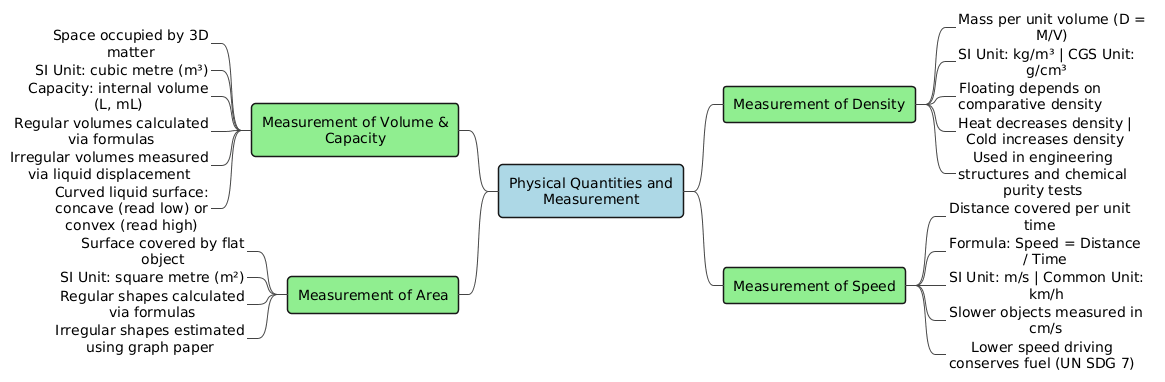
The following unified mindmap acts as a comprehensive study summary covering all core topics of the chapter: volume, area, density, and speed.
Want to print your doc?
This is not the way.
This is not the way.

Try clicking the ··· in the right corner or using a keyboard shortcut (
CtrlP
) instead.