Skip to content
Timeframe of Medieval India: The Medieval Period in India stretches roughly from the 8th to the mid-18th centuries CE.Key External Influences: For a comprehensive understanding of Indian history during this period, it is necessary to study the countries that influenced it. The major regions influencing Indian history were:West AsiaCentral AsiaEurope

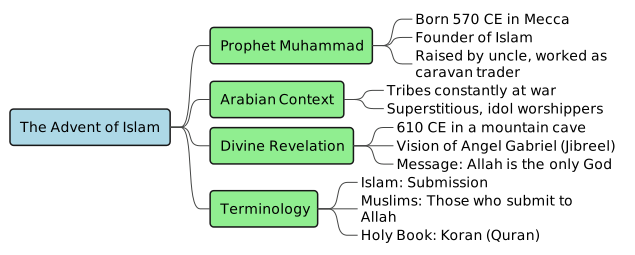
Birth of Prophet Muhammad: Born in 570 CE in Mecca, a small town in Arabia. He was the founder of Islam.Early Life of the Prophet:He was orphaned at a very early age and raised by his uncle.He worked in his uncle’s trading business, travelling far and wide with merchant caravans.His travels brought him into contact with Christians and Jews, whose religious beliefs and practices impressed him.State of Pre-Islamic Arabia:The Arabs were divided into numerous tribes that were constantly at war with each other.People lived hard, impoverished lives.They were superstitious and worshipped images of numerous gods (idol worship).The Divine Message (610 CE):Around 610 CE, while praying and meditating in a cave in the mountains, Muhammad had a vision of Angel Gabriel (Jibreel).The angel revealed God’s divine message to him.Muhammad carried the word of God (Allah) to the people of Mecca, declaring that Allah was the one and only God and Muhammad was His Prophet.Meaning of Terminology:Islam: Means submission.Muslims: Those who submit to the will of Allah.Koran (Quran): The holy book of the Muslims containing the recorded teachings of Muhammad.
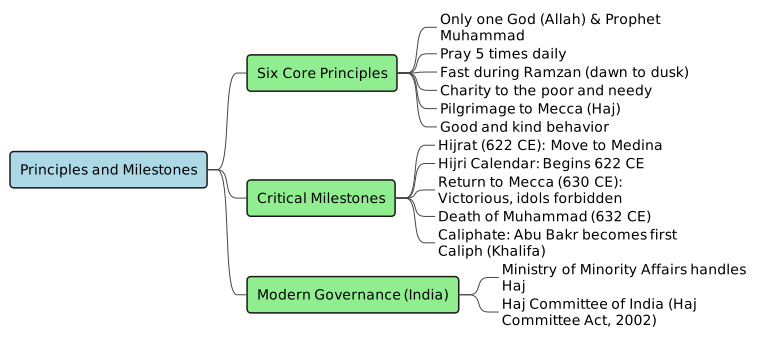
Monotheism: There is only one God (Allah) and Muhammad is His Prophet.Daily Prayer: Muslims must pray five times a day.Fasting: They must fast from dawn to dusk during the holy month of Ramzan (also known as Ramadan).Charity: They must help the poor and needy, and give away a portion of their wealth in charity.Pilgrimage (Haj): They must make a pilgrimage to Mecca at least once in their lifetime.Good Conduct: They must be good and kind to others.
Prohibition of Idols: Muhammad strictly forbade idol worship and emphasized kind behaviour. This angered the wealthy Arabs of Mecca.The Hijrat (622 CE): Due to opposition in Mecca, Muhammad and his small band of followers shifted to Medina in 622 CE. This migration is known as Hijrat.The Islamic Calendar (Hijri): The Muslim calendar, the Hijri, begins from the year of the Hijrat (622 CE).Return to Mecca (630 CE): Within ten years, Muhammad gathered strong support, including a devoted army. In 630 CE, he returned to Mecca victorious, forgave his enemies, and the people of Mecca adopted Islam. Mecca and Medina thus became the two holy places of Islam.Establishment of the Caliphate (632 CE):Prophet Muhammad died in 632 CE, by which time all of Arabia had converted to Islam.Abu Bakr, his faithful friend and follower, was chosen as his successor.He took the title of Caliph or Khalifa (meaning successor of the Prophet), becoming both the religious and political leader of the Muslim community.
Nodal Ministry: The Ministry of Minority Affairs is the nodal ministry created to conduct the Haj pilgrimage in India.Haj Committee: The pilgrimage for Indian pilgrims is organized mainly through the Haj Committee of India, a statutory body set up under the provisions of the Haj Committee Act, 2002.
Goal 16 (Peace, Justice and Strong Institutions): Compassion, empathy, and welfare are the core values of all major religions. Together with peace and justice, they create a solid foundation for sustainable and strong institutions in present times.
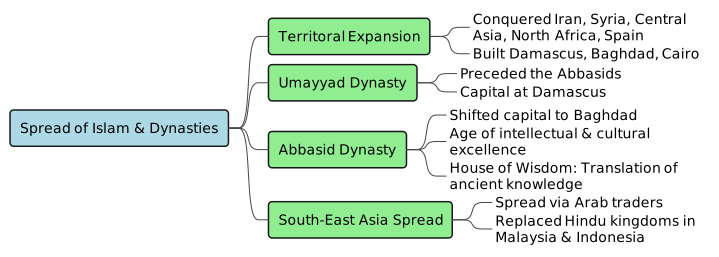
Abu Bakr transformed and mobilized the Arabs into an extraordinary, disciplined fighting force.Driven by missionary zeal, these invincible Arab armies conquered vast territories, creating an empire that stretched over:IranSyriaCentral AsiaNorth AfricaSpainThe warriors settled down, built magnificent cities like Damascus, Baghdad, and Cairo, and advanced agriculture, industry, and trade.
The Umayyad Caliphs: Preceded the Abbasids and established their capital at Damascus.The Abbasid Caliphs:Shifted the capital of the Caliphate from Damascus to Baghdad (the capital of present-day Iraq).Under their rule (for the next 150 years), the Arab empire reached its peak of power, prosperity, and intellectual enlightenment.They actively absorbed, translated, and assimilated ideas, skills, and scientific knowledge from other world cultures.
Following Prophet Muhammad’s advice to pursue learning, an Abbasid Caliph established the House of Wisdom in Baghdad.This institution was dedicated to translating the collective scientific, mathematical, and philosophical works of ancient civilizations into Arabic.Baghdad became the repository and preserve of the rich cultural heritage of the ancient world.
Islam spread to South-East Asia primarily through Arab traders.Consequently, the old Hindu kingdoms of Malaysia and Indonesia declined and were replaced by Muslim dynasties, causing Indian influence in these regions to gradually wane.
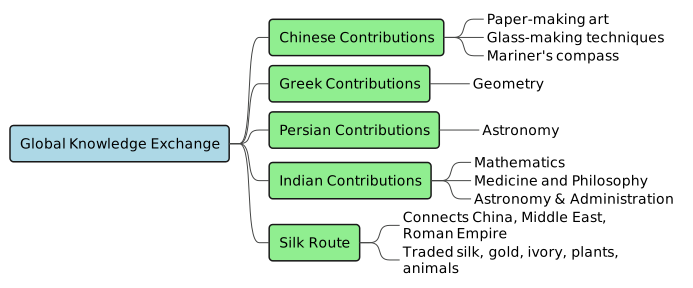
The Silk Route (or Silk Road) was an ancient trade route connecting China with the Middle East and the Roman Empire.It was not used solely for trading silk; a wide variety of commodities were exchanged, including gold, ivory, exotic plants, and animals.
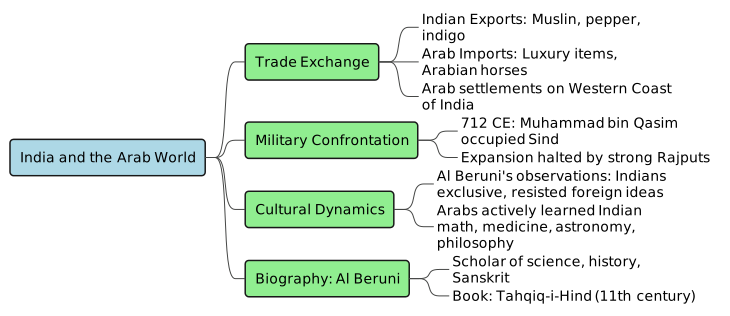
The Arabs established several trade settlements along the western coast of India. Many Arab traders intermarried and settled in India.Indian traders utilized Arab merchant ships to transport Indian goods to the Western world.Trade Exchanges:Indian Exports to Arabs: Muslin, pepper, indigo.Arab Imports to India: Luxury items and fine Arabian horses.
In 712 CE, an Arab military expedition led by Muhammad bin Qasim defeated the ruler of Sind and occupied the province.The Arab expansion into other parts of India was halted because the Rajputs were too strong for them.The occupation of Sind ended with the death of Muhammad bin Qasim.
According to the famous medieval Muslim scholar, Al Beruni, the Indians possessed a “spirit of exclusiveness.” He observed that Indians believed no other country on earth had any knowledge of science but theirs. This made them generally unreceptive to Arab learning and foreign cultural influences.Conversely, the Arabs learned extensively from India, assimilating Indian achievements in mathematics, medicine, astronomy, philosophy, and administration.
Profile: One of the most outstanding scholars of the medieval world, well-versed in mathematics, astronomy, geography, history, medicine, physics, chemistry, psychology, philosophy, and theology.Linguistic Skills: A gifted linguist who spoke many classical languages, including Sanskrit.Literary Work: He authored the famous book Tahqiq-i-Hind (History of India), which is a valuable 11th-century foreign source of historical information about Indian culture and science.
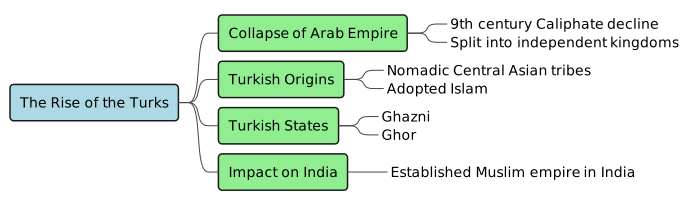
Decline of the Caliphs: By the 9th century CE, the power of the Caliphate declined, causing the vast Arab empire to split into multiple independent kingdoms.Origin of the Turks: The Turks were originally nomadic tribes of Central Asia who adopted Islam as their religion.Turkish States: They established two prominent independent states in Central Asia:GhazniGhorImpact on India: It was the Turks who eventually successfully established a Muslim empire in India.
India is a land of diverse cultures. Respecting different cultures and attempting to absorb and assimilate the best of what other cultures offer in terms of ideas, skills, and knowledge helps to enrich lives.
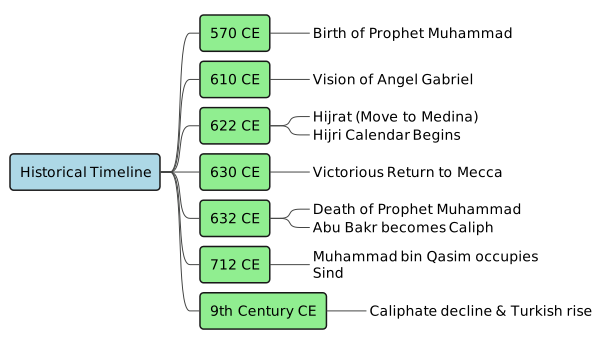
570 CE: Birth of Prophet Muhammad in Mecca.610 CE: Prophet Muhammad’s vision of Angel Gabriel (Jibreel) and commencement of the divine message.622 CE: The Hijrat (Muhammad moves to Medina); start of the Muslim Hijri calendar.630 CE: Victorious return of Muhammad to Mecca.632 CE: Death of Prophet Muhammad; Abu Bakr selected as the first Caliph.712 CE: Arab expedition under Muhammad bin Qasim occupies Sind.9th Century CE: Power of Caliphs declines; Arab empire splits; rise of independent Turkish states (Ghazni and Ghor).

Share
Explore
 Self Study
Prepared by: learnloophq@gmail.com
Chapter: 03. Birth Of Prophet Muhammad And Spread Of Islam
Birth of Prophet Muhammad and Spread of Islam

Introduction to the Medieval Period and Influences
The Advent of Islam
Main Principles and Milestones of Islam
Six Core Principles of Islam
Historical Milestones and the Caliphate
Important Terms
Term
Historical Definition
Mecca
A town in Arabia where Prophet Muhammad was born; the primary holy place for Muslims.
Medina
The town to which Prophet Muhammad and his followers migrated in 622 CE.
Hijrat
The departure of Prophet Muhammad from Mecca to Medina in 622 CE.
Hijri
The Muslim calendar, which marks its beginning year from 622 CE.
Abu Bakr
Faithful friend and follower of Prophet Muhammad, selected as the first Caliph.
Caliph / Khalifa
Title given to the religious and political head of the medieval Muslim community.
Knowledge of India: Haj Pilgrimage in Modern Times
Sustainable Development Goals (SDGs) Connection
The Spread of Islam and Key Dynasties

Expansion under the Early Caliphs
The Umayyad and Abbasid Dynasties
The Pursuit of Knowledge and the House of Wisdom

Spread to South-East Asia
Absorption and Exchange of Global Knowledge

Arab scholars actively absorbed ideas and advanced skills from various ancient civilizations:
Civilizations
Knowledge Absorbed & Assimilated by Arab Scholars
Chinese
Art of making paper, technique of making glass, use of the mariner’s compass.
Greeks
Geometry.
Persians
Astronomy.
Indians
Mathematical theories, medicine, astronomy, philosophy, and administration.
Did You Know? The Silk Route
India and the Arab World
Trade Relations
Military Confrontation (712 CE)
Cultural Exchange and Al Beruni’s Observations
Biography: Al Beruni

The Turks
Values and Life Skills: Cultural Assimilation
Timeline of Key Historical Events
The following chronological sequence maps the birth and spread of Islam from 500 CE to 800 CE and beyond:

Overview Flowchart: Advent of Islam

Want to print your doc?
This is not the way.
This is not the way.

Try clicking the ··· in the right corner or using a keyboard shortcut (
CtrlP
) instead.