Skip to content
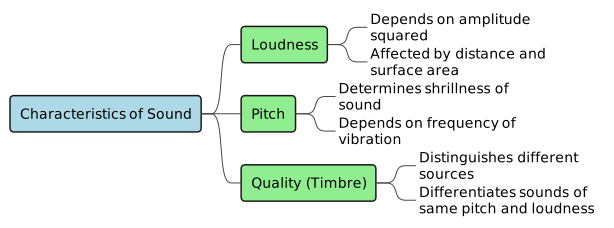
Discuss the three main characteristics of sound and the factors that influence them.The three primary characteristics that distinguish one sound from another are loudness, pitch, and quality or timbre. Loudness depends directly on the amplitude of the vibration, the distance from the source, the surface area of the vibrating body, and the sensitivity of the listener’s ear. Pitch is determined by the frequency of the vibration, where high frequency leads to a shrill sound and low frequency produces a flat sound. Quality or timbre is the unique characteristic that allows us to recognize and distinguish between different sound sources even when they share the same loudness and pitch.
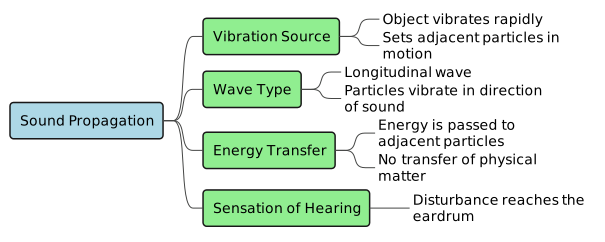
 Explain how sound is produced and how it propagates through a medium as a longitudinal wave.Sound is produced when an object vibrates, setting the adjacent particles in the surrounding medium into vibratory motion. As these particles move back and forth, they transfer energy to neighboring particles without carrying the actual matter along with them. This continuous transfer of energy in the same direction as the wave’s propagation constitutes a longitudinal wave. Eventually, these vibrations reach the human ear, striking the eardrum to produce the physical sensation of hearing.
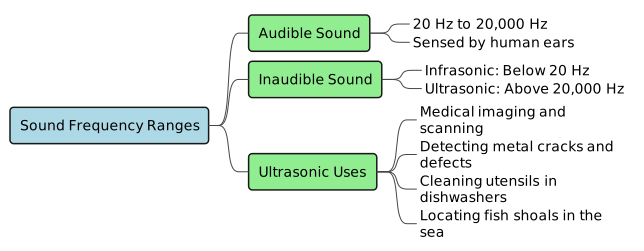
 Define audible and inaudible sounds, and outline several practical applications of ultrasonic waves.Audible sounds are those within the frequency range of 20 Hz to 20,000 Hz, which can be perceived by the human ear. Inaudible sounds fall outside this range, consisting of infrasonic sounds below 20 Hz and ultrasonic sounds above 20,000 Hz. Ultrasonic sounds have many valuable applications, such as diagnostic medical imaging and relieving pain in muscles or joints. They are also widely utilized to detect cracks in metal blocks, clean utensils in dishwashers, and help fishermen locate shoals of fish in the sea.
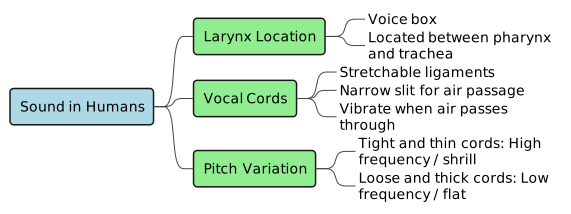
 Describe the mechanism of sound production in human beings and how the pitch of the voice changes.Humans produce sound using an organ called the larynx or voice box, which is located between the pharynx and the trachea. The larynx contains a pair of stretchable ligaments known as vocal cords, with a narrow slit between them for the passage of air. When air from the lungs is forced through this slit, the vocal cords vibrate to produce sound. The muscles attached to these cords can stretch or loosen them, where tight and thin cords produce a high-frequency shrill voice, while loose and thick cords produce a low-frequency flat voice.
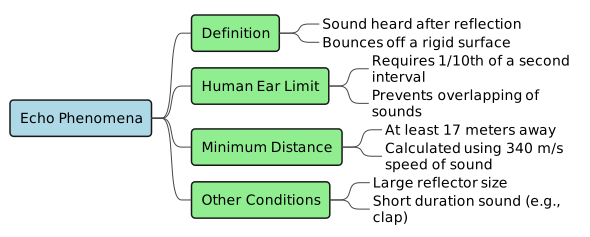
 Explain what an echo is and detail the conditions necessary for an observer to hear a distinct echo.An echo is a reflected sound that is heard by an observer after striking a rigid, distant surface. To hear a distinct echo, there must be a minimum time interval of 1/10th of a second between the original sound and the reflected sound so they do not overlap in the human ear. Based on the speed of sound in air being approximately 340 m/s, the reflecting surface must be located at a minimum distance of 17 meters from the source. Additionally, the reflecting surface must be sufficiently large, and the original sound must be of very short duration, such as a clap.

Share
Explore
 Answer key
Prepared by: learnloophq@gmail.com
Chapter: 06. Sound
Want to print your doc?
This is not the way.
This is not the way.

Try clicking the ··· in the right corner or using a keyboard shortcut (
CtrlP
) instead.