Skip to content
Accession: Akbar was proclaimed emperor in 1556 CE at the age of 13, following the accidental death of his father, Humayun.Reign: Ruled for 50 years (1556–1605 CE), establishing himself as one of the greatest rulers in medieval Indian history.Regency of Bairam Khan (1556–1560 CE):Humayun’s faithful general, Bairam Khan, acted as Akbar’s regent and managed state affairs.During this period, state forces conquered Gwalior, Ajmer, and Jaipur, while Akbar participated in royal pursuits (polo, hunting, camel riding).In 1560 CE, at the age of 18, Akbar dismissed Bairam Khan and assumed absolute authority.Initial Security Threats:Adil Shah: Nephew of Sher Shah, seeking to restore Afghan rule.The Rajputs: Growing in power and seeking to expel the Mughals.Kabul: Occupied and ruled independently by Akbar’s half-brother.
Second Battle of Panipat (November 1556 CE):Opponent: Hemu, the military genius, chief minister, and general of Adil Shah who had captured Delhi and Agra.Outcome: Bairam Khan led the Mughal forces to victory; Hemu was defeated and killed.Significance: Crushed Afghan power and secured the Mughal throne.Expansion Campaigns:Central India:Malwa (1561 CE): Ruler Baz Bahadur was defeated (later given a post in Akbar’s court).Gondwana (1564 CE): Conquered and later restored to its local ruler.Gujarat (1572 CE): Annexed due to its thriving agricultural and trade status.Bengal (1574–1576 CE): Rich and fertile province annexed after a two-year campaign.North-West Campaigns (1585–1595 CE): Conquered Kashmir, Kandahar, Lower Sind, and Eastern Balochistan, securing the north-west frontier.Deccan Campaigns (by 1601 CE): Annexed Berar, Khandesh, and parts of Ahmadnagar.
Strategic Objective: Akbar realized Rajput support was crucial to build and maintain a large, stable empire. He treated them with honor and equality.Matrimonial Alliances: Married the daughter of the Raja of Amber (Jaipur)—who became the mother of Jahangir—and married several other Rajput princesses.Administrative Appointments: Appointed Rajputs to high offices of trust (e.g., Raja Man Singh was made a military commander and provincial viceroy).Suzerainty & Autonomy: Did not annex the kingdoms of defeated Rajput rulers; they retained their lands provided they acknowledged Akbar as overlord and paid regular tribute.Conflict with Mewar:Rana Udai Singh: Rejected Akbar’s matrimonial alliance and submission.Akbar besieged the capital, Chittor.Udai Singh fled to the hills, leaving defense to commander Jai Mal.After Jai Mal was killed, Rajput women performed jauhar, and the remaining soldiers perished fighting.Chittor and Ranthambore fell; by 1570 CE, most Rajput princes accepted Akbar’s overlordship.Rana Pratap Singh: Continued the struggle from a new capital, Udaipur.Battle of Haldighati (1576 CE): Rana Pratap’s outnumbered forces clashed with the Mughal army (led by Raja Man Singh of Amber).Rana Pratap was defeated; his wounded horse, Chetak, carried him to safety before dying. Rana Pratap waged lifelong guerrilla warfare, recovering parts of Mewar but not Chittor.
Absolute Authority: The Emperor held final military, political, administrative, and judicial powers. His word was law.Audience Halls:Diwan-i-Khas: Private audience hall for regular meetings with senior officers.Diwan-i-Aam: Common audience hall to receive public petitions and deliver on-the-spot justice.Council of Ministers:Wazir / Diwan: Head of the revenue department.Mir Bakshi: Head of the military department and paymaster of the mansabdars.Chief Sadr / Qazi: Chief judge of the empire.Mir Saman: Supervisor of the royal household.Vakil: Prime minister (reduced by Akbar to an advisory, ceremonial head).
Subas: The empire was divided into 15 provinces (subas), each ruled by a governor called a subedar (handling civil and military affairs).Diwan: Kept records of the land revenue in the suba and acted as a check on the subedar.Sub-divisions:Subas  Sarkars (Districts) Parganas Villages (managed by village panchayats).
Mansab: Meaning office or rank. A mansabdar held a specific rank in civil/military administration.Ranks: Ranged from an officer of 10 horsemen to 7,000 horsemen (highest ranks reserved for the royal family).Remuneration: Paid via cash salaries or jagirs (assignments of land revenue).Non-hereditary: Ranks were not hereditary; upon a mansabdar’s death, the jagir reverted to the crown. Mansabdars had no administrative rights over their jagir lands.Military Efficiency: Introduced horse-branding (dagh) and maintaining descriptive rolls of soldiers (chehra). Akbar maintained a standing army, royal bodyguards, war elephants, and artillery.
Reforms: Spearheaded by revenue minister Raja Todar Mal, building on Sher Shah’s basic structure.Survey & Measurement: Land was measured using a bamboo jarib joined by iron rings (replacing hemp rope).Classification: Grouped into four categories based on cultivation frequency, and further classified into good, middling, and bad.Tax Calculation: Tax was fixed at one-third (1/3) of the average produce calculated over the past 10 years. Cash payment was preferred.Peasant Welfare: Loans were offered in easy installments for seeds, cattle, and tools. Revenue was waived (remission) during droughts or floods.Trade and Currency: Exported textiles, spices, indigo, and saltpetre. Akbar issued the mohur (a pure gold coin of standard weight), alongside silver and copper coins.
Tax Abolitions: Abolished the jizya (poll tax on non-Muslims) and the pilgrim tax on Hindus visiting holy sites.Freedom of Worship: Allowed Hindus to build temples, celebrate festivals (Holi, Diwali), and gave land grants to all religions.Ibadat Khana (1575 CE): Built at his capital, Fatehpur Sikri, as a hall of prayer for discussions among scholars of all faiths (Muslim, Hindu, Sikh, Buddhist, Jain, Parsee, Christian).The Mahzar (1579 CE): A declaration making Akbar the supreme and final authority in interpreting Islamic law, consolidating power over the ulemas.Din-i-Ilahi (1582 CE):A new religious order based on Sulh-i-Kul (universal peace).Blended ethical ideas from major religions; emphasized belief in one God and the emperor as God’s representative.No sacred books, priestly classes, places of worship, or rituals.Highly unpopular outside the court; Birbal was the only Hindu courtier to join. Ended with Akbar’s death.
Social Reforms: Prohibited forced sati (except where voluntary), legalized widow remarriage, and discouraged child marriage by raising the minimum age to 14 for girls and 16 for boys.Educational Reforms: Shifted focus from purely religious scriptures to secular subjects like mathematics, agriculture, logic, history, and astronomy.Translation Department: Established to translate major texts (Vedas, Mahabharata, Bhagavad Gita, Bible) into Persian.
Abul Fazl (Writer/Historian)Faizi (Poet)Birbal (Constant companion/Kavi Raj)Todar Mal (Revenue Minister)Raja Man Singh (Military Commander)Raja Bhagwan Das / Raja Birbal Das (Nobles/Commanders)Fakir Aziao-Din (Advisor)Mullah Do Piyaza (Advisor)Tansen (Musician)

Share
Explore
 Recap Hub
Prepared by: learnloophq@gmail.com
Chapter: 09. Akbar
Theme 5: The Mughal Empire — Akbar (Revision Crash Course)
1. Introduction & Early Years
2. Military Conquests and Expansion
3. Rajput Policy and Conflicts
4. Administrative Structure
Central Administration
Provincial Administration
5. Military & Revenue Systems
The Mansabdari System
Revenue System (Todar Mal’s Bandobast)
6. Religious and Social Policies
Religious Tolerance
Social and Educational Reforms
7. Cultural Achievements
Domain
Key Contributions & Figures
Language & Literature
Court language was Persian. Abul Fazl wrote the Akbarnama (historical account) and Ain-i-Akbari. Faizi served as the poet laureate. Hindi was also patronized; Birbal was named Hindi Kavi Raj. Tulsidas wrote the Ramacharitamanas.
Painting
Main contribution was the development of miniature paintings illustrating royal manuscripts in the imperial library.
Architecture
Transitioned from Persian style (e.g., Humayun’s Tomb) to a blend of Rajput and Indian traditions. Major structures: Agra Fort (red sandstone), and buildings at Fatehpur Sikri (“dream in stone”) including the Diwan-i-Khas, Panch Mahal, Jodha Bai’s Palace, and Buland Darwaza.
Music
Tansen was the most famous court musician. He composed new ragas and enriched Hindustani music by combining Persian and Indian styles.
The Nine Gems (Navratnas)
Akbar’s court was adorned by nine illustrious scholars, artists, and ministers:
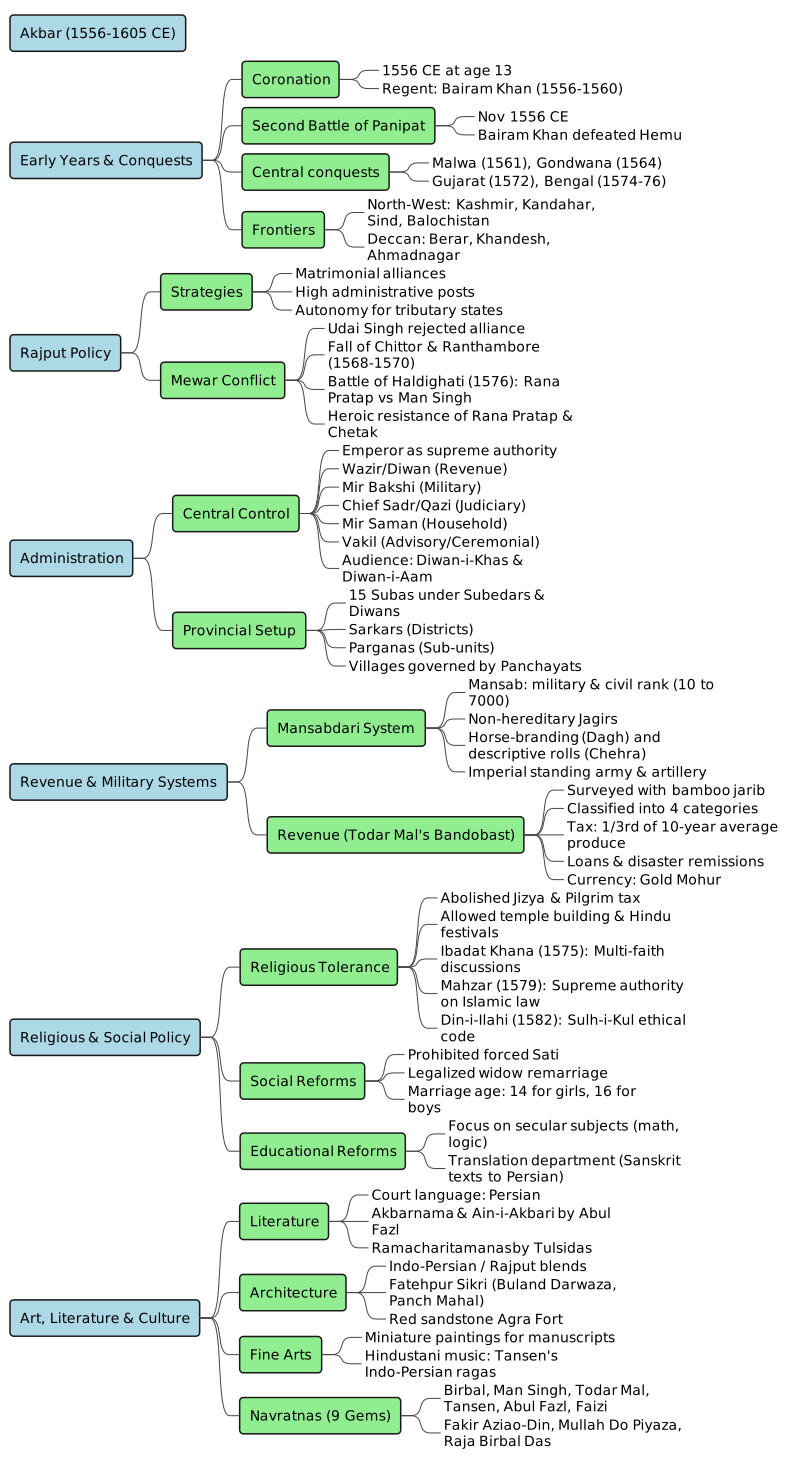
PlantUML Mindmap
Want to print your doc?
This is not the way.
This is not the way.

Try clicking the ··· in the right corner or using a keyboard shortcut (
CtrlP
) instead.