Skip to content
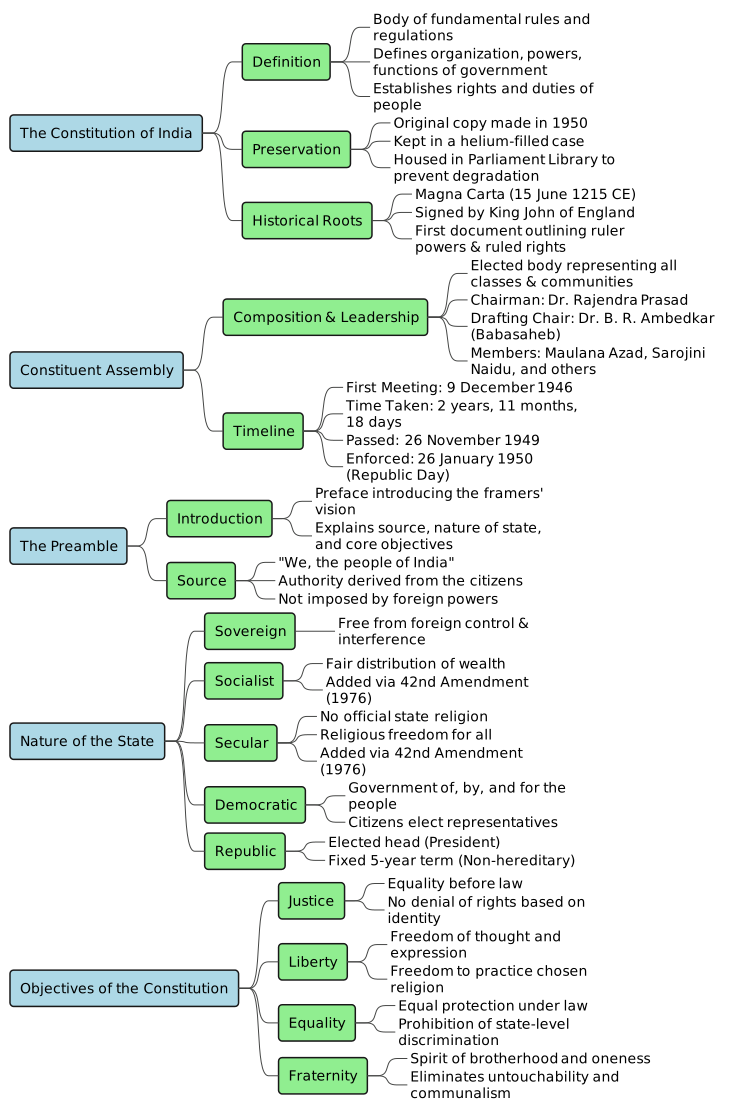
Definition: The Constitution is a body of fundamental rules and regulations according to which a country is organized and governed.Purpose:Defines and clearly mentions the organization, powers, and functions of the government.Establishes the rights and duties of the citizens.Preservation:The original 1950 copy of the Constitution of India is preserved in a special helium-filled case.It is kept in the Library of the Parliament of India to prevent discoloration and time-related degradation.
Magna Carta (The Great Charter): Signed on 15 June 1215 CE by King John of England. It was the world’s first written document outlining the powers of rulers and the rights of the ruled. Many global democracies base their constitutions on its salient features.
The Source of the Constitution.The Nature of the State.The Main Objectives of the State.
“We, the people of India”: This opening phrase indicates that the ultimate authority of the Government of India is derived from its citizens. The Constitution reflects the collective wishes of the people and is not imposed by any external or foreign power.
Sovereign: India is completely independent and free from any foreign control or interference in its internal and external affairs.Socialist (Added via the 42nd Amendment Act in 1976): Aims to achieve fair distribution of national wealth and provide equal opportunities to bridge the gap between the rich and the poor.Secular (Added via the 42nd Amendment Act in 1976):The state does not have an official or state religion.No discrimination is made on religious grounds.The state does not favor or promote any specific religion.Guarantees freedom to profess, practice, and propagate any religion.Democratic: The power to govern lies with the people, who elect representatives of their choice through elections.Republic: The head of the state is an elected official (the President, serving a fixed term of 5 years) and not a hereditary monarch or dictator.
Justice: All citizens are equal before the law. No individual can be denied justice based on place of birth, race, caste, creed, sex, status, or religion.Liberty: Citizens enjoy fundamental freedoms, including the freedom to think, express themselves, and practice their chosen religion.Equality: The state protects all citizens equally and prohibits discrimination based on birth, sex, caste, creed, race, religion, or wealth.Fraternity: Promotes a spirit of brotherhood and oneness among all diverse communities. It aims to eliminate social evils like untouchability and communalism, paving the way for national progress and harmony.
Role: Chairman of the Drafting Committee.Title: ‘Father of the Indian Constitution’.Vision: Aimed to eradicate social and economic inequalities and secure opportunities for India’s oppressed classes.
Sustainable Development Goal 16: Peace, Justice, and Strong Institutions.Indian Context: As the longest written constitution of any sovereign state, the Constitution of India incorporates global constitutional virtues to build a society rooted in equality, equity, and justice.

Share
Explore
 Recap Hub
Prepared by: learnloophq@gmail.com
Chapter: 12. The Constitution And The Preamble
CHAPTER REVISION CRASH COURSE: THE CONSTITUTION AND THE PREAMBLE
1. Introduction to the Constitution
2. The Constituent Assembly
The Constitution of India was framed by the Constituent Assembly, an elected body representing all communities, classes, and diverse shades of opinion.
Feature
Key Details
Chairman
Dr. Rajendra Prasad
Drafting Committee Chairman
Dr. B. R. Ambedkar (known as ‘Babasaheb’ and the ‘Father of the Indian Constitution’)
Other Prominent Members
Maulana Azad, Sarojini Naidu, and others
First Meeting
9 December 1946
Time Taken to Complete
2 years, 11 months, and 18 days
Date Passed
26 November 1949
Date of Enforcement
26 January 1950 (Celebrated annually as Republic Day)
Historical Context & Roots of Constitutions
3. The Preamble
The Preamble is the introduction to the Constitution. It outlines three main aspects:
A. Source of the Constitution
B. Nature of the State
┌── Sovereign (Independent, free from external control)
├── Socialist (Fair wealth distribution; added in 1976)
NATURE OF THE STATE ├── Secular (No state religion, religious freedom; added in 1976)
├── Democratic (Government of, by, and for the people)
└── Republic (Elected head of state / President with 5-year term)
C. Objectives of the Constitution
4. Key Thinker Spotlight: Dr. B. R. Ambedkar
5. Global Linkages: SDG Goal 16
Complete Chapter Mindmap
Want to print your doc?
This is not the way.
This is not the way.

Try clicking the ··· in the right corner or using a keyboard shortcut (
CtrlP
) instead.