Skip to content
The magnetic force of a magnet is always maximum at its _ _ _ _ _ _ _ _ _ _ _ _ _ _._ _ _ _ _ _ _ _ _ _ _ _ _ _ is the surest test of magnetism because only a magnet can experience this effect from another magnet.An electromagnet consists of a soft iron piece, called the _ _ _ _ _ _ _ _ _ _ _ _ _ _, on which an insulated copper wire is wound in a coil.The current produced in a conductor by the method of electromagnetic induction is called _ _ _ _ _ _ _ _ _ _ _ _ _ _.
When the push button switch of an electric bell is pressed, the electromagnet becomes demagnetized. [ ]Permanent magnets are usually made of soft materials and lose their magnetism easily. [ ]The end of the electromagnet where the current flows in a clockwise direction acts as the south pole. [ ]In Faraday’s experiment, a current is induced in the coil only when there is relative motion between the coil and the magnet. [ ]
ElectromagnetElectromagnetismElectromagnetic induction
What happens to the iron nail when the switch is turned on and electric current flows through the coil?What will happen to the paper clips when the switch is turned off? Explain why based on the properties of temporary magnets.
Why is repulsion, and not attraction, considered the surest test of magnetism?State two factors on which the strength of an electromagnet depends.In Faraday’s experiment, what happens to the galvanometer needle when the magnet is moved away from the coil?
Describe the construction and step-by-step working of an electric bell. Explain how the automatic break and restoration of the electrical circuit occur.State Faraday’s two laws of electromagnetic induction. Additionally, list three distinct ways to increase the magnitude of the induced current in a coil.

Share
Explore
 Question Paper
Prepared by: learnloophq@gmail.com
Chapter: 08. Magnetism
SECTION A: MULTIPLE CHOICE QUESTIONS (MCQs)
1. Which of the following is a naturally occurring magnet found in the Earth?
a. Cylindrical magnet
b. Magnetite (Fe₃O₄)
c. Horseshoe magnet
d. Bar magnet
2. What happens when a bar magnet is broken repeatedly into smaller pieces?
a. The poles get separated, resulting in isolated single poles.
b. The pieces completely lose their magnetic properties.
c. Each broken part turns into a complete magnet with its own north and south poles.
d. The pieces only retain the north pole.
3. Which of the following is classified as a non-magnetic material in the text?
a. Steel
b. Cobalt
c. Brass
d. Nickel
4. In Faraday’s experiment, when the magnet is completely inside the coil but kept stationary (not moving), the galvanometer reading is:
a. Zero
b. Maximum deflection to the right
c. Maximum deflection to the left
d. Fluctuating continuously
5. The strength of an electromagnet is directly proportional to:
a. The distance between the coil and the magnet
b. The thickness of the soft iron core
c. The amount of electric current flowing through the coil
d. The length of the copper wire outside the circuit
SECTION B: FILL IN THE BLANKS
SECTION C: TRUE OR FALSE QUESTIONS
SECTION D: EXPLANATION OF TERMS
Define the following terms in one or two sentences:
SECTION E: DIFFERENTIATE BETWEEN CONCEPTS
1. Differentiate between Permanent Magnets and Temporary Magnets by completing the table below:
Feature
Permanent Magnets
Temporary Magnets
Magnetic Retention
Type of Material Used
Examples
SECTION F: DIAGRAM-BASED QUESTIONS
A simple circuit diagram demonstrating how to make an electromagnet.
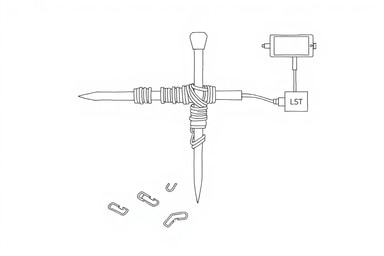
Based on the diagram above, answer the following questions:
SECTION G: SHORT ANSWER QUESTIONS
SECTION H: ENVIRONMENTAL AWARENESS & EVERYDAY USE
1." List four everyday applications or appliances that make use of electromagnets.
2. Based on the “Prepping for PISA”" passage, why are MRI scans preferred over CT scans when diagnosing certain soft tissue conditions, and what is one safety concern associated with MRI scans?
SECTION I: LONG ANSWER QUESTIONS
Want to print your doc?
This is not the way.
This is not the way.

Try clicking the ··· in the right corner or using a keyboard shortcut (
CtrlP
) instead.