Skip to content
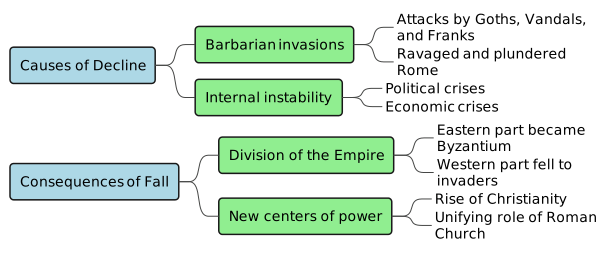
The mighty Roman Empire began to disintegrate by the end of the 5th century CE due to repeated barbarian invasions by Germanic tribes such as the Goths, the Vandals, and the Franks. These invaders penetrated deep into Roman territory, plundering and ravaging cities, including the magnificent city of Rome itself. Along with these external raids, severe political and economic crises within the empire further accelerated its downfall. Consequently, in 395 CE, the empire was divided into the western part, which fell to these tribes, and the resilient eastern part known as Byzantium. As the political unity of Western Europe dissolved, Christianity and the Roman Church emerged as the primary unifying factors.
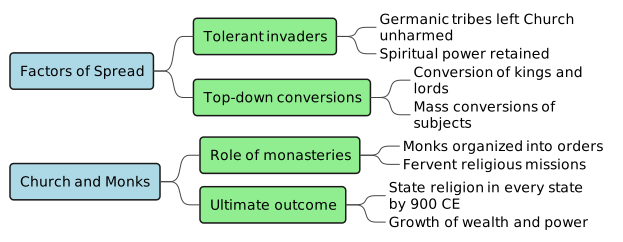
In 400 CE, the majority of the European population consisted of non-Christians, but within five hundred years, most of Europe had converted to Christianity. A major factor was that the invading Germanic tribes left the Church of Rome unharmed, allowing it to retain its spiritual power. Additionally, the conversion of kings and feudal lords played a crucial role, as their conversions were typically followed by the mass conversion of their subjects. Dedicated Christian monks, fueled by religious fervor, organized themselves into orders and established monasteries to actively pursue their religious missions. Consequently, by 900 CE, Christianity had successfully established itself as the state religion in every European state.
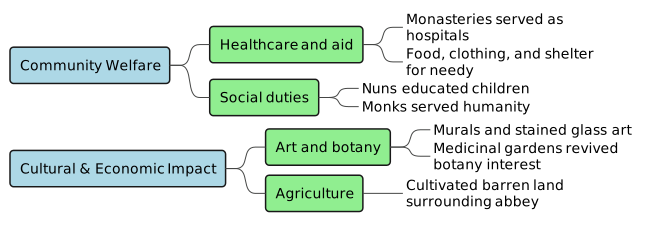
Monasteries played an incredibly vital role in medieval Europe by serving as key centers of welfare, education, and culture. The resident monks and nuns actively helped the community by educating children, treating the sick in attached hospitals, and providing food, clothing, and shelter to the needy. They also contributed to the economy by bringing barren lands around the monasteries under cultivation to make them highly productive. Furthermore, monasteries fostered artistic growth through the development of architecture, woodcarving, mural painting, and stained glass painting. Finally, by growing medicinal herbs in their gardens, they revived a strong interest in the field of botany.
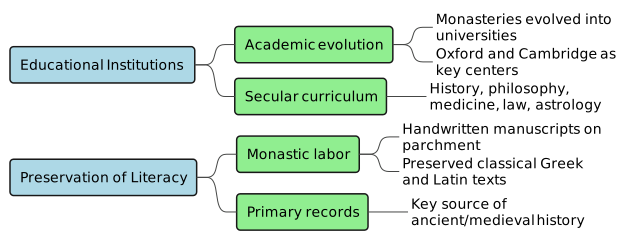
The greatest contribution of medieval Christian monasteries lay in the field of education, as they evolved into major centers of academic scholarship and learning. Many of these monastic institutions eventually developed into globally renowned secular universities, such as Oxford and Cambridge. In these universities, students were taught not only religious texts but also secular subjects including history, philosophy, medicine, law, and astrology. Since the printing press and paper were not yet invented, the monks meticulously hand-copied books onto parchment. These copied works, including the Bible and classical Greek and Latin texts, became invaluable historical sources of ancient and medieval European knowledge.
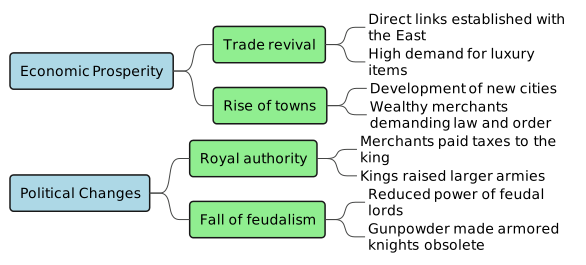
Although the Crusades failed to achieve their primary objective of reclaiming the holy land, they brought transformative changes to Europe’s economy and political structure. Direct trade contacts with the East were re-established as Europeans developed a taste for Eastern luxury goods, causing the European economy to flourish. The increased trade led to the establishment of many new towns and cities inhabited by merchants who demanded better law and order. These merchants paid taxes directly to the king, allowing him to raise large armies and successfully consolidate royal authority. Consequently, this shift in power, combined with the military introduction of gunpowder, led to a major decline in feudalism.

Share
Explore
 Long Answers
Prepared by: learnloophq@gmail.com
Chapter: 02. Spread Of Christianity
Question 1: What were the causes and consequences of the decline of the ancient Roman Empire?
Question 2: Explain how Christianity spread rapidly across Europe between 400 CE and 900 CE.
Question 3: Discuss the multi-faceted role and impact of monasteries on medieval European society.
Question 4: What were the educational contributions of Christian monasteries in medieval Europe?
Question 5: Explain how the Crusades significantly transformed the economic and political conditions of medieval Europe.
Want to print your doc?
This is not the way.
This is not the way.

Try clicking the ··· in the right corner or using a keyboard shortcut (
CtrlP
) instead.