Skip to content
Initial Friction to Coexistence: The political relationship between the Delhi Sultans and native Indians was initially hostile. However, because the Muslim rulers were a small minority in a vast country with a rich Hindu heritage, they chose not to disrupt the predominantly Hindu cultural fabric.Cultural Synthesis: Parallel streams of Hindu and Muslim cultures flowed alongside each other, giving rise to mutual influence, enrichment, and two liberal religious reform movements: the Sufi Movement and the Bhakti Movement.Pre-Sultanate Islam: Islam was introduced in India before the establishment of the Delhi Sultanate.
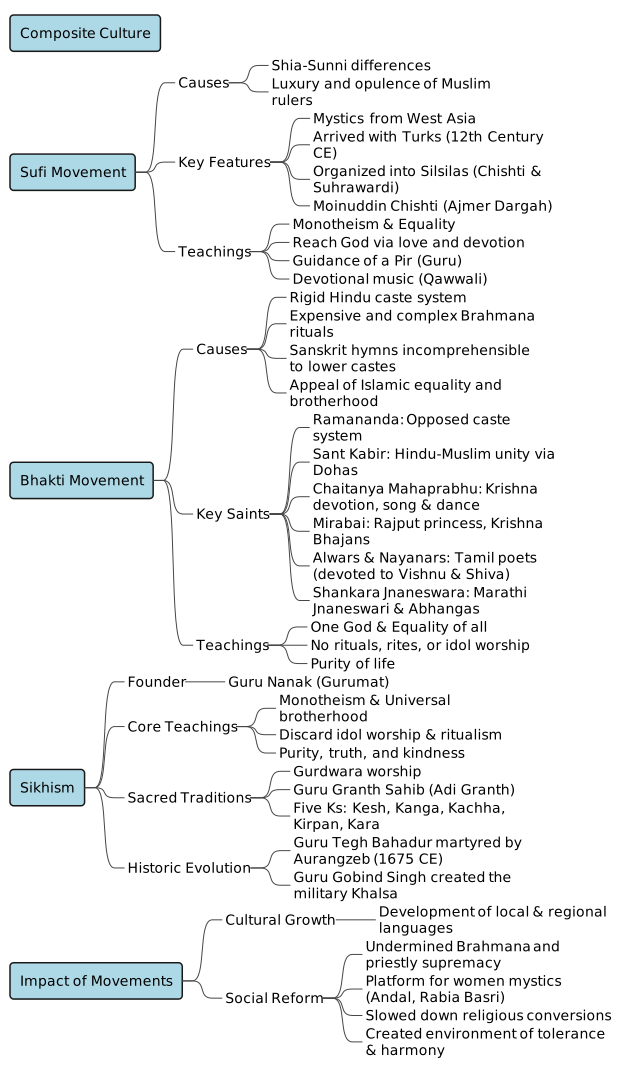
Sectarian Disputes: Intense hostility and division arose between the Shias and Sunnis after the death of Prophet Muhammad, threatening the concepts of Islamic monotheism and brotherhood.Protest Against Luxury: Muslim rulers and nobles increasingly lived luxurious and opulent lifestyles, which went against the Islamic principles of piety and simplicity.
Origins: Inspired by the teachings of the Koran, they came to India with the Turks in the 12th century CE and absorbed Buddhist and Hindu practices.Silsilas: Monastic organizations similar to the Buddhist sangha. The two most popular orders in India were:Chishti Order: Founded in India by Moinuddin Chishti. His dargah in Ajmer remains a key pilgrimage site for both Hindus and Muslims.Suhrawardi Order.
Monotheism: There is only one God, and all human beings are equal.Respect for All Paths: Different religions are simply different paths leading to the same God.No Rituals Required: Rites, rituals, and fasts are unnecessary; God is reached via love and deep devotion.Spiritual Guide: Necessity of following a pir (guru) for spiritual guidance.Music as Worship: Devotional music (qawwali) is a means of coming closer to God.No Conversion Needed: One should simply strive to lead a pure, disciplined life within their own faith.
Rigidity in Hinduism: The religion had become complex and dominated by evil practices.Social Inequality: A rigid caste system led to the exploitation of lower castes (especially shudras).Ritualism: Brahmanas prescribed expensive and complex rituals that burdened the poor.Language Barrier: Sacred texts were in Sanskrit, which lower castes were forbidden to study, preventing them from understanding hymns and mantras.Islamic Influence: The egalitarian principles of Islam (equality, brotherhood, monotheism) appealed to liberal-minded Hindus.
There is only one God, and everyone is equal in His eyes.God is reached through love, devotion, and complete surrender, not through rituals, ceremonies, or idol worship.Purity of life is essential.
Belief in one God, the creator of the universe.Universal brotherhood and rejection of the caste system.Rejection of idol worship and ritualism; living a pure life based on truth and kindness.Essential role of the guru (spiritual guide). The word “Sikh” means disciple, and the religion is also called Gurumat (the guru’s doctrine).
Ten Gurus: There were ten human gurus in Sikhism.Guru Granth Sahib: The last human guru, Guru Gobind Singh, transferred spiritual authority to the holy scripture, the Adi Granth, which came to be known as the Guru Granth Sahib.Gurdwara: The place of worship, meaning “the door of the guru”.The Five Ks (Five Sacred Symbols):Kesh (unshorn hair)Kanga (comb)Kachha (shorts)Kirpan (sword)Kara (steel bracelet)Militarization (Khalsa): The execution of the 9th Guru, Guru Tegh Bahadur, in 1675 CE by Mughal Emperor Aurangzeb angered the community. The 10th Guru, Guru Gobind Singh, organized the Sikhs into a disciplined military order of soldier-saints called the Khalsa, transforming them into a martial race.
Development of Local Languages: Saints preached in local vernaculars, boosting regional literature (e.g., Hindi, Marathi, Tamil).Reduction in Religious Conversions: Since lower castes gained direct access to spiritual truths without complex rituals, conversions to other faiths slowed down.Erosion of Priestcraft: Undermined the religious supremacy of the Brahmanas and exposed the futility of empty rituals.Communal Harmony: Fostered mutual respect, religious tolerance, and universal brotherhood between Hindus and Muslims, building a composite culture.

Share
Explore
 Recap Hub
Prepared by: learnloophq@gmail.com
Chapter: 11. Bhakti And Sufi Movements
CRASH COURSE REVISION MATERIAL: MAKING OF COMPOSITE CULTURE (BHAKTI & SUFI MOVEMENTS)
1. Context of Medieval India
2. The Sufi Movement
The Sufis were a group of Muslim mystics from West Asia who sought to achieve spiritual union with God through prayer, meditation, love, and devotion.
A. Causes for the Rise of Sufism
B. Core Features & Organizations (Silsilas)
C. Major Teachings of Sufism
3. The Bhakti Movement
The word ‘bhakti’ means devotion to God. It was a reform movement within Hinduism that began in south India in the 7th century CE and later spread north.
A. Causes for the Rise of the Bhakti Movement
B. Core Teachings of Bhakti Saints
4. Prominent Bhakti Saints & Reformers
Saint / Reformer
Key Contributions & Teachings
Medium of Expression
Ramananda
Strongly opposed the caste system. Welcomed disciples from all castes, including a leather worker, a barber, and a Muslim weaver.
Oral teachings
Sant Kabir
Stressed monotheism (asserted Ishwar, Allah, Ram, and Rahim are names of the same God). Denounced caste, rituals, and idol worship.
Dohas (simple, beautiful Hindi couplets)
Chaitanya Mahaprabhu
Devotee of Lord Krishna. Preached universal brotherhood. Believed God is experienced through love, devotion, song, and dance. Condemned priestly domination.
Kirtans and devotional dance
Mirabai
Rajput princess (daughter of Ratan Singh Rathore of Merta). Devoted her life to Lord Krishna, challenging traditional patriarchal norms.
Bhajans (devotional songs)
Alwars
Tamil poet-saints from South India who popularized Vaishnavism by preaching total devotion to Vishnu.
Tamil hymns
Nayanars
Tamil poet-saints from South India devoted to Shiva. Together with Alwars, they spearheaded the southern Bhakti Movement.
Tamil hymns
Shankara Jnaneswara (Sant Dnyaneshwar)
First Bhakti preacher in Maharashtra. Condemned the caste system, ritualism, and Brahmana supremacy. Devoted to Vithoba (incarnation of Vishnu).
Jnaneswari (commentary on Bhagavad Gita in Marathi) and abhangas (lyrical poems)
Note on Women Mystics:
The Bhakti and Sufi movements provided an active platform for women to challenge patriarchal limits and express spiritual experiences. Notable figures include Andal, Mirabai, and Janabai (Bhakti), as well as Rabia Basri and Bibi Fatima Sam (Sufi).
5. Sikhism
Founded by Guru Nanak, Sikhism emerged as an independent sect by combining elements of both Hinduism and Islam. By the 17th century, it was widely accepted, especially in Punjab.
A. Core Teachings of Guru Nanak
B. Evolution & Core Practices
6. Impact of the Movements on Indian Society
Want to print your doc?
This is not the way.
This is not the way.

Try clicking the ··· in the right corner or using a keyboard shortcut (
CtrlP
) instead.