Skip to content
The structural and functional unit of the nervous system is the _ _ _ _ _ _ _ _ _ _ _ _ _ _ .The point of contact between terminal branches of an axon and the dendrites of an adjacent neuron is called a _ _ _ _ _ _ _ _ _ _ _ _ _ _ .The outer layer of the brain is formed of _ _ _ _ _ _ _ _ _ _ _ _ _ _ matter.The folds and grooves present in the wall of the cerebrum are called _ _ _ _ _ _ _ _ _ _ _ _ _ _ and sulci respectively.The _ _ _ _ _ _ _ _ _ _ _ _ _ _ nervous system has an inhibitory or calming effect, bringing the body activities back to normal.
The spinal nerves are all of the mixed type, containing both sensory and motor nerve fibres.Receptors convert environmental stimuli into electrical nerve impulses during a process called transduction.In the spinal cord, the arrangement of gray matter and white matter is identical to that of the brain.The sympathetic nervous system prepares the body for violent action against any adverse eventuality.Motor neurons conduct sensory impulses from the receptors to the central nervous system.
StimulusSynapseReflex ActionMeninges
What are the three main parts of a neuron? Briefly describe the longest single extension from the cell body.Why is the medulla oblongata considered a vital part of the brain stem? What could happen if it is injured?Explain how the nervous system and endocrine system differ in the way they exercise control and coordination in multicellular organisms.Name the organs/structures that represent the:
(a) Coordinator, and
(b) Effector, when a bright light causes a change in the shape and size of the pupil of the eye.
Describe the structural components of the Human Central Nervous System (CNS), detailing how each component is protected from injury.Explain the step-by-step mechanism of nervous coordination, starting from receiving a stimulus to producing a response.

Share
Explore
 Question Paper
Prepared by: learnloophq@gmail.com
Chapter: 07. Nervous System
CLASS 7: BIOLOGY PRACTICE PAPER
CHAPTER: NERVOUS SYSTEM
Time Allowed: 1.5 Hours
Max Marks: 50
SECTION A: MULTIPLE CHOICE QUESTIONS (1 Mark Each)
1. Which part of a neuron is surrounded by a spirally-coiled sheath of fatty substance that insulates and speeds up nerve impulse conduction?
(a) Cyton
(b) Dendron
© Myelin sheath
(d) Terminal knob
2. Which type of nerves contain only nerve fibres that bring impulses from the sense organs to the brain or spinal cord?
(a) Motor nerves
(b) Sensory nerves
© Mixed nerves
(d) Autonomic nerves
3. The central H-shaped region of the spinal cord is made up of:
(a) White matter
(b) Gray matter
© Meninges
(d) Cranium
4. The part of the brain responsible for maintaining body balance and coordinating voluntary movements during walking or swimming is the:
(a) Cerebrum
(b) Medulla oblongata
© Spinal cord
(d) Cerebellum
5. How many pairs of cranial nerves and spinal nerves are present in the human body?
(a) 12 pairs of cranial nerves and 31 pairs of spinal nerves
(b) 31 pairs of cranial nerves and 12 pairs of spinal nerves
© 10 pairs of cranial nerves and 24 pairs of spinal nerves
(d) 12 pairs of cranial nerves and 12 pairs of spinal nerves
SECTION B: FILL IN THE BLANKS (1 Mark Each)
SECTION C: TRUE OR FALSE (1 Mark Each)
SECTION D: EXPLAIN THE TERMS (2 Marks Each)
SECTION E: DIFFERENTIATE THE CONCEPTS (3 Marks Each)
1. Cerebrum vs. Cerebellum (On the basis of their major functions)
2. Sensory Nerves vs. Motor Nerves (On the basis of the direction of impulses they carry)
3. Gray Matter vs. White Matter (On the basis of their composition and location in the brain)
SECTION F: SHORT ANSWER QUESTIONS (3 Marks Each)
SECTION G: DIAGRAM-BASED QUESTIONS (5 Marks)
A simplified line diagram of a single motor neuron with four pointers labeled A, B, C, and D pointing to its key structures.
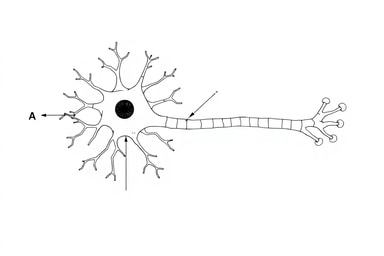
Using the diagram above, answer the following questions:
(a) Identify and label the parts marked A, B, C, and D. (2 Marks)
(b) State the function of part A. (1.5 Marks)
© What is the function of the sheath surrounding part C, and what are the regular constrictions along its length called? (1.5 Marks)
SECTION H: LONG ANSWER QUESTIONS (5 Marks Each)
Want to print your doc?
This is not the way.
This is not the way.

Try clicking the ··· in the right corner or using a keyboard shortcut (
CtrlP
) instead.