Skip to content
Which social group occupied the highest position of wealth and power, enjoying a lavish lifestyle during the Sultanate period?
(a) Priests
(b) Town Dwellers
© Aristocracy
(d) PeasantsThe sitar is believed to have been invented by combining which of the following two instruments?
(a) Veena and Sarangi
(b) Veena and Tanpura
© Tabla and Tanpura
(d) Sarangi and SitarWhich language replaced Sanskrit as the official language in many regions during the Turkish rule?
(a) Arabic
(b) Persian
© Urdu
(d) HindiDuring the reign of which sultan did the condition of the peasants improve, allowing them to enjoy many benefits?
(a) Muhammad bin Tughlaq
(b) Alauddin Khilji
© Firoz Shah Tughlaq
(d) Ghiyasuddin TughlaqWhat is the Persian style of chorus singing popularized by the Sufi saints known as?
(a) Kathak
(b) Hindustani
© Qawwali
(d) Sehtar
The rule of the Delhi sultans lasted from 1206 CE to _ _ _ _ _ _ _ _ _ _ _ _ _ _ CE.The classical dance form _ _ _ _ _ _ _ _ _ _ _ _ _ _ combines Hindu themes with Persian costumes.The _ _ _ _ _ _ _ _ _ _ _ _ _ _ system of medicine was a legacy of the Turkish rule and a result of interaction with Arab traders.The name sitar is derived from the Persian word _ _ _ _ _ _ _ _ _ _ _ _ _ _ which means “three strings”.The chief advisers to the sultans were the religious leaders known as the _ _ _ _ _ _ _ _ _ _ _ _ _ _.
The caste system among Hindus was very flexible during the Sultanate period.The purdah system was strictly observed by Muslim women during this era.The early Turkish rulers showed a deep interest in painting and established major art academies.The south Indian drum was probably altered to create the tabla.The Rajput style of miniature painting disappeared entirely during the Sultanate period.
QazisUlemasSehtarHindustani Music
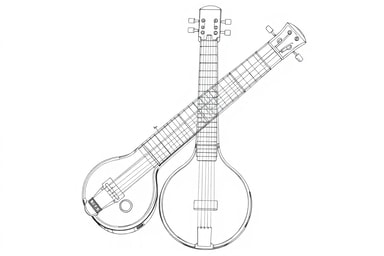
Identify the musical instrument shown in the diagram. (1 Mark)Who is credited with inventing this instrument during the Sultanate period? (1 Mark)Describe how this instrument was created by combining existing instruments. (3 Marks)
State two major reasons why many lower-class Hindus converted to Islam during the Sultanate period.What are the main physical characteristic features of Sultanate architecture?Name two famous historical poems written by the scholar and poet Amir Khusrau.How did the food habits of Indians change as a result of the interaction with the Turks?How did the Turkish rulers gradually become “Indianized” over time?
Describe the four major groups into which society was classified during the Sultanate period.Discuss the development of music and dance as a fusion of Indo-Islamic culture during the Delhi Sultanate.Explain the distinctive features of Sultanate architecture, and list four major monuments built during this period.

Share
Explore
 Question Paper
Prepared by: learnloophq@gmail.com
Chapter: 06. Life Under The Delhi Sultanate
PRACTICE EXAM PAPER
Theme 3: Life under the Delhi Sultanate
Time Allowed: 2 Hours
Maximum Marks: 50
SECTION A: MULTIPLE CHOICE QUESTIONS (5 Marks)
Choose the correct option for each of the following questions:
SECTION B: FILL IN THE BLANKS (5 Marks)
Fill in the blanks with the correct words. Use _ _ _ _ _ _ _ _ _ _ _ _ _ _ for the blank space:
SECTION C: TRUE OR FALSE (5 Marks)
State whether the following statements are True or False. If False, rewrite the statement correctly:
SECTION D: EXPLANATION OF TERMS (4 Marks)
Briefly explain the following terms based on the chapter:
SECTION E: DIAGRAM-BASED QUESTION (5 Marks)
This is an illustration of a popular classical stringed musical instrument developed during the Sultanate period.
SECTION F: SHORT ANSWER QUESTIONS (10 Marks)
Answer the following questions in 2 to 3 sentences:
SECTION G: LONG ANSWER QUESTIONS (12 Marks)
Answer the following questions in detail:
SECTION H: VALUES AND SDG-BASED QUESTION (4 Marks)
Read the prompt below and answer the question:
Sustainable Development Goal (SDG) 10 aims to “Reduce Inequalities.” During the medieval period, the rigidity of the Hindu caste system and the imposition of taxes like the jizya prompted many people to seek alternative lifestyles and religions.
Based on this context, why is reducing social and economic inequalities important for the peace, harmony, and prosperity of a country today?
Want to print your doc?
This is not the way.
This is not the way.

Try clicking the ··· in the right corner or using a keyboard shortcut (
CtrlP
) instead.