Skip to content
The Medieval Period in India: Spans roughly from the 8th to the mid-18th centuries CE.External Influences: Indian medieval history was heavily shaped by interactions with West Asia, Central Asia, and Europe.
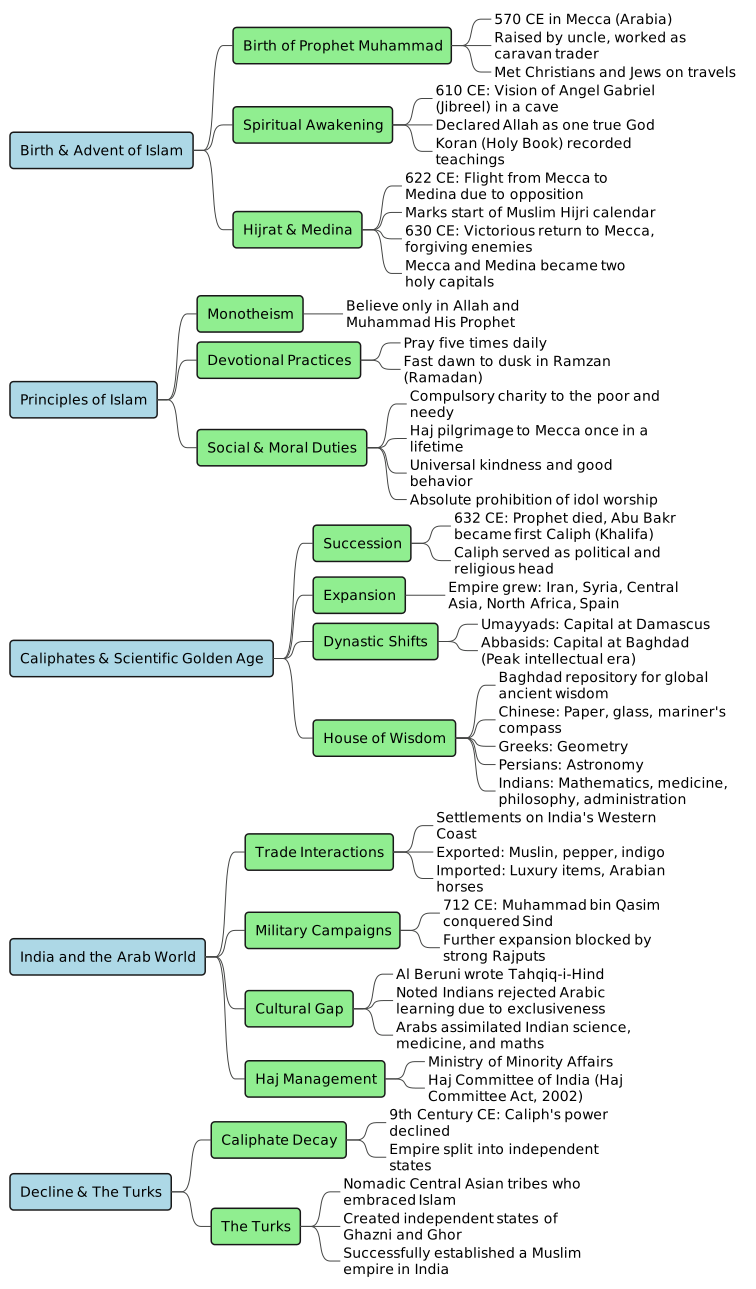
Birth: Prophet Muhammad was born in 570 CE in Mecca, a small town in Arabia.Upbringing: Orphaned early, he was raised by his uncle. He worked in his uncle’s trading business, travelling extensively with caravans.External Influences: During his travels, he interacted with Christians and Jews, becoming impressed by their religious beliefs and practices.Arabia before Islam:Divided into numerous tribes constantly at war.People lived in poverty and harsh conditions.Deeply superstitious, worshipping multiple gods via idol/image worship.
610 CE: Muhammad experienced a vision of Angel Gabriel (Jibreel) in a mountain cave, who revealed God’s divine message.Declaration: Muhammad declared Allah as the one and only God, and himself as Allah’s Prophet.Terminology:Islam: Means “submission”.Muslims: Followers who “submit to the will of Allah”.Koran (Quran): The holy book containing the teachings and revelations of Muhammad.
Monotheism: There is only one God (Allah), and Muhammad is His Prophet.Daily Prayer: Muslims must pray five times a day.Fasting: Fasting from dawn to dusk during the holy month of Ramzan (Ramadan).Charity: Helping the poor and needy by giving away a portion of wealth.Pilgrimage (Haj): Making a journey to Mecca at least once in a lifetime.Moral Conduct: Being good, kind, compassionate, and empathetic to others.Rejection of Idolatry: Muhammad strictly forbade idol worship.
Muhammad’s teachings against idol worship angered wealthy Arab merchants in Mecca.622 CE (Hijrat): Muhammad and his followers shifted from Mecca to Medina due to persecution.Hijri Calendar: The Islamic calendar begins with the year of the Hijrat (622 CE).
630 CE: Backed by a devoted, highly disciplined army built in Medina, Muhammad returned to Mecca victorious. He forgave his enemies, and the Meccans adopted Islam.Holy Sites: Mecca and Medina established as the two premier holy places of Islam.632 CE: Prophet Muhammad passed away, by which time the entirety of Arabia had embraced Islam.
Abu Bakr: Muhammad’s faithful friend and follower, chosen as the first Khalifa or Caliph (meaning successor of the Prophet).Role: Acted as both the political and religious head of the Muslim community.Military Transformation: Abu Bakr forged the Arabs into an invincible fighting force.
Middle East & Central Asia: Syria, Iran, and Central Asia.North Africa & Europe: North Africa and Spain.Vibrant Civilization: Conquering armies transitioned to settled lives, building majestic cities (Damascus, Baghdad, Cairo) and promoting trade, agriculture, and industries.
The House of Wisdom: Established in Baghdad by an Abbasid Caliph to translate the collective scientific and literary works of ancient civilizations into Arabic.Preservation of Heritage: Baghdad became the main repository of ancient world culture.
Arab traders set up permanent settlements along the western coast of India, intermarrying and integrating with local communities.Indian merchants utilized Arab ships to export cargo to the West.
712 CE: An Arab expedition led by Muhammad bin Qasim defeated the ruler of Sind and occupied the province.The Halt: The occupation ended with Qasim’s death. Further Arab expansion into India was completely blocked by powerful Rajput kingdoms.
Indian Exclusiveness: The Muslim scholar Al Beruni noted that a spirit of exclusiveness made Indians believe that no other country possessed scientific knowledge, making them closed to Arabic learning.Arab Adoption: Conversely, Arabs eagerly adopted and assimilated Indian theories in mathematics, medicine, astronomy, philosophy, and administrative practices.
9th Century CE: The power of the Caliphs declined, splitting the expansive Arab empire into several independent kingdoms.The Turks: Nomadic Central Asian tribes who converted to Islam.Turkish States: Established powerful independent states like Ghazni and Ghor.Impact on India: The Turks eventually succeeded where the Arabs could not, establishing a Muslim empire in India.
Identity: An outstanding medieval Muslim scholar who traveled to India with Mahmud of Ghazni.Savoir-Faire: Polymath fluent in Sanskrit, mathematics, geography, history, medicine, physics, chemistry, philosophy, and theology.Key Literary Work: Author of Tahqiq-i-Hind (History of India), which serves as an invaluable primary historical source on 11th-century Indian society and culture.
Nodal Agency: Ministry of Minority Affairs, Government of India.Execution Body: Haj Committee of India (a statutory body established under the Haj Committee Act, 2002).

Share
Explore
 Recap Hub
Prepared by: learnloophq@gmail.com
Chapter: 03. Birth Of Prophet Muhammad And Spread Of Islam
CHAPTER REVISION CRASH COURSE: BIRTH OF PROPHET MUHAMMAD AND SPREAD OF ISLAM
1. INTRODUCTORY OVERVIEW
2. THE ADVENT OF ISLAM & PROPHET MUHAMMAD
Birth and Early Life
Spiritual Awakening and the Birth of Islam
3. MAIN PRINCIPLES OF ISLAM
4. THE HIJRAT AND RISE OF THE ISLAMIC STATE
The Journey to Medina
Victory and Consolidation
5. SUCCESSION AND SPREAD OF THE EMPIRE
The Caliphate
Territorial Expansion
The early Caliphs expanded the Islamic empire across continents, capturing vast territories:
6. THE UMAYYAD AND ABBASID DYNASTIES
Comparison of the Dynasties
Feature
The Umayyad Dynasty
The Abbasid Dynasty
Chronological Order
Preceded the Abbasids
Succeeded the Umayyads
Capital City
Damascus (Syria)
Baghdad (Iraq)
Historical Highlight
Early territorial consolidation
Greatest intellectual, cultural, and scientific excellence
The Golden Age of Baghdad
Assimilation of Global Knowledge
[Chinese Civilization] ──> Art of paper-making, glass-making, mariner's compass
[Greek Civilization] ──> Geometry
[Persian Civilization] ──> Astronomy
[Indian Civilization] ──> Mathematics, medicine, astronomy, philosophy, administration
7. INDIA AND THE ARAB WORLD
Trade Relations
Indian Exports to Arabs
Arab Imports to India
Muslin
Luxury goods
Pepper
Fine Arabian horses
Indigo
Military Contact & Expansion Limits
Cultural and Scientific Exchange
8. THE DECLINE OF THE CALIPHATE AND THE TURKS
9. IMPORTANT HISTORICAL BIOGRAPHY: AL BERUNI
10. MODERN-DAY HAJ ADMINISTRATION IN INDIA
Want to print your doc?
This is not the way.
This is not the way.

Try clicking the ··· in the right corner or using a keyboard shortcut (
CtrlP
) instead.