Skip to content
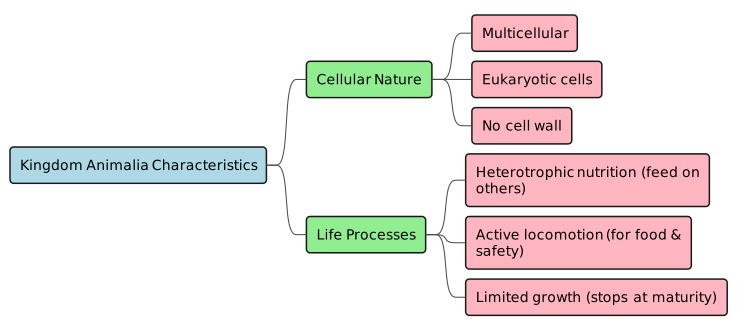
Multicellular Eukaryotes: All members of this kingdom consist of multiple eukaryotic cells that do not contain a cell wall.Heterotrophic Nutrition: Animals are unable to utilize solar energy to manufacture their own food. They must feed on plants, other animals, or both.Locomotion: Most animals possess the ability to move from place to place actively in search of food, shelter, and protection.Limited Growth: Animals exhibit a distinct growth pattern that is limited and stops once they reach maturity.
Body Structure: Covered with small pores all over the body to draw water in, and a large opening at the top to expel the incoming water.Habitat: Primarily marine, found attached to the bottom of the sea or ponds; only a few species live in freshwater.Examples:SyconSpongilla (Freshwater sponge)Euspongia (Bath sponge)
Body Structure: Hollow, sac-like body with only a single opening: the mouth. The mouth is surrounded by finger-like structures called tentacles used for capturing food.Habitat: Aquatic animals, mostly marine. They exist as free-floating or attached to the sea floor.Examples:Hydra (found in freshwater)Sea anemoneJelly-fishesCorals (marine colonial organisms)
Body Structure: Soft, thin, and highly flattened bodies without a body cavity. The body is divided into multiple segments.Lifestyle: Mostly live as parasites inside the bodies of host animals.Deep-Dive: Tapeworm ParasitismTapeworms reside as parasites inside the human intestine.They can grow up to 5 meters in length.They resemble a long ribbon with a small head-like structure at the front.Their segments directly absorb pre-digested food from the host’s intestine.Examples:LiverflukePlanariaBlood flukeTapeworm
Body Structure: Long, cylindrical, and unsegmented bodies. Some members are extremely thin and thread-like.Lifestyle: Live as parasites inside animal and human bodies, causing various diseases.Examples:Ascaris (Roundworm)HookwormsThreadworms
Body Structure: Soft, segmented, and bilaterally symmetrical bodies. They possess a true body cavity and a well-developed alimentary canal.Excretory System: Specialized excretory structures called nephridia.Locomotion: Move using specialized structures called parapodia or setae.Ecological Callout: The Farmer’s FriendEarthworms burrow into the ground and feed on organic matter.Their burrowing action makes the soil porous, improving aeration and water absorption.Their waste enriches the soil, enhancing fertility.Examples:EarthwormLeech
Body Structure: Bilaterally symmetrical body divided into three regions: head, thorax, and abdomen. The outer body is protected by a tough covering called a chitinous exoskeleton.Locomotion: Paired, jointed legs.Subclasses of Arthropoda:Crustaceans: Head and thorax are fused. Possess multiple jointed legs. (Examples: Prawn, Crab, Shrimp, Lobster)Insects: Distinct head, thorax, and abdomen. Possess three pairs of jointed legs (6 legs total) and typically two pairs of wings. (Examples: Housefly, Butterfly, Mosquito, Cockroach)Arachnids: Fused head and thorax. Possess six pairs of appendages, four pairs of which are dedicated walking legs (8 legs total). No wings. (Examples: Spider, Scorpion, Tick)Myriapods: Long, multi-segmented bodies. Each segment bears legs. Centipedes carry one pair of legs per segment, while millipedes carry two pairs of legs per segment. (Examples: Centipede, Millipede)
Body Structure: Soft, unsegmented bodies usually enclosed within a protective hard shell.Locomotion: Specialized muscular foot used for crawling or movement.Habitat: Primarily aquatic (mostly marine).Examples:Octopus (lacks an external shell)Pond snailGarden snailPearl oyster
Body Structure: Rough, spiny, and star-shaped body. They lack a distinct head and tail.Habitat: Exclusively marine.Examples:StarfishSea urchin
Ectothermic: Cold-blooded animals whose body temperature changes with the surroundings.Habitat: Completely aquatic.Locomotion: Swim using specialized structures called fins.Body Design: Streamlined body shape, which reduces friction and aids swimming.Respiration & Circulation: Breathe using gills and have a two-chambered heart (one atrium, one ventricle).Examples:CatlaRohuSharkSeahorseElectric rayMahasheer
Dual Life: Can live both in water and on dry land.Skin Texture: Covered with a slimy, slippery, and moist skin.Ectothermic: Cold-blooded animals.Respiration: Breathe through lungs when on land, and via their moist skin when submerged in water. Their larval form (tadpoles) breathe using gills.Circulation: Possess a three-chambered heart (two atria, one ventricle).Reproduction: Must return to water bodies to lay eggs.Examples:FrogSalamanderToad

Share
Explore
 Self Study
Prepared by: learnloophq@gmail.com
Chapter: 03. Kingdom Animalia
CHAPTER 3: KINGDOM ANIMALIA

1. Introduction to Kingdom Animalia
Kingdom Animalia includes all multicellular animals. They exhibit specific eukaryotic characteristics that separate them from other kingdoms.
Characteristic Features of Kingdom Animalia
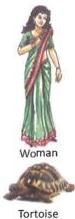
Fig: Examples of diverse animal forms (Woman and Tortoise)
Fig: Examples of diverse animal forms (Woman and Tortoise)
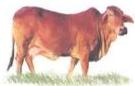
Fig: Cow
Fig: Cow
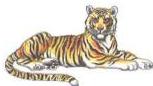
Fig: Tiger
Fig: Tiger
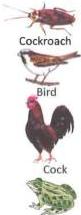
Fig: Frog
Fig: Frog
2. Broad Classification of Kingdom Animalia
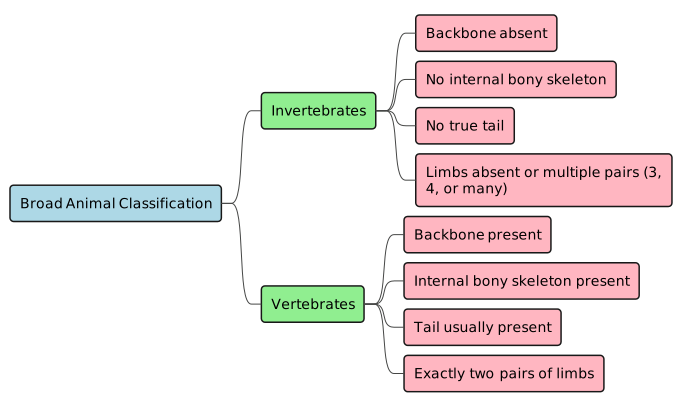
Animals are classified into two major categories based on the absence or presence of a vertebral column (backbone): Invertebrates and Vertebrates.
Comparison: Invertebrates vs. Vertebrates
Feature
Invertebrates
Vertebrates
Backbone
Absent
Present
Internal Skeleton
Internal skeleton of bones is absent
Internal bony skeleton is present
True Tail
Absent
Usually present
Limbs
Either absent or occur as three, four, or many pairs
Possess exactly two pairs of limbs
Examples
Worms, Cockroach, Butterfly, Snail, Starfish, Spider
Fishes, Frogs, Lizards, Birds, Mammals (including Humans)
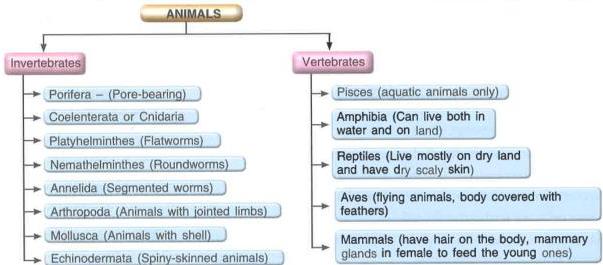
Fig: Overview flowchart of Kingdom Animalia Classification
Fig: Overview flowchart of Kingdom Animalia Classification
3. Detailed Study of Invertebrates (Phyla 1-8)
Invertebrates constitute a vast array of organisms and are further divided into eight distinct phyla.
1. Phylum Porifera (Pore-bearing Animals: Sponges)
Fig: Sycon
Fig: Sycon
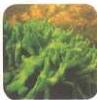
Fig: Spongilla
Fig: Spongilla

Fig: Euspongia
Fig: Euspongia
2. Phylum Coelenterata / Cnidaria (Hollow Sac-like Animals)

Fig: Hydra
Fig: Hydra

Fig: Sea anemone
Fig: Sea anemone
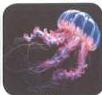
Fig: Jellyfish
Fig: Jellyfish
3. Phylum Platyhelminthes (Flatworms)
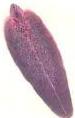
Fig: Liverfluke
Fig: Liverfluke
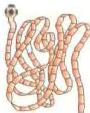
Fig: Tapeworm
Fig: Tapeworm
4. Phylum Nemathelminthes / Nematoda / Aschelminthes (Roundworms)
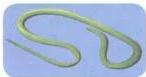
Fig: Roundworm
Fig: Roundworm
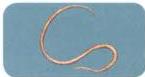
Fig: Hookworm
Fig: Hookworm
5. Phylum Annelida (Segmented Worms / True Worms)
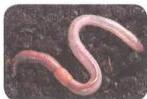
Fig: Earthworm
Fig: Earthworm
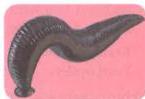
Fig: Leech
Fig: Leech
6. Phylum Arthropoda (Animals with Jointed Limbs)

Fig: Earthworms are vital for soil aeration
Fig: Earthworms are vital for soil aeration
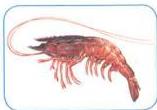
Fig: Prawn (Crustacean)
Fig: Prawn (Crustacean)
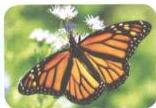
Fig: Butterfly (Insect)
Fig: Butterfly (Insect)
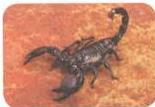
Fig: Scorpion (Arachnid)
Fig: Scorpion (Arachnid)
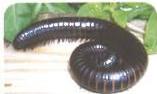
Fig: Millipede (Myriapod)
Fig: Millipede (Myriapod)
7. Phylum Mollusca (Soft-Bodied Animals)
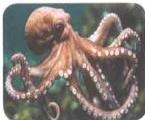
Fig: Octopus
Fig: Octopus
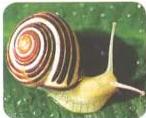
Fig: Snail
Fig: Snail
8. Phylum Echinodermata (Spiny-skinned Animals)
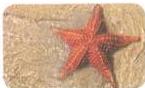
Fig: Starfish
Fig: Starfish
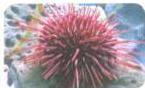
Fig: Sea urchin
Fig: Sea urchin
Summary Table of Invertebrate Phyla
Phylum
Key Characteristics
Typical Examples
Porifera
Pore-bearing body, aquatic, sessile
Sycon, Spongilla, Euspongia
Coelenterata
Hollow sac-like, mouth surrounded by tentacles
Hydra, Sea Anemone, Jellyfish, Corals
Platyhelminthes
Flat, ribbon-like body; no body cavity; parasitic
Tapeworm, Liverfluke, Planaria
Nemathelminthes
Cylindrical, unsegmented, thread-like; parasitic
Ascaris (Roundworm), Hookworm
Annelida
Segmented, true body cavity, nephridia for excretion
Earthworm, Leech
Arthropoda
Jointed limbs, chitinous exoskeleton, segmented body
Cockroach, Prawn, Scorpion, Millipede
Mollusca
Soft-bodied, unsegmented, muscular foot, calcareous shell
Snail, Octopus, Pearl Oyster
Echinodermata
Spiny-skinned, radial star shape, no head or tail
Starfish, Sea urchin

4. Detailed Study of Vertebrates (Classes 1-5)
Vertebrates belong to the phylum Chordata and are characterized by the presence of an internal vertebral column (backbone). They are split into five distinct classes based on morphological and physiological traits.
1. Class Pisces (Fishes)
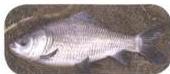
Fig: Catla
Fig: Catla
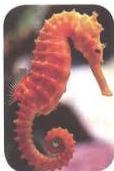
Fig: Seahorse
Fig: Seahorse
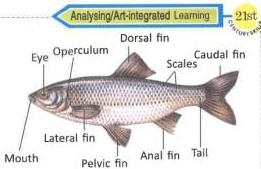
Fig: External Anatomy of a Fish showing streamlined body, fins, and gills
Fig: External Anatomy of a Fish showing streamlined body, fins, and gills
2. Class Amphibia
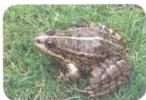
Fig: Frog
Fig: Frog
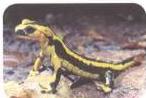
Fig: Salamander
Fig: Salamander
Want to print your doc?
This is not the way.
This is not the way.

Try clicking the ··· in the right corner or using a keyboard shortcut (
CtrlP
) instead.