Skip to content
Who was the founder of the Sufi Movement in India?
(a) Hazrat Nizamuddin
(b) Baba Farid
© Moinuddin Chishti
(d) Salim ChishtiThe word ‘Sikh’ is derived from a word which means:
(a) Warrior
(b) Disciple
© Teacher
(d) SaintWho was the first Bhakti preacher in Maharashtra?
(a) Ramananda
(b) Shankara Jnaneswara
© Sant Kabir
(d) Chaitanya MahaprabhuThe execution of Guru Tegh Bahadur in 1675 CE was ordered by which Mughal Emperor?
(a) Akbar
(b) Shah Jahan
© Jahangir
(d) AurangzebMirabai was the daughter of:
(a) Ratan Singh Rathore of Merta
(b) Rana Sanga of Mewar
© Raja Man Singh of Amber
(d) Udai Singh of Marwar
As the spirit of tolerance and understanding developed between the Hindus and the Muslims, two liberal religious reform movements took shape in the Medieval Period. They were the _ _ _ _ _ _ _ _ _ _ _ _ _ _ and _ _ _ _ _ _ _ _ _ _ _ _ _ _ movements.Ramananda’s twelve closest followers included a leather worker, a barber, and a _ _ _ _ _ _ _ _ _ _ _ _ _ _.The Sufis established several monastic organizations called _ _ _ _ _ _ _ _ _ _ _ _ _ _.The Alvars (Always) were Tamil poet-saints who popularized Vaishnavism by composing hymns in the local _ _ _ _ _ _ _ _ _ _ _ _ _ _ language.Every year on 24 November, _ _ _ _ _ _ _ _ _ _ _ _ _ _ is observed to remember the martyrdom of Guru Tegh Bahadur.
The advent of Islam in India occurred only after the establishment of the Delhi Sultanate.Chaitanya Mahaprabhu believed that through song and dance, one could experience God’s existence.Kabir preached his message through simple, beautiful Hindi poems called abhangas.Guru Gobind Singh organized the Sikhs into a disciplined, military group called the Khalsa.The Sufi and Bhakti movements led to a decrease in the development of local regional languages.
SilsilasMonotheismGurumatDohas
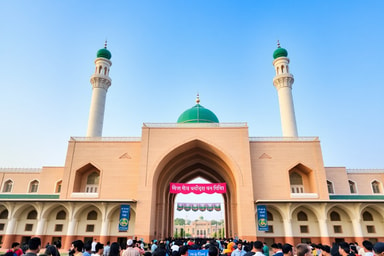
Identify the monument and the city where it is located.Who is buried at this site, and which religious movement did he start in India?Why is this site considered a highly significant pilgrimage center today?
Why were the lower castes in medieval India unable to understand Sanskrit hymns and mantras?Mention any two women mystics/saints associated with the Bhakti and Sufi movements as highlighted under the “Knowledge of India” section.What are the “five Ks” that every Sikh must possess at all times?How did the Sufi and Bhakti movements affect the rate of religious conversions during the medieval period?Who wrote the commentary on the Bhagavad Gita in Marathi, and what was it called?
Discuss the causes that led to the rise of the Sufi Movement in West Asia and subsequently in India.Explain the core teachings of Guru Nanak and explain how the holy scripture of the Sikhs came to be known as the Guru Granth Sahib.

Share
Explore
 Question Paper
Prepared by: learnloophq@gmail.com
Chapter: 11. Bhakti And Sufi Movements
PRACTICE EXAM PAPER
Subject: History
Chapter: Making of Composite Culture — Bhakti and Sufi Movements
Grade Level: Middle School
Total Marks: 80
Time Allowed: 2 Hours
SECTION A: MULTIPLE CHOICE QUESTIONS (10 Marks)
Choose the correct option for each of the following questions.
SECTION B: FILL IN THE BLANKS (10 Marks)
Fill in the blanks using the exact words from the chapter. Use the blank space provided.
SECTION C: TRUE OR FALSE (10 Marks)
State whether the following statements are True or False. Rewrite the false statements correctly.
SECTION D: EXPLANATION OF TERMS (12 Marks)
Explain the following terms in one or two sentences based on the text:
SECTION E: IDENTIFY AND DIFFERENTIATE CONCEPTS (8 Marks)
Answer the following differentiation question based on the text:
Feature
Alvars (Always)
Nayanars
Primary Deity Worshipped
Region of Origin
SECTION F: OBSERVATION-BASED / DIAGRAM QUESTION (10 Marks)
Below is an illustration of a famous religious monument associated with a medieval movement.
SECTION G: SHORT ANSWER QUESTIONS (10 Marks)
Answer the following questions in 20-30 words:
SECTION H: LONG ANSWER QUESTIONS (10 Marks)
Answer the following questions in 50-80 words:
Want to print your doc?
This is not the way.
This is not the way.

Try clicking the ··· in the right corner or using a keyboard shortcut (
CtrlP
) instead.