Skip to content
Definition: Organisation is the hierarchical manner in which smaller units of any structure or system are arranged into larger units.Purpose: The primary purpose of organisation in multicellular organisms is the division of labour, which allows different functions to be carried out more efficiently and in a coordinated fashion.
Cellular Level:The cell is the smallest living unit that can exist independently.Unicellular Organisms: Perform all life activities in a single cell (e.g., Amoeba, Euglena, Paramecium, and bacteria).Simple Multicellular Organisms: Cells are grouped but function independently, lacking division of labour (e.g., algae and sponges).Tissue Level:Group of structurally similar cells performing a similar function (e.g., nerve cells conducting messages, muscle cells contracting, RBCs transporting oxygen).Marks the beginning of the division of labour.Historical Note: Marie Francois Xavier Bichat (French anatomist/pathologist) introduced the term “tissue” in the 180s. He is called the Father of Modern Histology.Organ Level:Different tissues working together to perform a specialised function (e.g., brain, kidney, stomach, heart in animals; root, stem, leaf, flower in plants).Organ System Level:Many organs working together to perform a major life function.Animal Examples: Digestive system (mouth, foodpipe, stomach, intestine, rectum); Circulatory system (heart, blood vessels).Plant Examples: Shoot system (stem, branches, leaves, flowers, fruits) and Root system (main root, branches, root hairs).Represents the complete living individual where all organ systems work together in a coordinated manner.Population Level: All individuals of a single species living in a particular area.Community Level (Biotic Community): Populations of different species interacting in a specific area.Ecosystem Level: Biotic community interacting with the abiotic (nonliving) components of their environment. Food chains and food webs facilitate energy transfer.Biosphere Level: The entire part of the Earth inhabited by living organisms.
Definition: Tissues formed of actively dividing young cells responsible for plant growth.Characteristics:Oval, small, thin cell walls.No intercellular spaces.Large, centrally located nuclei.Vacuoles are either absent or very small.Types & Locations:Apical Meristem: Found at growing points (tips of roots, shoots, and branches). Promotes growth in length.Lateral Meristem: Found along the sides of stems and roots. Promotes growth in thickness/girth.Functions: Helps plants grow in length and girth; forms new organs (buds, flowers, leaves, branches).
Definition: Formed of mature, differentiated cells that have lost the power to divide and are specialised for specific functions.Characteristics:Derived from meristematic cells.Cells may be alive or dead.Diverse shapes suited to their functions.Thick cell walls and large vacuoles.Nucleus is displaced to one side.
Epidermis: Single layer of thick-walled cells covering all parts of the plant. The epidermis of leaves secretes a waxy, waterproof layer called the cuticle to protect underlying tissues.Cork: Formed of dead cells; found only in old and woody dicot stems.Parenchyma:Structure: Oval/polygonal cells with thin walls and large vacuoles; loosely packed with intercellular spaces. Located in soft parts.Chlorenchyma: Parenchyma containing chlorophyll.Functions: Stores food, forms ground tissue, helps in photosynthesis and conduction of water.Collenchyma:Structure: Elongated cells with walls irregularly thickened at the corners; no intercellular spaces. Located in leaves, stems, and petioles of herbaceous dicots.Functions: Provides mechanical support and flexibility.Sclerenchyma:Structure: Long, dead, fibre-like cells with uniformly thick cell walls; no intercellular spaces. Located around vascular bundles in stems, leaf veins, and petioles.Functions: Provides mechanical strength and rigidity.
Function: Conducts water and dissolved minerals upwards from roots to leaves.Components:Xylem Tracheids: Spindle-shaped, dead conducting cells.Xylem Vessels: Long, tubular, dead cells joined end-to-end like drain pipes (partitions dissolved).Xylem Fibres: Long, dead structural fibres.Xylem Parenchyma: The only living cells in xylem; helps in storage.Note: Old xylem forms wood used for furniture.Function: Transports prepared food downwards and outwards from leaves to all parts of the plant.Components:Sieve Tubes: Long, tubular living cells joined end-to-end. End plates are perforated (sieve plates).Companion Cells: Living cells associated with sieve tubes.Phloem Parenchyma: Living cells that store food.Phloem Fibres: The only dead cells in phloem; provide support.
Characteristics: Closely packed cells forming continuous sheets; no intercellular spaces.Location: Covers external body surface (skin), outer surface of organs, and lines hollow internal organ cavities.
Areolar Tissue: Most abundant tissue. Binds skin to underlying tissues; acts as packing material within organs.Adipose Tissue: Stores fat inside specialised adipose cells filled with oil globules.Fibrous Connective Tissue:Tendons: Strong, inelastic structures made of white fibrous tissue. Connect muscles to bones.Ligaments: Strong, elastic structures made of yellow elastic tissue. Connect bones to bones at joints.Cartilage: Firm but elastic (flexible) tissue. Supports windpipe wall, nasal septum, external ear (pinna), and reduces friction/shocks at joints.Bone: Hard and nonelastic tissue. Matrix is rich in calcium, magnesium, and phosphorus salts making it strong but brittle (fractures easily). Forms the skeletal framework, protects internal organs, aids locomotion, and produces blood cells in the red bone marrow of long bones.Blood: Red fluid. Matrix is straw-coloured, nonliving plasma containing floating cells:Red Blood Cells (RBCs): Supply oxygen to body cells.White Blood Cells (WBCs): Act as “soldiers of the body” by fighting and killing foreign germs.Blood Platelets: Vital for blood clotting.Lymph: Filtered blood (blood plasma without RBCs and blood proteins). Surrounds tissues, assists in substance exchange, and protects against infections.
Components: Made of nerve cells called neurons.Cyton (Cell body): Main part of the nerve cell containing the nucleus.Dendrons: Short processes arising from the cyton, branching into fine dendrites.Axon: A long, single cylindrical process that carries messages away from the cyton.Synapse: The functional junction/connection between the terminal end of an axon of one neuron and the dendrites of an adjacent neuron.Nerve: A bundle of several axons bound together.Location: Brain, spinal cord, and sense organs.Working Mechanism: Dendrites receive stimuli -> pass impulse to Cyton -> Axon transmits impulse to next neuron via synapse -> reaches brain/spinal cord for response.

Share
Explore
 Recap Hub
Prepared by: learnloophq@gmail.com
Chapter: 01. Tissues
CRASH COURSE: TISSUES & LEVELS OF BIOLOGICAL ORGANISATION
1. UNDERSTANDING ORGANISATION & ITS LEVELS
What is Organisation?
The Hierarchical Levels of Organisation
The living world is organised into levels that become increasingly complex step-by-step:
A. Levels Lower to the Organism
B. Organism Level
C. Levels Higher to the Organism
2. PLANT TISSUES
Plant tissues are broadly divided into Meristematic Tissues and Permanent Tissues.
I. Meristematic Tissues (Meristems)
II. Permanent Tissues
Comparison: Meristematic vs. Permanent Tissues
Feature
Meristematic Tissues
Permanent Tissues
Cell State
Young and undifferentiated
Mature and differentiated
Division Power
Keep on dividing continuously
Do not divide
Vacuoles & Spaces
Small/absent vacuoles; no intercellular spaces
Living cells have large vacuoles and intercellular spaces
Cell Wall
Thin
Thick
Classification of Permanent Tissues
A. Simple Permanent Tissues
Formed of only one type of cell. They are classified into Protective and Supporting tissues:
1. Protective Tissues
2. Supporting Tissues
Provide mechanical strength, support, and storage.
Comparison: Supporting Tissues
Feature
Parenchyma
Collenchyma
Sclerenchyma
Packing
Loosely packed
Very little intercellular space
No intercellular spaces
Cell Wall
Thin
Irregularly thick at corners
Uniformly thick
Location
Soft parts / Widely distributed
Below epidermis (leaves, petioles, stems)
Around vascular bundles (stems, veins)
Living State
Living
Living
Dead
B. Complex Permanent Tissues (Conducting/Vascular Tissues)
Formed of more than one type of cells working together to transport water, minerals, and food.
1. Xylem (Wood)
2. Phloem
Comparison: Simple vs. Complex Tissues
Feature
Simple Tissues
Complex Tissues
Cell Composition
Formed of only one type of cell
Formed of more than one type of cell
Cell Function
All cells perform the same function
Different cells carry out different tasks
Types
Parenchyma, collenchyma, sclerenchyma
Xylem and phloem
Primary Role
Protection and structural support
Transport of water, minerals, and sugars
3. ANIMAL TISSUES
Classified into four major functional groups: Epithelial, Connective, Muscular, and Nervous tissues.
I. Epithelial Tissues
Types of Epithelial Tissues
Tissue
Location
Structure
Functions
Squamous
Skin outer layer, alveoli, blood vessels, buccal cavity
Flattened, scale-like cells (pavement-like)
Protection of underlying tissues
Cuboidal
Kidney tubule lining, thyroid glands, germinal epithelium of gonads
Cube-like cells, single layer, central nucleus
Absorption, secretion, gamete formation
Columnar
Pharynx, stomach, intestine, sweat & sebaceous glands
Cylindrical cells, nucleus near base, single layer
Absorption and secretion
Ciliated (Specialised)
Nasal passages, trachea, oviduct, oviductal funnel
Modified columnar cells with hair-like cilia
Moves substances through the cavity
Glandular (Specialised)
Stomach, intestine, skin glands, mammary glands
Modified columnar cells
Secretes juices, sebum (oil), tears, milk
Sensory (Specialised)
Sense organs (ears, nose, eyes, taste buds)
Modified columnar with sensory hairs
Collects environmental/sensory stimuli
II. Connective Tissues
Cells are suspended within an intercellular matrix (ground substance).
1. Connecting / Binding Tissues
Comparison: Tendon vs. Ligament
Feature
Tendon
Ligament
Elasticity
Strong and nonelastic
Strong and elastic
Tissue Type
White fibrous tissue
Yellow elastic tissue
Position
At the ends of muscle bundles
Between the ends of bones
Connection
Joins skeletal muscle to bone
Joins two bones together
2. Skeletal / Supporting Tissues
3. Fluid / Transporting Tissues
III. Muscular Tissues
Contractile tissues composed of long, fibrous muscle fibres made of highly contractile myofibrils (formed of contractile proteins).
Types of Muscular Tissues
Feature
Striated (Voluntary / Skeletal)
Nonstriated (Involuntary / Smooth)
Cardiac (Heart)
Location
Attached to bones
Alimentary canal, blood vessels, urinary bladder
Wall of the heart
Structure
Long, cylindrical, unbranched fibres with light/dark bands
Spindle-shaped, long, unbranched fibres with no bands
Cylindrical, branched fibres arranged in a network with light/dark bands
Control
Voluntary (conscious control)
Involuntary (unconscious control)
Involuntary (unconscious control)
Function
Movement of bones, locomotion
Movement of food, urine, and bodily fluids
Continuous pumping of blood
IV. Nervous Tissue
Specialised for coordinating body activities by detecting environmental stimuli and sending impulses.
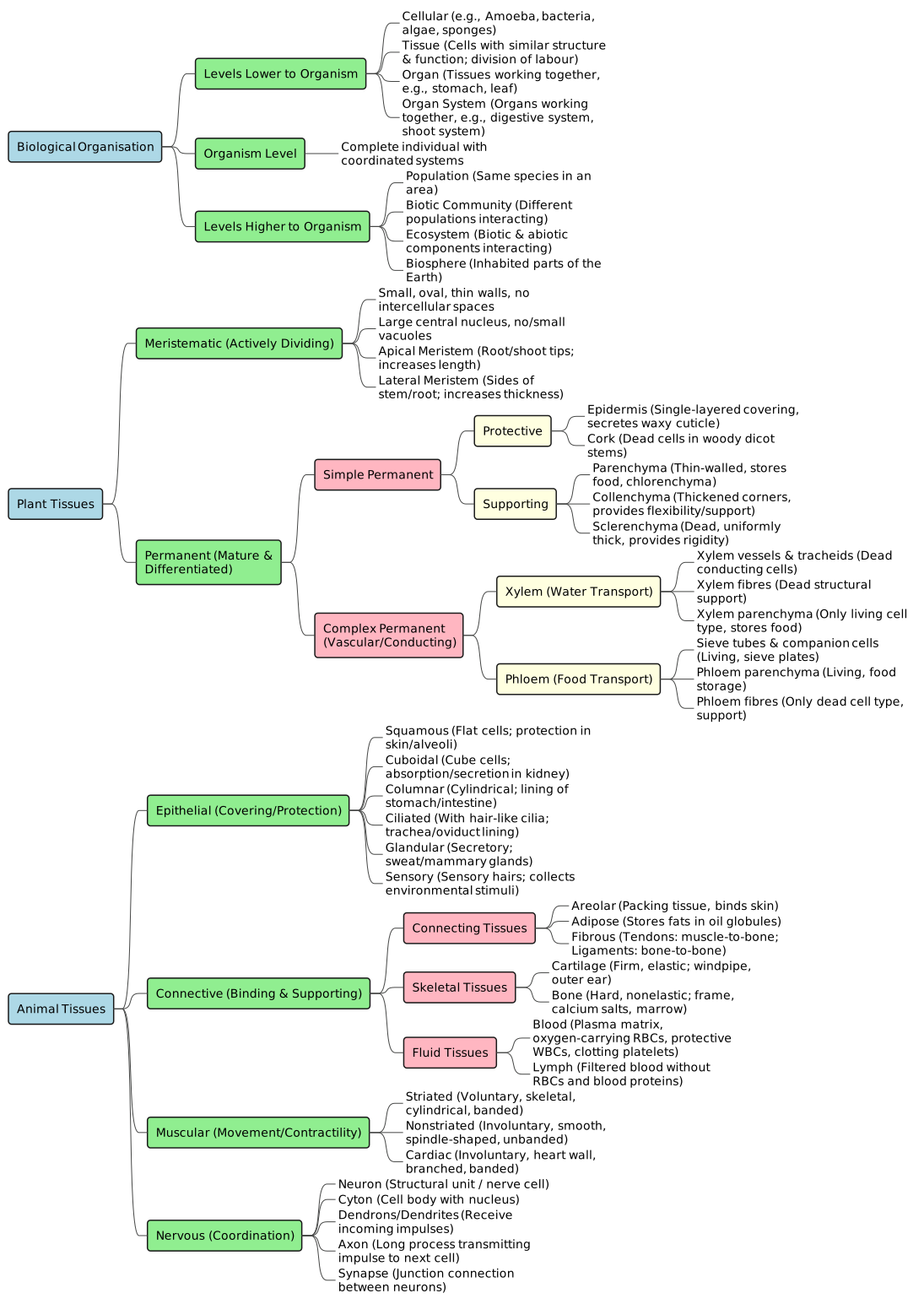
CHAPTER MINDMAP
Want to print your doc?
This is not the way.
This is not the way.

Try clicking the ··· in the right corner or using a keyboard shortcut (
CtrlP
) instead.