Skip to content
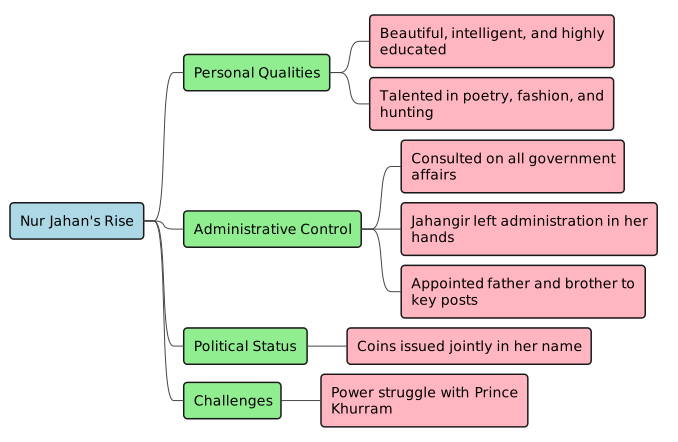
How did Nur Jahan emerge as the virtual ruler and become the power behind the throne during the reign of Jahangir?After marrying Emperor Jahangir in 1611 CE, Nur Jahan quickly became the most influential force at court due to her beauty, intelligence, and administrative talent. Jahangir trusted her capabilities deeply and consulted her on all important matters of state, eventually leaving the active administration in her hands while he indulged in leisure. She solidified her control by appointing close relatives, such as her father and brother, to key administrative positions across the empire. Her unique status was publicly demonstrated by issuing coins jointly in the names of both Jahangir and Nur Jahan. This supreme influence eventually led to a major power struggle with Jahangir’s favorite son and heir apparent, Prince Khurram, in the final years of the reign.
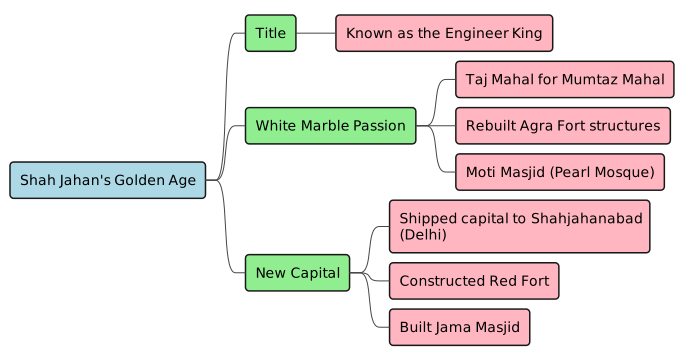
 Why is Shah Jahan’s reign known as the Golden Age of the Mughal empire and why is he referred to as the “Engineer King”?Shah Jahan is remembered as the Engineer King because his exceptional patronage of architecture is the defining, legendary characteristic of his rule. He commissioned the world-famous Taj Mahal in memory of his beloved wife Mumtaz Mahal, utilizing pure white marble and exquisite semi-precious stone inlay work. His passion for marble led him to replace many older sandstone structures, most notably constructing the elegant Moti Masjid at Agra Fort. Furthermore, he shifted his capital to Delhi in 1639 CE, building the city of Shahjahanabad, the magnificent Red Fort, and the grand Jama Masjid. These spectacular architectural achievements and cultural brilliance made his reign the undisputed Golden Age of the empire.
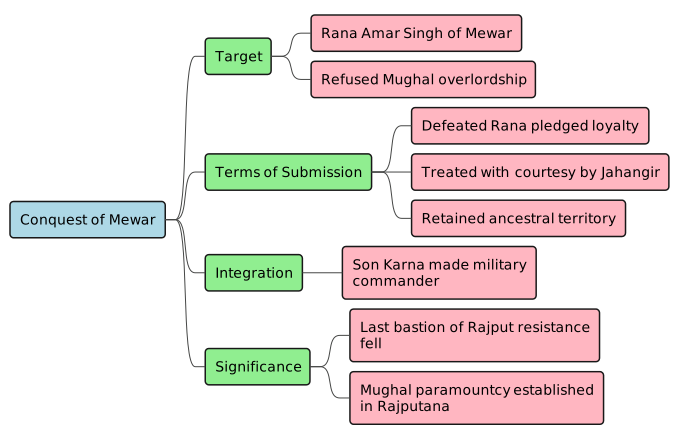
 How did Jahangir successfully manage the conquest and submission of Mewar, and what was its significance?Jahangir sent a major military expedition against Rana Amar Singh of Mewar, who had continuously refused to acknowledge Mughal overlordship just like his father, Rana Pratap Singh. Following the defeat of the Mewar forces, the Rana pledged his loyalty to Jahangir, who treated his defeated adversary with great courtesy. Jahangir allowed the Rana to fully retain his ancestral territory and appointed his son, Karna, as a military commander in the imperial army. This respectful diplomatic settlement marked the fall of the very last bastion of active Rajput resistance in the region. Ultimately, the successful submission of Mewar established the paramountcy of Mughal authority across Rajputana and fulfilled an unrealized imperial dream of Akbar.
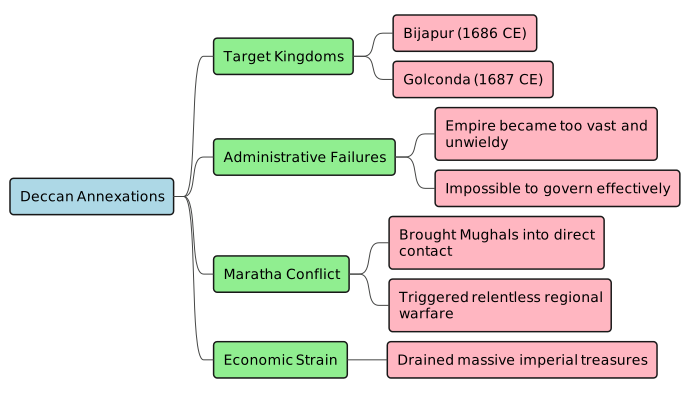
 Why did the annexation of the Deccan kingdoms of Bijapur and Golconda prove harmful to the Mughal empire during Aurangzeb’s reign?Aurangzeb successfully annexed the wealthy sultanates of Bijapur in 1686 CE and Golconda in 1687 CE to achieve his ambition of an all-India empire. However, these massive territorial additions made the Mughal empire excessively vast, unwieldy, and highly difficult to govern from a single central capital. The geographical expansion brought the Mughal frontiers into direct, hostile contact with the highly mobile and resilient Maratha forces. This proximity triggered a prolonged, exhausting warfare that systematically drained the military and economic resources of the imperial treasury. Rather than strengthening the state, these conquests destabilized the empire, showing that Aurangzeb had gained vast land but lost crucial administrative stability.
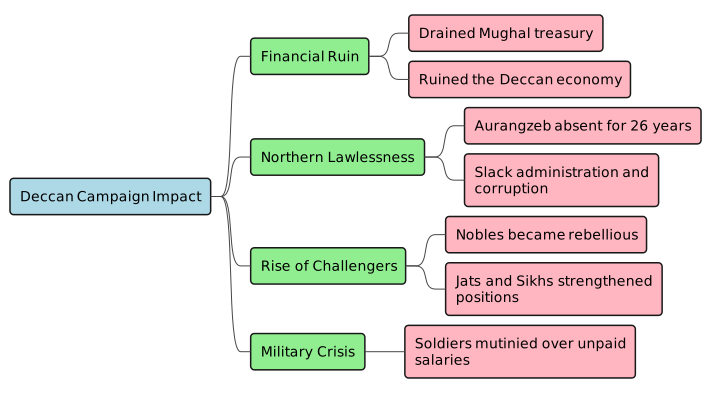
 What were the devastating long-term consequences of Aurangzeb’s prolonged Deccan campaigns on the administration and stability of the Mughal empire?Aurangzeb spent the final 26 years of his life in the Deccan fighting endless, exhausting campaigns to crush Maratha resistance and annex southern territories. These prolonged military operations completely drained the immense wealth of the Mughal treasury and ruined the local agrarian economy of the Deccan. Because the emperor remained absent from the north for over two decades, central administration slackened, giving rise to rampant corruption, disorder, and lawlessness. This administrative vacuum allowed regional groups like the Jats and Sikhs to strengthen their positions, while ambitious provincial nobles turned rebellious. Ultimately, the disgruntled Deccan soldiers mutinied over unpaid wages, and the grand edifice of the empire suffered irreparable cracks by the time of Aurangzeb’s death in 1707 CE.

Share
Explore
 Long Answers
Prepared by: learnloophq@gmail.com
Chapter: 10. Jahangir Shah Jahan And Aurangzeb
Want to print your doc?
This is not the way.
This is not the way.

Try clicking the ··· in the right corner or using a keyboard shortcut (
CtrlP
) instead.