Skip to content
Babur inherited the small principality of ‘_ _ _ _ _ _ _ _ _ _ _ _ _ _’ in Central Asia from his father in 1494 CE.Babur’s autobiography, written in flawless Turkish, is called the ‘_ _ _ _ _ _ _ _ _ _ _ _ _ _’.Humayun escaped drowning in the Ganga after his defeat at Chausa with the help of a ‘_ _ _ _ _ _ _ _ _ _ _ _ _ _’.In Sher Shah’s administration, the officer responsible for the collection of land revenue in the villages was the ‘_ _ _ _ _ _ _ _ _ _ _ _ _ _’.The system of land deeds introduced by Sher Shah consisted of the ‘_ _ _ _ _ _ _ _ _ _ _ _ _ _’ (title deed) and the qubuliat (agreement).
Babur died in Agra in December 1530 CE and was buried there.Humayun’s brothers supported him loyally during his 15 years of exile.Sher Shah Suri revived Alauddin Khilji’s military system of branding horses (dagh) and maintaining descriptive rolls of soldiers (chehra).Sher Shah’s land revenue policy insisted on strict assessment but lenient collection of taxes.
SarkarsDak ChaukisMunsifQubuliat
Which administrative unit was placed directly under the charge of an Afghan chief?Name the officials responsible for supervising the work of the parganas.How did Sher Shah keep in touch with the villages, and who managed the local village affairs?
What was the political condition of India on the eve of Babur’s invasion?Why did Humayun abandon the siege of the fort of Chunar in his initial conflict with Sher Khan?How did the Shah of Persia assist Humayun during his period of exile?Mention any two military measures taken by Sher Shah to make his army disciplined and efficient.Why did Sher Shah make the local village headmen and chieftains responsible for crimes in their areas?
The Battle of Khanwa (1527 CE) is considered more decisive than the First Battle of Panipat (1526 CE). Explain why, comparing the outcomes of both battles.Discuss the land revenue administration of Sher Shah Suri. Explain how the land was assessed and what relief measures were offered to the peasants.Describe the communication system developed by Sher Shah Suri. How did it benefit trade, military movement, and the general public?

Share
Explore
 Question Paper
Prepared by: learnloophq@gmail.com
Chapter: 08. Babur Humayun And Sher Shah
PRACTICE EXAM PAPER
Subject: History
Theme: The Mughal Empire (Babur, Humayun, and Sher Shah)
Class: Middle School
SECTION A: MULTIPLE CHOICE QUESTIONS (MCQs)
Q1. In 1522 CE, who invited Babur to invade India and help overthrow Ibrahim Lodi?
(a) Rana Sanga
(b) Daulat Khan Lodi
© Sher Khan Suri
(d) Medini Rai
Q2. Which battle gave Babur supreme control over central India and removed the biggest obstacle to Mughal rule?
(a) The First Battle of Panipat
(b) The Battle of Chanderi
© The Battle of Khanwa
(d) The Battle of Ghagra
Q3. The detailed biography of Humayun, titled Humayunnama, was authored by:
(a) Hamida Banu Begum
(b) Gulbadan Begum
© Maham Begum
(d) Nur Jahan
Q4. Sher Shah divided his entire empire into 47 provinces called:
(a) Parganas
(b) Sarkars
© Jagirs
(d) Subas
Q5. The silver coin introduced by Sher Shah, which remained a standard coin for centuries, was called the:
(a) Rupia
(b) Tanka
© Dam
(d) Jital
SECTION B: FILL IN THE BLANKS
Instructions: Write the correct word(s) in place of the blank ‘_ _ _ _ _ _ _ _ _ _ _ _ _ _’.
SECTION C: TRUE OR FALSE
Instructions: State whether the following statements are True or False. If False, rewrite the statement correctly.
SECTION D: EXPLANATION OF TERMS
Instructions: Explain the following terms in one or two sentences based on the chapter.
SECTION E: DIAGRAM-BASED QUESTION
A flowchart depicting the administrative hierarchy of Sher Shah’s Empire.
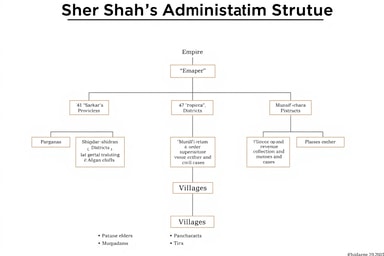
Based on the diagram and your reading of the text, answer the following questions:
SECTION F: SHORT ANSWER QUESTIONS
SECTION G: LONG ANSWER QUESTIONS
SECTION H: ENVIRONMENTAL AWARENESS / SDG-13 APPLICATION
Q1. Humayun’s Tomb in Delhi is a UNESCO World Heritage Site. The text mentions that environmental issues such as acid rain, caused by human-induced pollution, damage these historical monuments over time.
(a) Name two other human activities (besides air pollution leading to acid rain) that can cause physical damage to historical monuments.
(b) Suggest two practical steps that students and local citizens can take to help protect and preserve historical monuments in their region.
Want to print your doc?
This is not the way.
This is not the way.

Try clicking the ··· in the right corner or using a keyboard shortcut (
CtrlP
) instead.