Skip to content
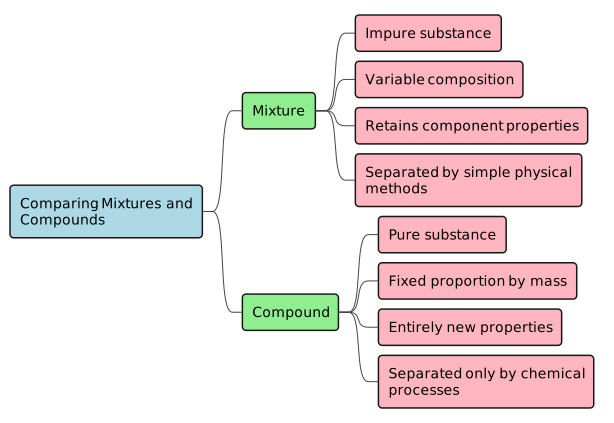
Explain the differences between a mixture and a compound on the basis of their composition, properties, and separation methods.A mixture is an impure substance containing two or more substances physically mixed in any variable proportion by mass, whereas a compound is a pure substance containing two or more elements chemically combined in a fixed proportion. The components of a mixture retain their individual physical and chemical properties, but a compound exhibits entirely different properties from those of its constituent elements. Additionally, the constituents of a mixture can be easily separated using simple physical methods because they do not combine chemically. In contrast, the constituent elements of a compound cannot be separated by physical means and can only be separated through complex chemical processes.
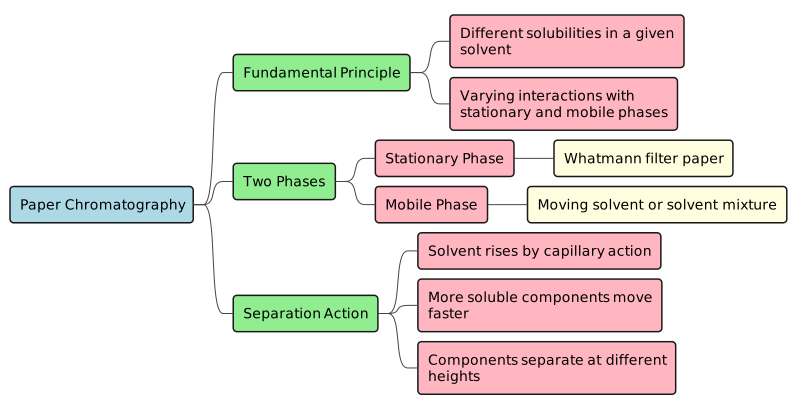
 Describe the process of paper chromatography and explain the fundamental principle on which it works.Chromatography is a separation technique used to separate dissolved solids present in a solution in very small quantities. The process is based on the principle that different substances in a mixture have varying solubilities in a given solvent, causing them to interact differently with the stationary and mobile phases. In paper chromatography, a specially designed Whatmann filter paper acts as the stationary phase, while a pure solvent or solvent mixture serves as the mobile phase. As the mobile phase rises through the paper by capillary action, it carries the dissolved components along at different speeds. The substance that is more soluble in the solvent moves faster and produces a spot at a greater height, successfully separating the components.
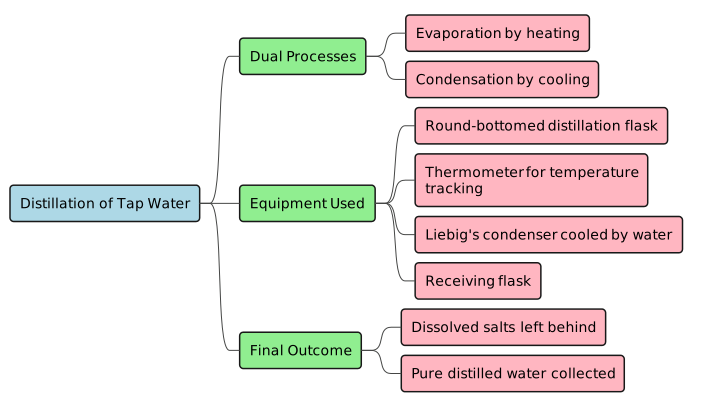
 Discuss the purification of tap water containing dissolved salts using the process of distillation.Distillation is a separation method used to obtain a pure liquid from a solution through consecutive processes of evaporation and condensation. In this process, tap water is placed in a round-bottomed distillation flask connected to a Liebig’s condenser, which has cold water continuously flowing through it. When the distillation flask is heated, the water boils to form water vapour, leaving the non-volatile dissolved salts behind. The rising water vapour escapes through a side tube and passes through the condenser, where it cools and condenses back into liquid form. Finally, this pure distilled water is collected in a receiving flask as the distillate.
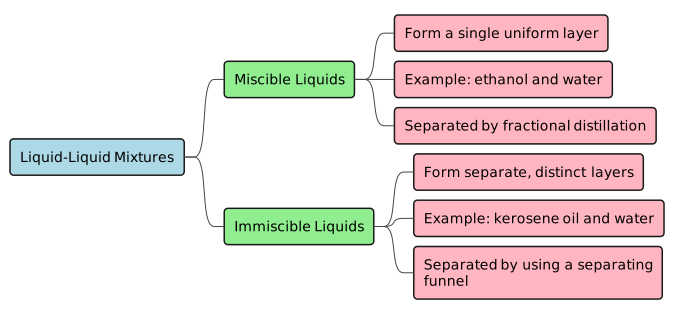
 What are miscible and immiscible liquids, and how are they separated differently?Liquids that dissolve completely in each other to form a single uniform layer are called miscible liquids, such as milk and water. In contrast, immiscible liquids are those that do not mix completely and instead form separate layers based on their densities, like oil and water. A mixture of miscible liquids can be separated using fractional distillation, which relies on a difference in their boiling points of less than 25 degrees Celsius. On the other hand, immiscible liquids are separated using a separating funnel. In a separating funnel, the heavier liquid settles to the bottom layer and is drained out by opening a stopcock, leaving the lighter liquid behind.
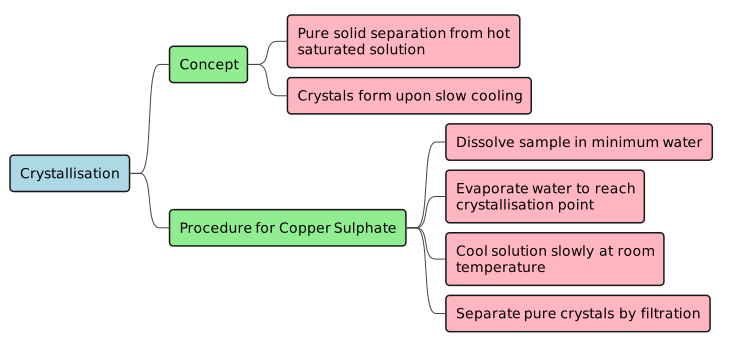
 Explain the method of crystallisation and outline how pure crystals of copper sulphate are obtained from an impure sample.Crystallisation is the process of separating a pure solid substance in the form of crystals from its hot saturated solution by cooling. To obtain pure copper sulphate, an impure sample is first dissolved in a minimum amount of water and filtered to remove insoluble impurities. The clear filtrate is then heated in a china dish over a water bath to evaporate water until the crystallisation point is reached. Once tiny crystals begin to form on a glass rod, the heating is stopped, and the hot saturated solution is left undisturbed to cool slowly. As the temperature decreases, the solubility of copper sulphate drops, resulting in the formation of pure crystals that can then be separated by filtration.

Share
Explore
 Long Answers
Chapter: 03. Elements Compounds And Mixtures
Want to print your doc?
This is not the way.
This is not the way.

Try clicking the ··· in the right corner or using a keyboard shortcut (
CtrlP
) instead.