Skip to content
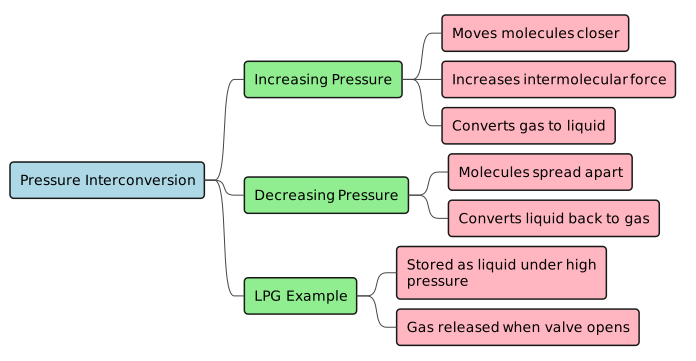
Explain how change in pressure helps in the interconversion of gases to liquids and vice versa, using the example of Liquefied Petroleum Gas (LPG).Applying high pressure on certain gases forces their molecules closer together, which increases the intermolecular force and converts them into liquids. This principle is utilized to store cooking gas as Liquefied Petroleum Gas (LPG) in a liquid form inside highly pressurized cylinders. When the valve of the gas regulator is opened, this high pressure is released. Consequently, the liquid LPG immediately changes back into its gaseous state as it exits the cylinder.
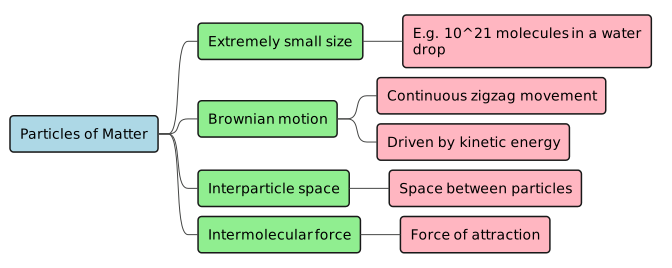
 What are the characteristics of particles of matter? Explain.Particles of matter are extremely small in size, so much so that a single drop of water contains about 10²¹ molecules. These particles are in continuous random zigzag motion known as Brownian motion, which is driven by their kinetic energy. Additionally, particles of matter have spaces between them called interparticle or intermolecular spaces. Finally, there exists an intermolecular force of attraction between these particles, which holds them together and varies in strength across different substances.
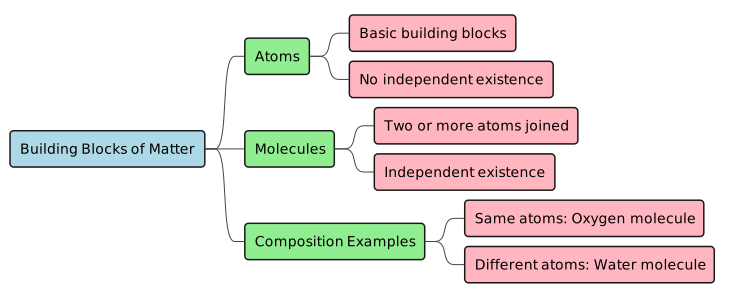
 Describe the concepts of atoms and molecules as the building blocks of matter according to the chapter.Matter is made up of extremely small particles called atoms, which are the basic units or building blocks of everything in the universe. An atom is the smallest particle that exhibits all properties of matter, but it usually does not have an independent existence. To achieve stability, atoms join together to form molecules, which are the smallest particles of matter capable of independent existence. These molecules can consist of either the same kind of atoms, like in an oxygen molecule, or different kinds of atoms, like in a water molecule.
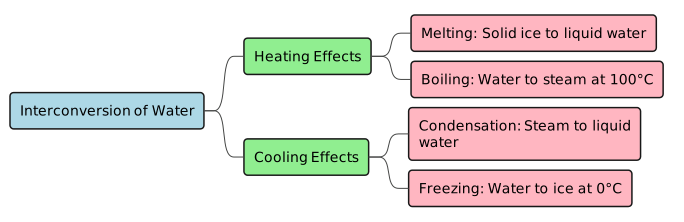
 How do the different states of water interconvert on heating and cooling?Water exists as a liquid at room temperature but can change states when heat energy is added or removed. When liquid water is heated to 100°C, it gains energy and boils to become steam, which is a gaseous state. Conversely, when steam is cooled, it loses energy and undergoes condensation to turn back into liquid water. Further cooling of liquid water to 0°C causes it to freeze into solid ice, which can melt back into liquid water when kept at room temperature.
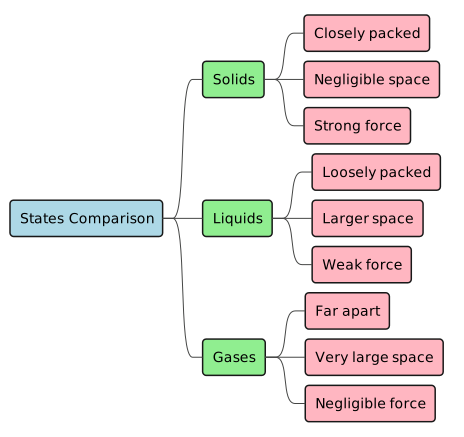
 Differentiate between solids, liquids, and gases on the basis of their intermolecular space, intermolecular force of attraction, and molecular arrangement.In solids, molecules are very closely packed with negligible intermolecular space and a very strong intermolecular force of attraction. Liquids have loosely packed molecules, resulting in larger intermolecular spaces and a weak intermolecular force of attraction compared to solids. In contrast, gas molecules are far apart because their intermolecular space is very large and the intermolecular force of attraction is negligible. These differences in packing explain why solids have a definite shape, whereas liquids and gases flow and take the shape of their container.

Share
Explore
 Answer key
Prepared by: learnloophq@gmail.com
Chapter: 01. Matter And Its Composition
Want to print your doc?
This is not the way.
This is not the way.

Try clicking the ··· in the right corner or using a keyboard shortcut (
CtrlP
) instead.