Skip to content
One calorie of heat energy is equal to approximately _ _ _ _ _ _ _ _ _ _ _ _ _ _ joules.The standard SI unit of temperature used in scientific measurements is _ _ _ _ _ _ _ _ _ _ _ _ _ _.The process in which a solid directly converts into a gaseous state on heating is called _ _ _ _ _ _ _ _ _ _ _ _ _ _.Sea breeze and land breeze are natural examples of _ _ _ _ _ _ _ _ _ _ _ _ _ _ currents.The brightly polished silvery walls of a thermos flask minimize heat loss or gain by _ _ _ _ _ _ _ _ _ _ _ _ _ _.
A laboratory thermometer is typically graduated from 35°C to 42°C.Gases expand much more than solids and liquids for the same rise in temperature.Air is a very good conductor of heat.When a bimetallic strip is heated, it bends towards the metal strip that has a lower rate of expansion.For most substances, their melting point and freezing point are almost identical.
Thermal ExpansionThermal EquilibriumInsulator
Conduction vs. Convection (Mechanism and state of matter where it occurs)Clinical Thermometer vs. Laboratory Thermometer (Range and structural differences)
Temperature Conversion:
The temperature of water in a beaker is measured to be 65°C using a laboratory thermometer. Convert this temperature into the Fahrenheit scale. Show your working clearly.Everyday Science Application:
Why do birds puff up their feathers on a cold winter day?Reasoning Corner:
Why are the iron rims of bullock cart wheels made slightly smaller than the wooden wheels, and how are they fitted onto them?
Which structural feature of the thermos flask prevents heat transfer by conduction and convection, and why?"How does the “silvery/shining wall” minimize heat transfer?
Convection Currents in Nature:
Describe in detail how convection currents are responsible for the formation of Sea Breeze during the day and Land Breeze at night in coastal areas. Draw a brief comparison of both phenomena.

Share
Explore
 Question Paper
Prepared by: learnloophq@gmail.com
Chapter: 05. Heat
PRACTICE EXAM PAPER: HEAT
Grade Level: Middle School (Science)
Time Allowed: 1 Hour 30 Minutes
Maximum Marks: 50
SECTION A: MULTIPLE CHOICE QUESTIONS (10 Marks)
Choose the correct option for each of the following questions.
1. The normal body temperature of a healthy human being is 37°C. What is this temperature on the Fahrenheit scale?
a. 94.0°F
b. 98.6°F
c. 108.0°F
d. 212.0°F
2. Which of the following substances shows anomalous expansion (contracts on heating) when its temperature rises from 0°C to 4°C?
a. Alcohol
b. Mercury
c. Water
d. Benzene
3. Which mode of heat transfer does not require any material medium to travel?
a. Conduction
b. Convection
c. Radiation
d. Sublimation
4. A clinical thermometer has a slight bend or kink in its capillary tube called a constriction. What is its purpose?
a. To make the thermometer look stylish.
b. To allow the mercury to expand faster.
c. To prevent the mercury level from dropping immediately after removal from the mouth.
d. To help in measuring temperatures up to 110°C.
5. Which of the following liquids is a good conductor of heat?
a. Water
b. Alcohol
c. Mercury
d. Benzene
SECTION B: FILL IN THE BLANKS (5 Marks)
Fill in the blanks with the correct term. Use exactly ‘_ _ _ _ _ _ _ _ _ _ _ _ _ _’ for the blank space.
SECTION C: TRUE OR FALSE (5 Marks)
State whether the following statements are True (T) or False (F).
SECTION D: EXPLANATION OF TERMS (6 Marks)
Define and briefly explain the following terms in one or two sentences.
SECTION E: IDENTIFY AND DIFFERENTIATE CONCEPTS (6 Marks)
Distinguish between the following pairs of concepts.
SECTION F: SHORT ANSWER QUESTIONS (8 Marks)
Answer the following questions in brief.
SECTION G: DIAGRAM-BASED QUESTION (4 Marks)
A labeled cross-section diagram of a thermos flask showing its various parts.
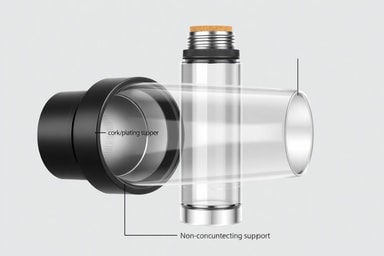
Based on the diagram and your understanding of a thermos flask, answer the following questions:
SECTION" H: LONG ANSWER QUESTIONS (6 Marks)
Answer the following question in detail.
Want to print your doc?
This is not the way.
This is not the way.

Try clicking the ··· in the right corner or using a keyboard shortcut (
CtrlP
) instead.