Skip to content
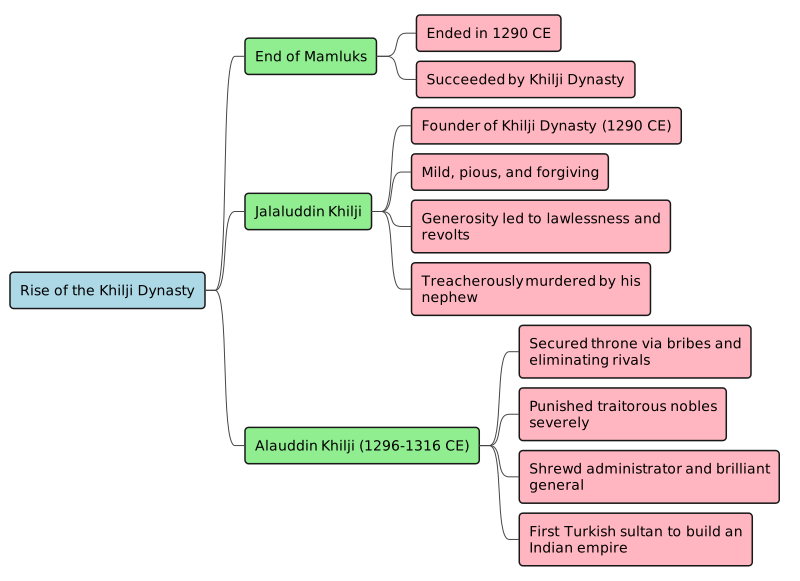
Chronology: The Mamluk dynasty came to an end in 1290 CE.Transition of Power: The control of the Delhi Sultanate passed into the hands of the Khilji dynasty.
Rise to Power: Captured the Delhi throne from the last Mamluk ruler in 1290 CE.Personality & Rule:Characterized as a mild, pious, and generous person.Forgave rebellious nobles and treated them with kindness.Consequences of Generosity: His soft approach led to lawlessness and widespread revolts across the kingdom.Demise: His ambitious nephew, Alauddin Khilji, took advantage of Jalaluddin’s generosity and treacherously murdered him.
Elimination of Rivals:Bribed the nobles with rich gifts to win their support.Blinded or killed Jalaluddin’s sons and grandsons to remove all obstacles to the throne.Declared himself Sultan and ascended the throne.Treatment of Traitors: He eventually took back the rich gifts from the nobles who had betrayed Jalaluddin, and had all except three of them blinded and killed.Significance of Reign (1296–1316 CE):He was a brilliant military general and a shrewd administrator.He became the first Turkish sultan to successfully build an empire in India.Extended the boundaries of the Delhi Sultanate south of the Vindhyas, reaching new heights of power and glory.
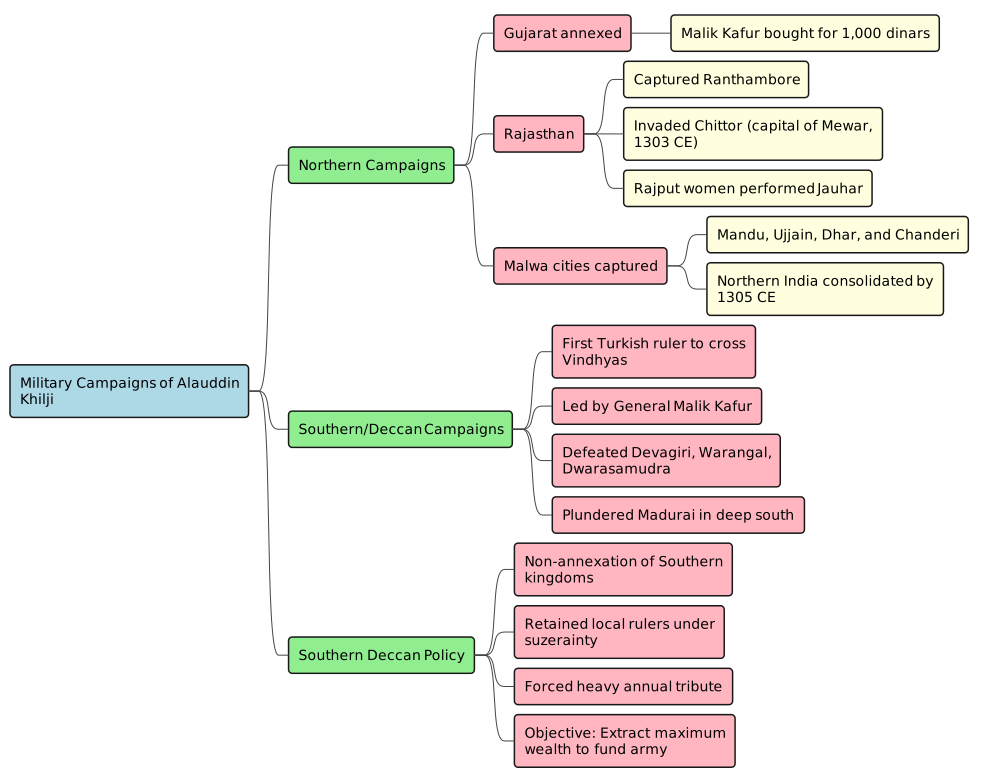
Gujarat:Alauddin sent an expedition to Gujarat, which was conquered and annexed.During this campaign, Malik Kafur (a slave) was purchased for 1,000 dinars. Malik Kafur rose rapidly to become the premier general of Alauddin’s army.Rajasthan:Captured the strategically important fort of Ranthambore.Attacked Chittor, the capital of Mewar. The Rajputs fought bravely but lost.Chittor Legend: According to a famous legend, the invasion of Chittor in 1303 CE was driven by Alauddin’s desire to possess Queen Padmini, the beautiful queen of Rana Ratan Singh, after catching a glimpse of her in a mirror. However, Queen Padmini and other palace women committed jauhar (self-immolation) to protect their honor.Central India (Malwa):Captured key cities including Mandu, Ujjain, Dhar, and Chanderi.By 1305 CE, Alauddin was the master of the whole of north India, which cleared the geographical pathway to the south.
Geographical Barrier Crossed: Alauddin was the first Turkish ruler to send military expeditions beyond the rugged terrain of the Vindhyas into the Deccan.Leadership of Malik Kafur:Led the southern campaigns and successfully defeated the rulers of Devagiri, Warangal, and Dwarasamudra.Plundered and attacked Madurai in the far south.The Siege of Dwarasamudra (1311 CE): Modern-day Halebidu in Karnataka’s Hassan district, celebrated for Hoysala architecture and the Hoysaleswara Temple.
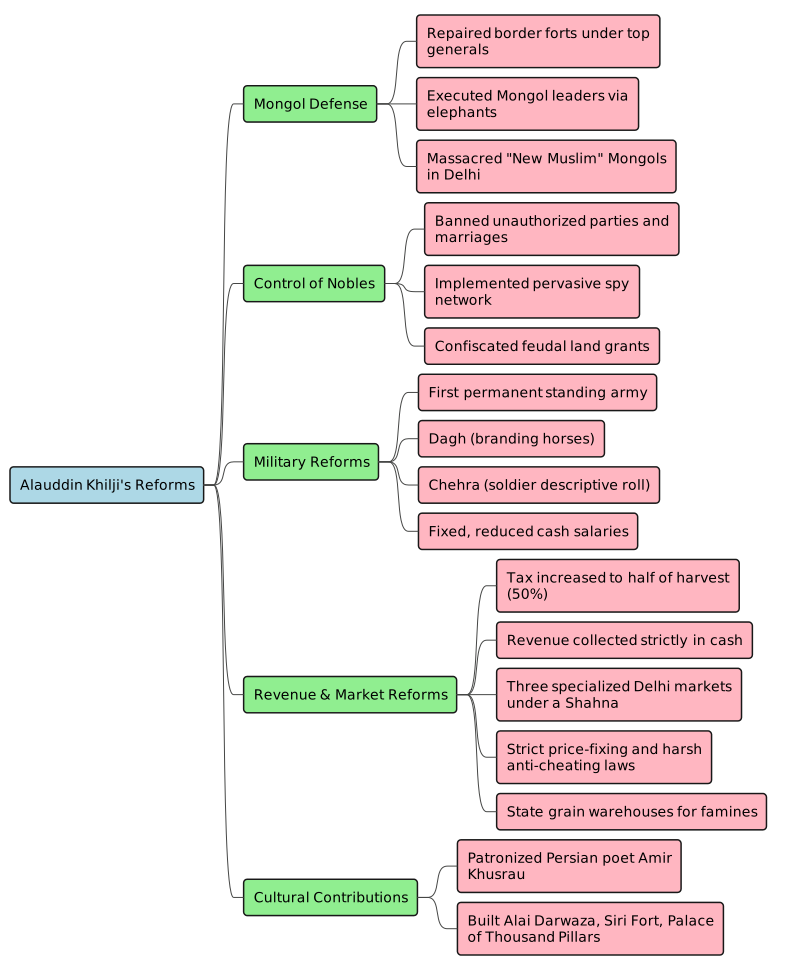
Fortifications: Repaired existing forts along the Mongol invasion routes and placed frontier provinces under his finest generals.Army Mobilization: Strengthened and reorganized the army.Severe Deterrents: Captured Mongol leaders were executed by being trampled to death by elephants.Massacres: Mercilessly killed the “New Muslims” (Mongols who had embraced Islam and settled in Delhi during Jalaluddin’s reign) to eliminate internal security threats.
Social Restrictions: Nobles were forbidden from holding social gatherings, organizing parties, or intermarrying without the Sultan’s prior permission.Spy System: Set up an elaborate, efficient espionage network. Spies reported all private and public activities of the nobles directly to the Sultan.Land Confiscation: All feudal land grants were confiscated. New landholders were only entitled to collect a portion of the revenue fixed by the Sultan and were strictly forbidden from levying extra taxes on peasants.
Direct Control: Enlarged the army and barred nobles from maintaining private forces.Dagh System: Introduced the practice of branding horses (dagh) to prevent the substitution of high-quality imperial horses with inferior ones.Chehra System: Maintained a detailed descriptive roll (chehra) of every soldier to prevent proxy enlistment.Salaries: Reduced and fixed the cash salaries of the soldiers to prevent inflation and control state expenditure.
Land Measurement: Land was systematically measured, and the state’s share of revenue was strictly fixed.Increased Taxation: The land tax was raised from one-third to half (50%) of the harvest.Cash Collection: All revenue had to be paid in cash, collected by specially appointed state officials.
Three Dedicated Markets:Food grains.Cloth and luxury goods (e.g., sugar, dry fruits).Horses, slaves, and cattle.Administrative Control: Each market was supervised by an officer called a shahna.Price Standardization: Prices of all commodities, including essential goods, were strictly fixed at low rates.Anti-Cheating Measures: Market officers closely monitored weights, measures, and trader activity. If a merchant was caught short-weighing a product, an equivalent weight of flesh was sliced from their body as punishment.Food Security: Established state-run warehouses stocked with grain reserves to be released during famines or shortages.
Amir Khusrau: The legendary Persian poet was patronized in Alauddin’s court.Key Architectural Contributions:Alai Darwaza: Built as an imposing entrance door to the Qutb Minar; a masterpiece of Khilji architecture.Siri Fort and the Palace of Thousand Pillars.A Madrasa within the Qutb complex, along with various other mosques and palaces.
Rise: Overthrew the last Khilji ruler in 1320 CE.Heritage: Born to a Turkish father and an Indian mother.Achievements: Re-established stability, suppressed provincial revolts, repaired administration, and was succeeded by his son Jauna Khan (who took the title Muhammad bin Tughlaq) after dying in a suspicious, seemingly pre-planned accident.
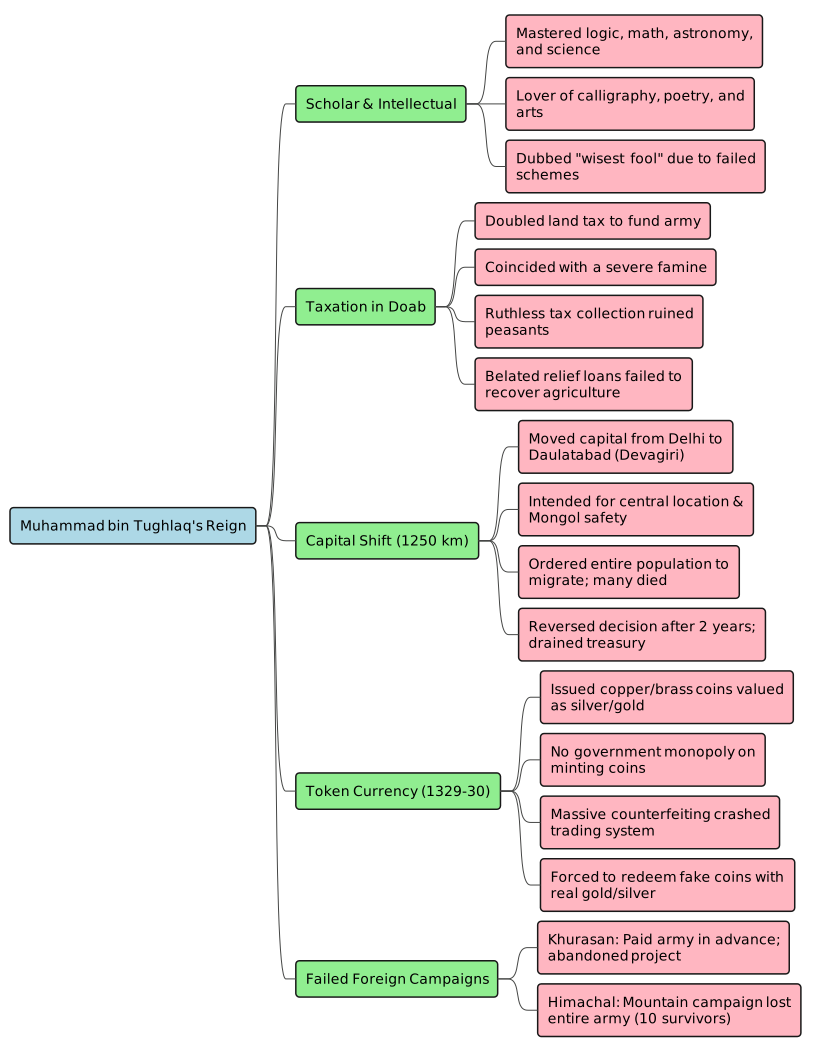
Personality: Highly learned scholar, master of logic, philosophy, mathematics, astronomy, physical sciences, Persian poetry, calligraphy, and fine arts.Historical Conflict: Historians debate his character; some label him a “madman” or “wisest fool”, while others call him an “idealist” and “visionary”. His projects were brilliantly conceived but ruined by poor implementation.
Goal: Generate additional revenue to fund and expand his large military forces.Crisis: The tax increase coincided with a failure of rains and a severe famine.Execution Error: Revenue collectors ruthlessly demanded payment, forcing ruined peasants to abandon their farms and flee into jungles.Belated Relief: Although the Sultan eventually set up free kitchens, distributed agricultural loans, and improved irrigation, the measures came too late and agriculture suffered an irreparable setback.
Objectives:Centralized Administration: Devagiri (renamed Daulatabad) was located centrally, almost equidistant from Delhi and other vital zones of the empire.Mongol Defense: Delhi was constantly vulnerable to Mongol raids; Daulatabad lay at a safe distance in the south.The Blunder: Instead of shifting only his court, he ordered the entire population of Delhi to make the grueling 1,250 km journey.Arduous Journey: Despite establishing a broad road with shade trees, rest houses, and free food, thousands died during the march. The survivors could not adapt to the alien conditions.The Return: With the Sultan in the south, the northern borders became highly vulnerable to Mongol attacks. Realizing his error, the Sultan ordered everyone back to Delhi after two years, leaving Daulatabad deserted and the state treasury empty.Note: Modern historians debate the extent of the mass exodus, pointing out that construction work in Delhi during this period indicates it was never completely depopulated.
Concept: Introduced copper and brass token coins to have the equivalent value of silver and gold coins, aimed at overcoming a financial treasury deficit.The Blunder: The state failed to secure a government monopoly on minting coins.Outcome: Every household turned into an illegal mint, flooding the market with counterfeit coins. Trade collapsed as foreign merchants refused the token coins, and citizens paid their state taxes using fake currency.Withdrawal: The Sultan had to withdraw the coins, paying back gold and silver for fake copper coins, which dealt a devastating blow to the treasury and his royal prestige.
Khurasan Expedition: Mobilized a colossal army to conquer Persia, Iraq, and Khurasan, paying them a full year’s salary in advance. He abandoned the campaign when he realized crossing the snowy Himalayan passes was practically impossible, depleting the treasury further.Himachal Expedition: Sent an expedition to conquer the Himachal region. The army suffered catastrophic casualties in the mountains, and only ten soldiers returned to Delhi.
Widespread Revolts: The financial ruin led to countrywide rebellions.Territorial Losses:Mewar recaptured Ranthambore and Chittor.In the South, the Hindu Vijayanagar Empire and the Muslim Bahmani Kingdom established independence.Bengal and Sind broke free.State of the Empire (1351 CE): When Muhammad bin Tughlaq died, the Delhi Sultanate was in an advanced state of decay and disintegration.
Profile: A major political thinker and companion (nadim) of Muhammad bin Tughlaq for 17 years.Famous Work: Composed the Tarikh-i-Firoz Shahi, chronicling the history of the Sultanate from Ghiyasuddin Tughlaq to the early years of Firoz Shah Tughlaq’s reign.
Accession: Muhammad bin Tughlaq’s cousin; nominated to the throne by the nobles and ulemas.Character: A peace-loving, just, and benevolent ruler who prioritized public welfare over military conquest.
Tax Relief: Reduced land taxes in the Doab and cancelled all outstanding famine loans. Abolished numerous minor taxes.Irrigation Network: Built and repaired old canals, dug hundreds of wells, and constructed several dams to boost farming. This restored agricultural productivity and prosperity.New Cities Founded: Built prosperous urban centers including Hisar Firoza (Hisar in Haryana), Firozpur, Firozabad (Firoz Shah Kotla), and Jaunpur (Uttar Pradesh).

Share
Explore
 Self Study
Prepared by: learnloophq@gmail.com
Chapter: 05. Expansion Of The Delhi Sultanate The Khilji And The Tughlaq Dynasties
Theme 3: The Delhi Sultanate
Chapter: Expansion of the Delhi Sultanate: The Khilji and the Tughlaq Dynasties
Section 1: The End of the Mamluk Dynasty and the Rise of the Khiljis
The transition from the Mamluk (Slave) Dynasty to the Khilji Dynasty in 1290 CE marked a critical turning point in the history of the Delhi Sultanate.
1. End of the Mamluk Dynasty
2. Jalaluddin Khilji (Founder of the Khilji Dynasty)
3. Alauddin Khilji’s Ascension

Section 2: Conquests and Deccan Policy of Alauddin Khilji
Alauddin Khilji transformed the regional Delhi Sultanate into a massive pan-Indian empire through aggressive and calculated military expeditions.
1. Military Conquests of North India
2. Deccan Campaigns and Policy

Comparison of Northern and Southern Administrative Policy
Region
Administrative Policy
Core Objective
North India (e.g., Gujarat, Malwa, Rajasthan)
Direct Annexation and administration.
Territorial expansion and direct imperial control.
The Deccan (South India)
Non-Annexation: Forced rulers to accept suzerainty and pay a heavy annual tribute.
Financial exploitation to pay for his massive army and administration; realized the difficulty of governing the south from Delhi.

Section 3: Administrative, Economic, and Defense Reforms of Alauddin Khilji
To sustain a massive empire and defend it from external threats, Alauddin Khilji executed radical reforms in defense, nobility control, military structure, land revenue, and market prices.
1. Mongol Defense Measures
The Mongols attacked India five times during the early years of Alauddin’s reign. To repulse these, he instituted a strict defense system:
2. Measures Against Rebellious Nobles
To curb conspiracies and revolts among his relatives and nobles, Alauddin implemented strict regulations:
3. Reorganization of the Standing Army
Alauddin laid the foundation of a permanent, centralized standing army:
4. Land Revenue Reforms
5. Market Control and Price Regulation Policy
To enable soldiers to live comfortably on their fixed, reduced salaries, Alauddin introduced unprecedented market control regulations in Delhi:
6. Art, Learning, and Architecture
Alauddin Khilji passed away in 1316 CE, triggering a phase of political instability. In 1320 CE, Ghiyasuddin Tughlaq executed the last Khilji ruler and established the Tughlaq Dynasty.

Section 4: The Tughlaq Dynasty – Rise and the Controversial Reign of Muhammad bin Tughlaq
The Tughlaqs ruled the major part of the 14th century, characterized by massive administrative experiments, extreme territorial expansions, and severe internal decay.
1. Ghiyasuddin Tughlaq (Founder)
2. Muhammad bin Tughlaq (1324–1351 CE)

3. Major Administrative Experiments & Failures
A. Increased Taxation in the Ganga-Yamuna Doab
B. Transfer of the Capital (Delhi to Devagiri / Daulatabad)
C. The Token Currency Experiment (1329–1330 CE)
D. Ambitious Military Expansion Schemes
4. Consequences and Decline
Ziauddin Barani (1285–1358 CE) - Key Historian


Section 5: Firoz Shah Tughlaq, the Collapse of the Sultanate, and Later Dynasties
Following the chaotic reign of Muhammad bin Tughlaq, the Sultanate adopted a policy of conciliation under Firoz Shah, before facing ultimate destruction by foreign invasion.
1. Firoz Shah Tughlaq (1351–1388 CE)
2. Welfare and Administrative Reforms
A. Economic & Agricultural Reforms
Want to print your doc?
This is not the way.
This is not the way.

Try clicking the ··· in the right corner or using a keyboard shortcut (
CtrlP
) instead.