Skip to content
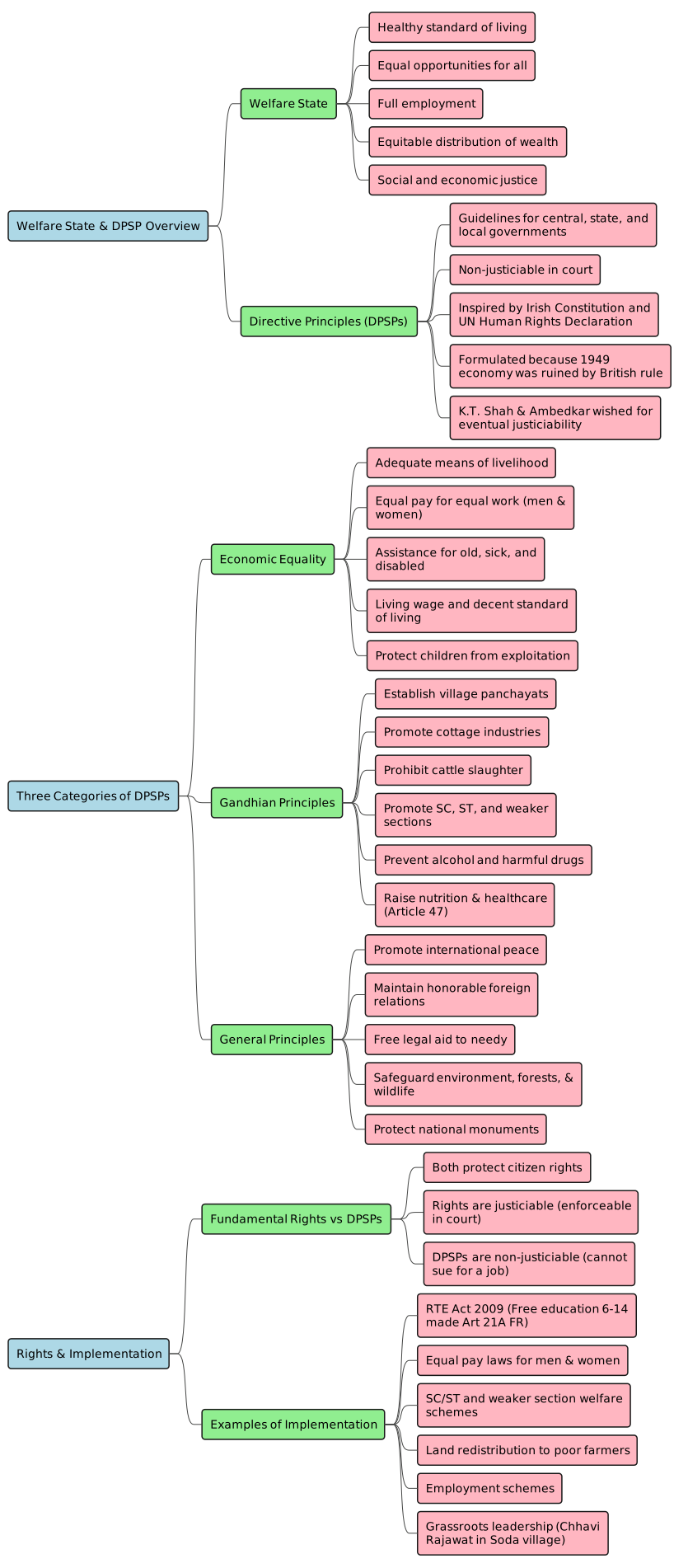
Economic Legacy of British Rule:For over 200 years, British economic policies systematically exploited and drained India’s wealth, leaving it an economic wasteland.Remedying this poverty and economic devastation was a primary responsibility of the newly formed Indian government.Genesis of the Directive Principles:In 1949, the framers of the Constitution could not immediately establish a fully realized welfare state because the country’s economy had been ruined by foreign rule.To guide future development, they incorporated specific guidelines in the Constitution for central, state, and local governments to follow. These guidelines are known as the Directive Principles of State Policy.Key Influences & Advocates:Inspirations: The Constitution of Ireland, the Gandhian Principles, and the United Nations Universal Declaration of Human Rights.Key Figures:K. T. Shah (economist and Constituent Assembly member) advocated for their inclusion.K. T. Shah and B. R. Ambedkar both wished for these principles to become justiciable after a certain period of time had passed.
State Responsibility: The welfare of all citizens is the primary responsibility of the state.Justice: Every citizen is guaranteed social and economic justice.Equality & Employment: It operates on the principle of equal opportunities for all and aims to secure full employment.Wealth Distribution: It guarantees an equitable distribution of wealth so that resources serve the common good.
Equitable Wealth: Fair and equitable distribution of the country’s wealth and material resources for the common good.Livelihood: Adequate means of livelihood for all citizens.Equal Pay: Equal pay for equal work for both men and women.Right to Work: Employment opportunities to tackle unemployment.Social Assistance: Public aid and assistance for the elderly, sick, disabled, and unemployed.Living Wage: A wage that enables workers to afford basic necessities.Decent Life: A decent standard of living and sufficient leisure time.Protection of Youth: Securing children and youth against exploitation.
Free Education: Provide free and compulsory education for all children up to the age of 14.Cottage Industries: Promote cottage industries in rural villages.Agriculture & Animal Husbandry: Modernize agriculture and animal husbandry, and prohibit the slaughter of cattle.Weaker Sections: Promote the educational and economic interests of Scheduled Castes (SCs), Scheduled Tribes (STs), and other weaker sections of society.Public Health: Raise nutrition and general health levels (Article 47).Prohibition: Prevent the consumption of intoxicating drinks and harmful drugs.Local Self-Government: Establish village panchayats.
International Relations: Promote international peace and security, and maintain just and honorable relations with other nations.Legal Aid: Provide free legal aid to needy citizens to ensure justice is accessible to all.Environmental Protection: Protect and improve the environment, and safeguard forests and wildlife.Heritage Protection: Protect national monuments, places, and objects of national importance.
Right to Education (RTE) Act, 2009: Under Article 21A, free and compulsory education for children between 6 and 14 years of age was upgraded to a Fundamental Right.Support for Weaker Sections: Targeted welfare schemes are implemented for Scheduled Castes (SCs), Scheduled Tribes (STs), and other marginalized sections.Gender Equality: Passage of laws guaranteeing equal pay for equal work for both men and women.Land Reforms: Distribution of agricultural land among poor, landless farmers.Employment: Execution of various public employment and poverty alleviation schemes.Grassroots Leadership Example: Chhavi Rajawat left a corporate career to become India’s first woman sarpanch (Soda village, Rajasthan), successfully implementing welfare programs for clean water, solar power, and improved education.

Share
Explore
 Recap Hub
Prepared by: learnloophq@gmail.com
Chapter: 13. Directive Principles Of State Policy
CHAPTER REVISION CRASH COURSE: DIRECTIVE PRINCIPLES OF STATE POLICY
1. Introduction & Historical Background
2. The Concept of a Welfare State
A Welfare State is a country where citizens are guaranteed a healthy standard of living, equal opportunities, full employment, and a fair distribution of wealth.
Key Features of a Welfare State
3. Classification of the Directive Principles
The Directive Principles of State Policy are broadly classified into three major categories:
DIRECTIVE PRINCIPLES
│
┌─────────────────────┼─────────────────────┐
▼ ▼ ▼
Principles Promoting Gandhian General
Economic Equality Principles Principles
A. Principles Promoting Economic Equality
The government is directed to enact policies to ensure:
B. Gandhian Principles (Economic & Social Development)
Based on Mahatma Gandhi’s vision for social development during the freedom struggle, the state is directed to:
C. General Principles
These guidelines address justice, environment, cultural heritage, and foreign policy. The state is directed to:
4. Fundamental Rights vs. Directive Principles
Feature
Fundamental Rights
Directive Principles of State Policy
Common Purpose
Protect citizens’ rights and ensure national social, economic, and political progress.
Protect citizens’ rights and ensure national social, economic, and political progress.
Justiciability
Justiciable: Citizens can approach a court of law (High Court/Supreme Court) for enforcement if deprived of these rights.
Non-justiciable: Citizens cannot seek justice in a court of law if these guidelines (e.g., right to a job or equal wages) are not met.
Nature
Legally binding guarantees.
Non-binding constitutional guidelines/goals for governments to strive toward.
5. Implementation of Directive Principles
Though India is still working toward becoming a complete welfare state, successive governments have successfully implemented several principles:
Chapter Mindmap (PlantUML)
Want to print your doc?
This is not the way.
This is not the way.

Try clicking the ··· in the right corner or using a keyboard shortcut (
CtrlP
) instead.