Skip to content
Fragmentation: India was divided into numerous small, independent kingdoms.Decline of Delhi Sultanate: The Sultanate’s territory was vastly reduced, with control confined primarily to Delhi and its surrounding areas.Political Disunity: Severe discord and lack of unity among regional rulers created a highly vulnerable political climate, paving the way for foreign invasion.
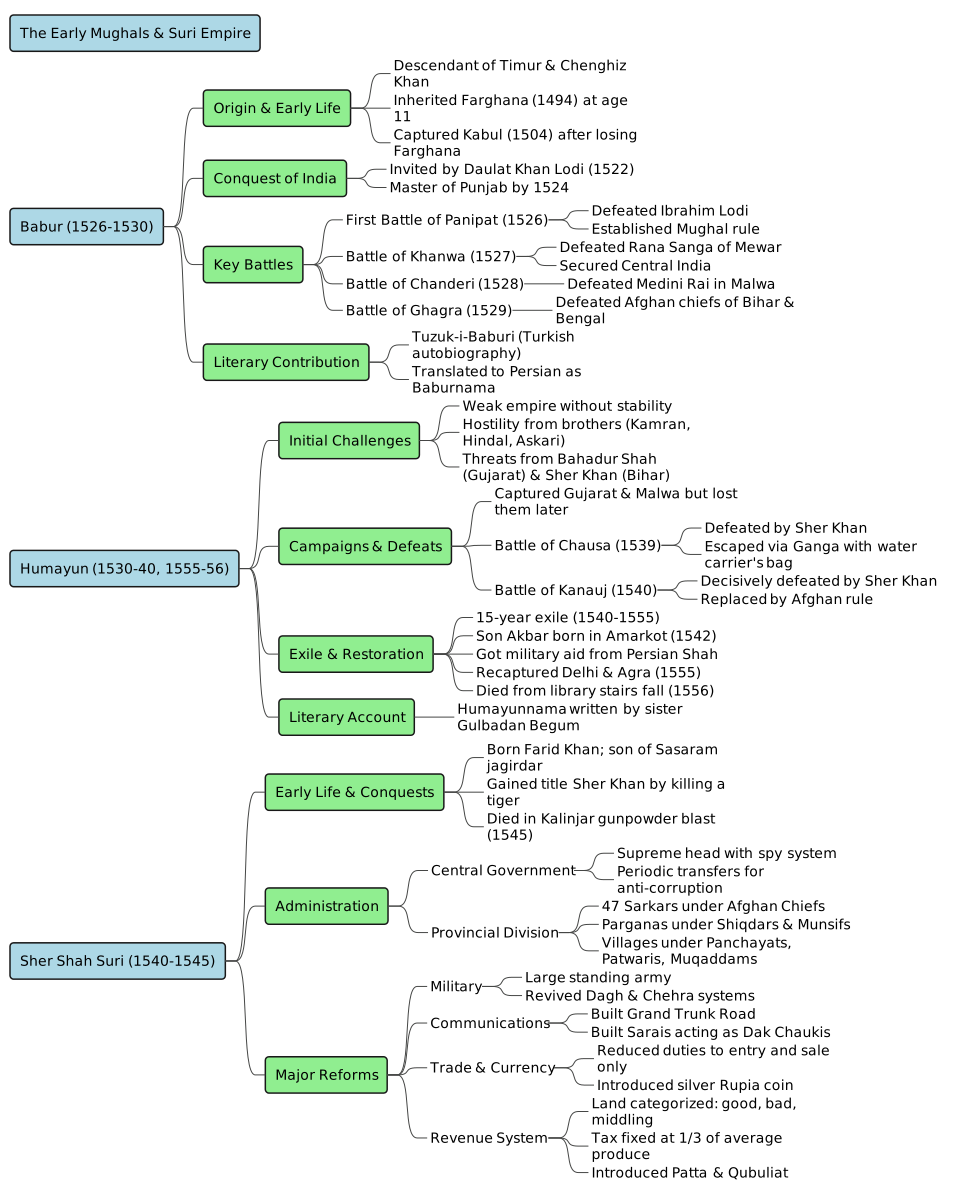
Heritage: Ambitious descendant of both Amir Timur and Chenghiz Khan.Farghana: Inherited the small Central Asian principality of Farghana in 1494 CE at just 11 years of age after his father’s death.Samarkand & Kabul: Conquered Samarkand at age 14 but quickly lost both Samarkand and Farghana, becoming a homeless wanderer. Through determination, he established himself as the ruler of Kabul in 1504 CE.Invitation to India: In 1522 CE, Daulat Khan Lodi invited Babur to India to help overthrow the unpopular Delhi Sultan, Ibrahim Lodi.Entry into Punjab: By 1524 CE, Babur conquered Punjab. Although Daulat Khan later turned against him, Babur defeated him and marched toward Delhi.
Tuzuk-i-Baburi: Babur’s autobiography written in Turkish. It is highly regarded for its candid observations on India’s flora, fauna, geography, population, resources, and customs.Baburnama: The Persian translation of Tuzuk-i-Baburi commissioned during the reign of his grandson, Akbar.Death: Babur died in Agra on December 26, 1530 CE, and was buried in Kabul, in accordance with his wishes.
Weak Foundation: Inherited a vast but unstable and poorly consolidated empire.Internal Threats: His younger brothers (Kamran, Hindal, Askari) were highly ambitious and plotted against him, despite Humayun dividing the empire among them to respect his father’s dying wish.External Rivals:Sher Khan Suri, an ambitious Afghan chief in the east (Bihar and Bengal).Bahadur Shah, the powerful ruler of Gujarat and Malwa.
Siege of Chunar: Humayun besieged Sher Khan’s stronghold but abandoned it after 4 months to deal with Bahadur Shah. Sher Khan was left in possession of the fort in exchange for a promise of loyalty.Campaign in Gujarat & Malwa: Humayun successfully captured Gujarat and Malwa. However, while he was away, Sher Khan consolidated power in Bengal and Bihar. When Humayun marched east to confront him, Bahadur Shah recaptured Gujarat and Malwa.Invasion of Bengal: Humayun wasted critical months in merrymaking at Gaur (Bengal) while Sher Khan cut off his communication lines and supply routes to Agra.Battle of Chausa (1539 CE): Sher Khan launched a surprise attack on the Mughal forces. The Mughal army was routed, and Humayun barely escaped drowning in the Ganga by using a water carrier’s inflated leather bag.Battle of Kanauj (1540 CE): Sher Khan decisively defeated the Mughal army. Humayun was forced to flee, and Sher Khan assumed the title of Sher Shah, ending the first phase of Mughal rule.
Exile (1540–1555 CE): Humayun spent 15 years wandering in exile.In 1542 CE, his son Akbar was born at Amarkot in Sind under the protection of the Rajput ruler Rana Virsala.Humayun secured military aid from the Shah of Persia, recaptured Kabul and Kandahar from his brother Kamran, and consolidated his position.Restoration (1555 CE): Recognizing that Sher Shah’s successors were weak and incompetent, Humayun invaded India and recaptured Delhi and Agra in 1555 CE.Death: Humayun died shortly after his return in 1556 CE due to an accidental fall down the stairs of his library.Humayunnama: A detailed account of his life written by his sister, Gulbadan Begum.
Background: Born Farid Khan, the son of Hasan Khan (a jagirdar of Sasaram in Bihar). He received the title Sher Khan after killing a tiger single-handedly.Rise: Joined Babur’s army, learned Mughal military techniques, and eventually established dominance over Bihar and Bengal during Humayun’s reign.Brief Reign: Crowned Emperor in 1540 CE. He conquered Malwa, Rajputana, Multan, Sind, and Punjab.Death: Died in 1545 CE in an accidental gunpowder explosion during the siege of Kalinjar.
Central Administration: Sher Shah held supreme authority. He divided the government into specialized departments led by ministers, instituted an efficient spy system, and undertook regular inspection tours.Sarkars & Parganas: The empire was divided into 47 sarkars (provinces), subdivided into parganas (districts).Shiqdar: Managed law, order, and general administration.Munsif: Looked after civil cases and revenue collection.Anti-corruption Policy: Officials were periodically transferred to prevent them from becoming corrupt or overly powerful.Village Level: Panchayats managed local affairs. Government representatives included the Patwari (revenue collector) and Muqaddam (peacekeeper).
Maintained a large, highly disciplined standing army.Personally supervised the recruitment, training, and salary determination of soldiers.Revived Alauddin Khilji’s military systems:Dagh: Branding of horses to prevent substitution.Chehra: Descriptive rolls of soldiers to prevent fraud.
Built an extensive network of roads to aid military movement, trade, and traveler comfort.Grand Trunk Road: The longest of his four major highways, connecting Sonargaon (modern Bangladesh) to Peshawar (modern Pakistan).Sarais (Rest Houses): Built at regular intervals with shady trees and wells. These also served as dak chaukis (post houses), where horsemen were stationed to relay royal mail.
Trade Boost: Abolished all transit duties except two: an import duty at the border and a sales duty at the marketplace.Security: Local zamindars and village headmen were held personally liable for the safety of merchants and their goods.Currency reform: Introduced standardized coins of gold, silver, and copper. His silver coin, the rupia, became a standard monetary unit for centuries.Strict Justice: Harsh criminal laws and severe punishments acted as strong deterrents. Local officials were heavily penalized if they failed to solve crimes in their jurisdictions.
Land Assessment: Land was measured annually and categorized into three types based on fertility: good, bad, and middling.Tax Rate: Fixed at one-third (1/3) of the average produce, payable in cash or kind.Peasant Relief: Followed a system of lenient assessment but strict collection. Taxes were waived and agricultural loans were granted during crop failures or wartime destruction.Land Ownership Reforms: Discouraged the jagir system and introduced:Patta: A formal title deed given to the peasant specifying land details.Qubuliat: A written agreement in which the peasant accepted his tax obligations to the state.

Share
Explore
 Recap Hub
Prepared by: learnloophq@gmail.com
Chapter: 08. Babur Humayun And Sher Shah
Theme 5: The Mughal Empire — Babur, Humayun, and Sher Shah
1. Political Scenario of India (Early 16th Century CE)
2. Zahiruddin Muhammad Babur (1526–1530 CE)
Early Life and Rise
Key Battles of Babur
Battle
Year
Opponent(s)
Key Significance
First Battle of Panipat
1526 CE
Ibrahim Lodi
Babur’s small but disciplined army, equipped with superior cavalry and fine artillery, routed Lodi’s massive army. Ibrahim Lodi was killed, and Babur was proclaimed the Emperor of Hindustan.
Battle of Khanwa
1527 CE
Rajput confederacy under Rana Sanga of Mewar
Babur used superior artillery and cavalry to defeat the Rajputs. This victory was highly decisive, giving Babur supreme control over Central India and removing the main obstacle to Mughal rule.
Battle of Chanderi
1528 CE
Medini Rai (Rajput chief)
Babur besieged and captured the strategic fort of Chanderi in Malwa, neutralizing further Rajput resistance.
Battle of Ghagra
1529 CE
Rebellious Afghan forces of Bihar and Bengal
Babur crushed the Afghan rebellion, extending his territory across Punjab, Delhi, and the Gangetic plain up to Bihar by 1530 CE.
Babur’s Literary Contributions & Death
3. Humayun (1530–1540 CE & 1555–1556 CE)
Challenges Faced
Military Expeditions & Fall
Exile and Return
4. Sher Shah Suri (1540–1545 CE)
Early Life and Conquests
5. Sher Shah’s Administration and Reforms
Sher Shah is celebrated as a brilliant organizer who ruled on the principles of a welfare state.
Administrative Divisions
[ Central Government ] — Headed by Sher Shah (assisted by Ministers)
|
[ Sarkars ] — 47 Provinces (headed by Afghan Chiefs)
|
[ Parganas ] — Districts (supervised by Shiqdar-i-Shiqdaran & Munsif-i-Munsifan)
|
[ Villages ] — Managed by Panchayats (assisted by Patwaris & Muqaddams)
Military Reforms
Infrastructure and Communication
Trade, Currency, and Justice
Revenue System (His Greatest Achievement)
Want to print your doc?
This is not the way.
This is not the way.

Try clicking the ··· in the right corner or using a keyboard shortcut (
CtrlP
) instead.