Skip to content
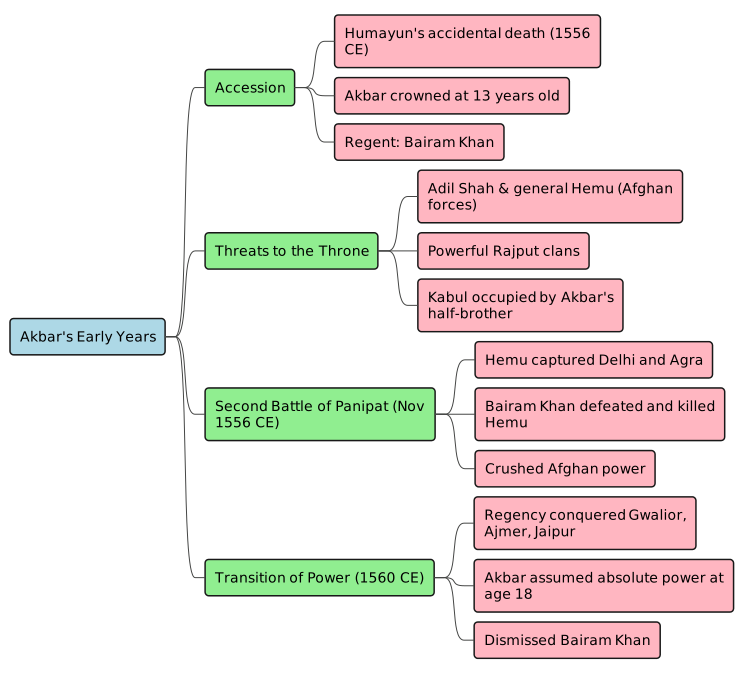
Humayun’s Death (1556 CE): Humayun returned to Delhi after 15 years in exile to re-establish Mughal rule. Shortly after regaining the throne from Sher Shah’s successors, he died from an accidental fall down his library stairs.Coronation at Age 13: His 13-year-old son, Akbar, was proclaimed emperor, embarking on a 50-year reign (1556–1605 CE) that would establish him as the greatest ruler of medieval India.Bairam Khan’s Regency: Bairam Khan, Humayun’s faithful and experienced general, served as Akbar’s regent to manage government affairs during his youth.
Afghan Revival: Adil Shah (Sher Shah’s nephew) sought to recapture Delhi and re-establish Afghan rule.Rajput Power: The Rajputs had grown strong and were prepared to expel the Mughals.Kabul Rebellion: Kabul was held by Akbar’s half-brother, who ruled independently.
Hemu’s Rise: Hemu, Adil Shah’s chief minister and military genius, occupied Delhi and Agra, declaring himself ruler.The Clash: Facing superior Afghan forces, Bairam Khan led the Mughal army to meet Hemu on the historic battlefield of Panipat (where Babur had defeated Ibrahim Lodi 30 years prior).Outcome: Hemu was defeated and killed. The victory crushed Afghan power and secured Akbar’s throne.
Early Conquests under Bairam Khan: Between 1556 and 1560 CE, Bairam Khan annexed Gwalior, Ajmer, and Jaipur while Akbar focused on pursuits like polo, hunting, and camel riding.Taking Charge: At age 18 (1560 CE), Akbar dismissed Bairam Khan, assuming absolute personal authority.
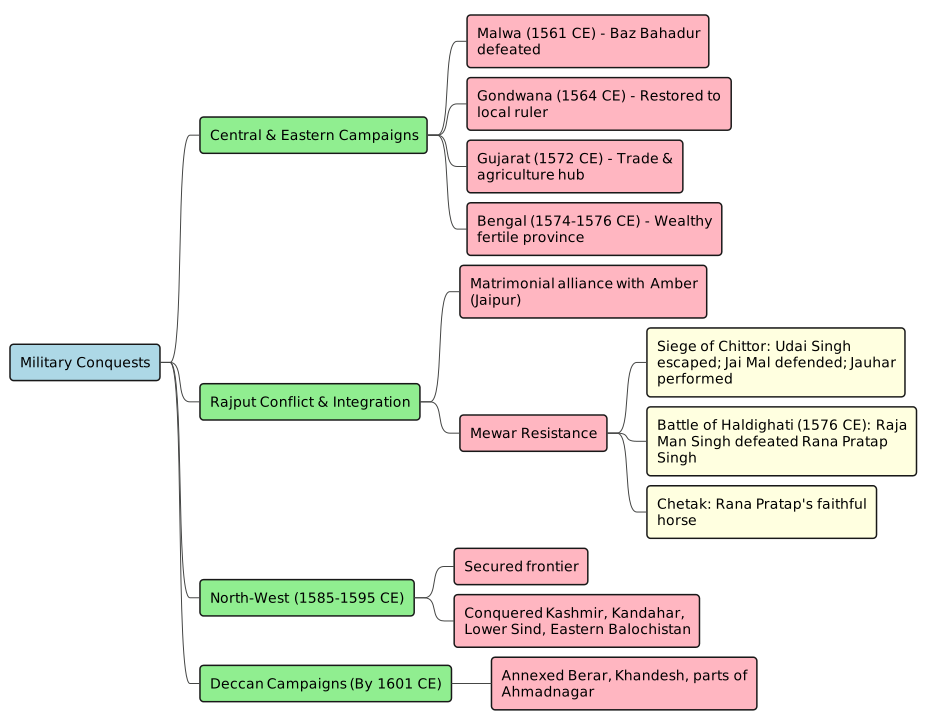
Malwa (1561 CE): Annexed from Baz Bahadur, who was later given a high post in Akbar’s court.Gondwana (1564 CE): Conquered but later restored to its local ruler.Gujarat (1572 CE): Conquered due to its importance as a rich trade and agricultural hub.Bengal (1574–1576 CE): Annexed after a two-year campaign, bringing one of India’s richest and most fertile provinces under Mughal control.
Matrimonial Alliances: Akbar married the daughter of the Raja of Jaipur (Amber). He also decided to marry the daughter of Udai Singh, the Rana of Mewar.
Rana Udai Singh’s Resistance: The Rana of Mewar, head of the Rajput clans, refused to submit or enter a matrimonial alliance. Akbar marched on the capital, Chittor.The Fall of Chittor: Udai Singh fled to the hills, leaving the defense to commander Jai Mal. After a 4-month siege, Jai Mal was killed. The Rajput women performed jauhar (self-immolation), and the soldiers perished fighting.Fall of Ranthambore: Following the fall of Chittor and Ranthambore, almost all Rajput princes accepted Akbar’s overlordship by 1570 CE.
Rana Pratap Singh: Udai Singh’s valiant son established a new capital at Udaipur and continued Mewar’s struggle against the Mughals.The Battle: Mughal forces, led by the Rajput chief Raja Man Singh of Amber, clashed with and defeated Rana Pratap’s outnumbered army.Chetak’s Sacrifice:Guerrilla Warfare: Rana Pratap took shelter in mountain fortresses, successfully recovering parts of Mewar’s territory (excluding Chittor) before his death.
North-West Campaigns (1585–1595 CE): Akbar conquered Kashmir, Kandahar, Lower Sind, and Eastern Balochistan, securing the north-west frontier.Deccan Campaigns: By 1601 CE, Akbar turned his focus south, annexing Berar, Khandesh, and parts of Ahmadnagar.
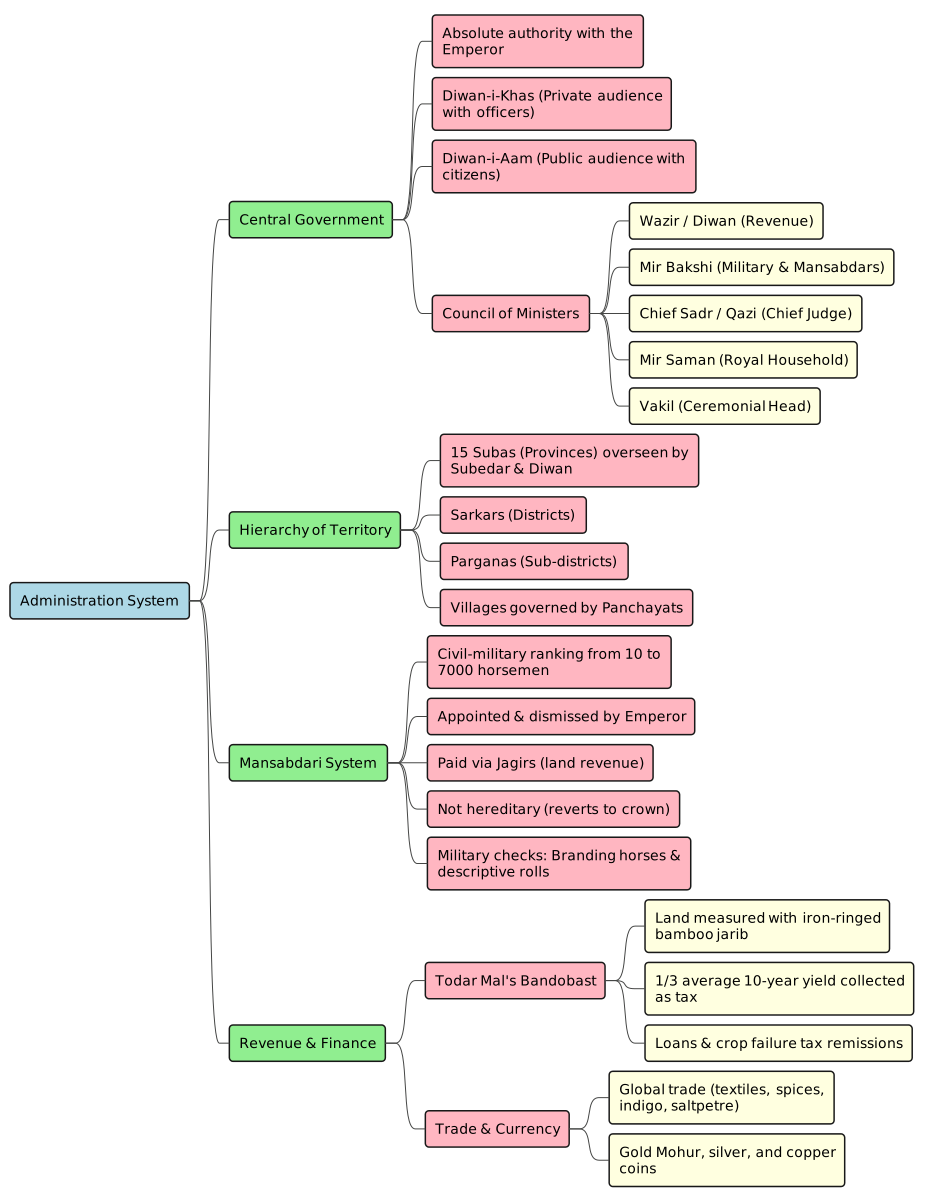
The Wazir / Diwan: Head of the revenue department.The Mir Bakshi: Head of the military department and paymaster of all mansabdars.The Chief Sadr / Qazi: Chief judge of the empire.The Mir Saman: Supervisor of the royal household.The Vakil: Prime minister, whose role Akbar reduced to an advisory, ceremonial head with no effective authority.Diwan-i-Khas: Private audience hall for meetings with senior officers.Diwan-i-Aam: Common audience hall where the emperor met his subjects, received petitions, and solved disputes.
Mansab & Mansabdar: “Mansab” means office or rank. A “Mansabdar” was a holder of a rank in the administration.Ranks: Ranks were assigned based on the importance of the office, ranging from an officer in charge of 10 horsemen (lowest) to 7,000 horsemen (highest, reserved for royal family members).Imperial Service: Mansabdars were appointed, promoted, or dismissed directly by the Emperor.Salaries & Jagirs: Originally paid in cash, they were later compensated via jagirs (land grants), collecting a fixed amount of revenue from the jagir to maintain themselves and their troops.Non-hereditary Nature: Ranks were not hereditary. Upon a mansabdar’s death, the jagir reverted to the crown.Military Efficiency: Akbar introduced the system of branding horses and maintaining descriptive rolls of soldiers.Standing Army: Along with troops supplied by mansabdars, Akbar directly recruited a standing army of loyal bodyguards, armed palace guards, war elephants, and an organized artillery.
Land Measurement: Land was measured using a bamboo jarib joined by iron rings (replacing the old hemp rope).Classification: Land was grouped into four categories based on cultivation frequency, further classified into good, middling, and bad.Assessment: The average produce and price over the preceding 10 years were calculated. The state’s share was fixed at one-third (1/3) of this average, payable preferably in cash (though kind was accepted).Peasant Welfare: Revenue officers were directed to treat peasants well. Loans (taccavi) were advanced in easy installments to purchase seeds, cattle, and implements. Remissions were granted during crop failures due to drought or flood.Trade and Currency:Internal and external trade of textiles, spices, indigo, and saltpetre flourished with China, Central Asia, and Europe.The Portuguese established trade centers on the west coast during this era.Akbar issued the Mohur, a high-purity gold coin of standard weight, alongside silver and copper coins.
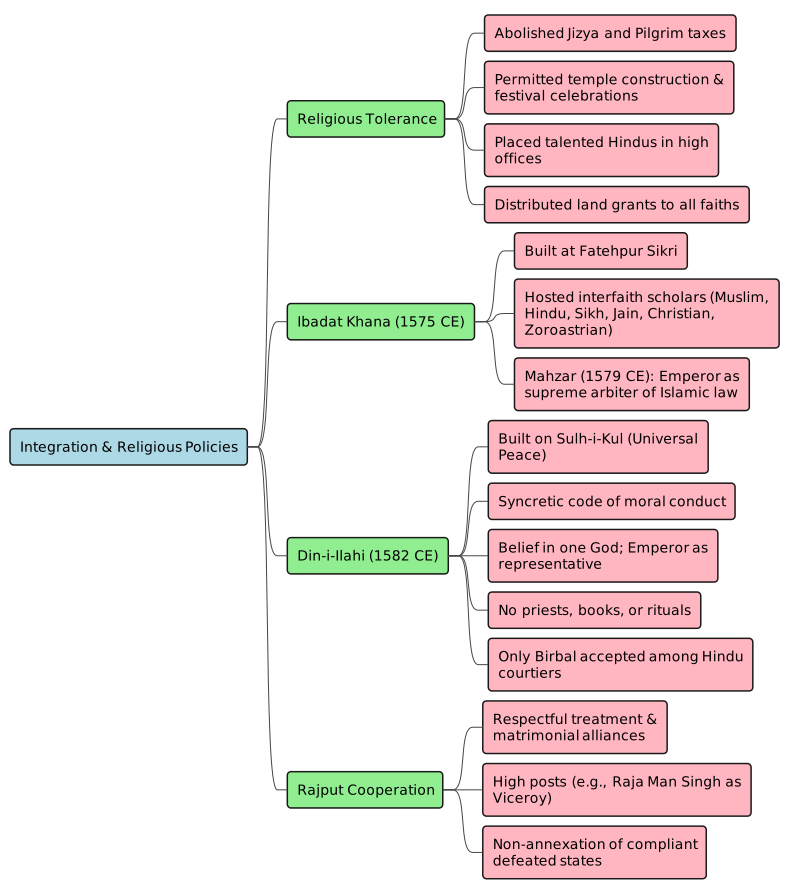
Abolition of Discriminatory Taxes: Akbar abolished the jizya (poll tax on non-Muslims) and the pilgrim tax (levied on Hindus visiting holy places), both of which were deeply resented by Hindus.Freedom of Worship: Hindus were permitted to build temples and celebrate festivals freely. Akbar married Rajput princesses, granted them freedom of worship, and actively participated in festivals like Holi and Diwali.High Administrative Appointments: Competent Hindus like Raja Todar Mal, Birbal, and Raja Bhagwan Das were appointed to top administrative and military posts.Charitable Grants: Akbar distributed land grants to individuals of all religious faiths.
Establishment (1575 CE): Akbar built the Ibadat Khana (Hall of Prayer) at his capital, Fatehpur Sikri, specifically for inter-religious debates.Interfaith Dialogues: He invited Muslim clerics, Hindu and Sikh scholars, Buddhist and Jain monks, Zoroastrian (Parsee) priests, and Christian missionaries to present and discuss their religious principles.The Mahzar (1579 CE): To bypass orthodox religious opposition, Akbar issued the Mahzar declaration. This designated him the supreme and final arbiter in interpreting Islamic law, consolidating his authority over the ulemas.
Synthesis of Beliefs: It merged moral principles from major world religions to promote national unity and universal brotherhood.Key Features: It emphasized belief in one God, recognized the Emperor as God’s representative on Earth, and operated as a code of ethical conduct rather than an organized religion.Structure: It lacked sacred scriptures, priests, dedicated places of worship, or complex rituals.Voluntary Nature: Akbar never forced conversion. Only a few courtiers joined, including his closest companion, Birbal (who was the sole Hindu courtier to accept it). Rajput friends like Raja Man Singh and Raja Bhagwan Das refused. The order dissolved following Akbar’s death.
Treatment: Treated them with respect, honor, and administrative equality.Alliances: Sealed alliances through political marriages. His successor, Jahangir (Prince Salim), was born to Akbar’s Rajput wife, the daughter of the Raja of Amber. Prince Salim also married the daughter of Raja Bhagwan Das.Key Appointments: Rajputs were assigned to key positions. For example, Raja Man Singh was appointed military commander and viceroy of a large province.Autonomy: Defeated Rajput rulers were allowed to retain their territories on the condition that they recognized Akbar as their overlord and paid regular tribute.
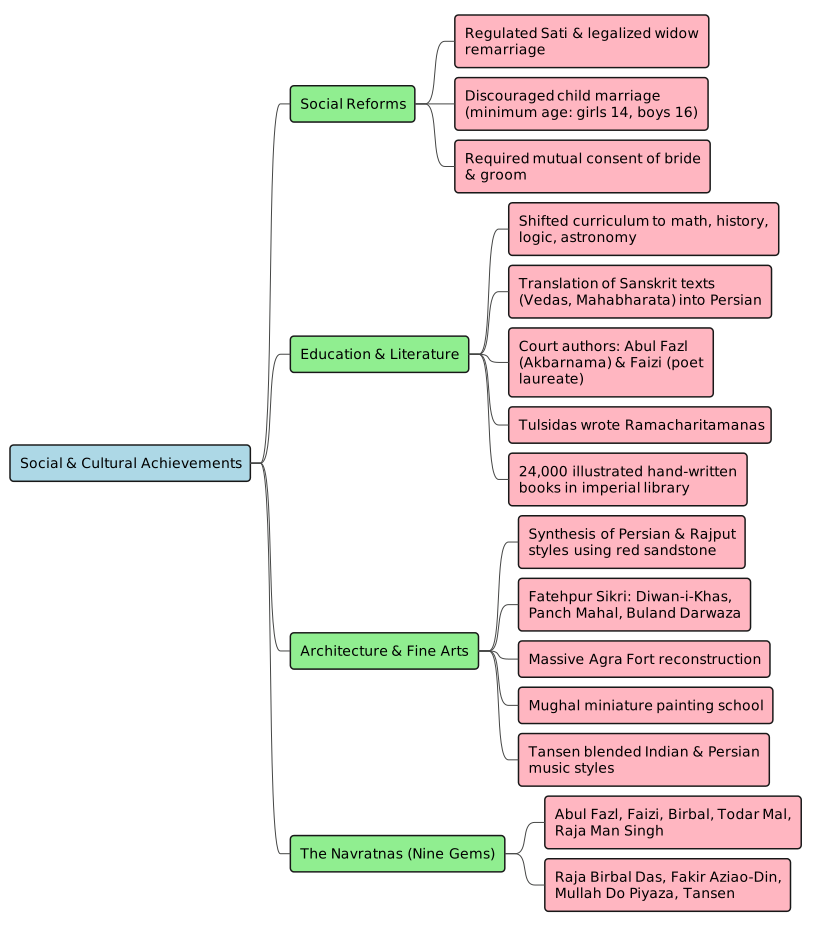
Sati Regulation: He tried to prohibit sati (excluding cases performed voluntarily and with the genuine consent of the widow) and legalized widow remarriage.Child Marriage Restrictions: Discouraged child marriage by raising the minimum age of marriage to 14 years for girls and 16 years for boys, requiring the consent of both the bride and bridegroom.
Secular Curriculum: Shifted the focus of education from purely religious scriptures to secular subjects, including mathematics, agriculture, logic, history, and astronomy.Translation Department: Established a specialized office to translate Sanskrit scriptures (such as the Vedas, the Mahabharata, and the Bhagavad Gita), the Bible, and classical Greek and Arabic texts into Persian.Language and Court Writers:Persian: The official court language. Abul Fazl wrote the Akbarnama (an extensive historical account), and his brother Faizi served as Akbar’s poet laureate.Hindi: Patronized at court; Birbal was named the Hindi Kavi Raj (poet laureate). Tulsidas wrote the epic Ramacharitamanas during this era.The Imperial Library: Though Akbar was illiterate, he possessed an insatiable curiosity and maintained a library of 24,000 highly illustrated, hand-written manuscript volumes.
Miniature Paintings: The imperial library maintained a large workshop of artists dedicated to illuminating manuscripts through intricate miniature paintings.Music Patronage: Abul Fazl recorded 36 top-ranking musicians at court, split into 7 groups to perform on specific days of the week. The most celebrated was Tansen, who composed new ragas and laid the foundation of modern Hindustani music by blending Indian and Persian musical styles.
Fatehpur Sikri: Akbar’s custom-built capital, widely called a “dream in stone,” contains the Diwan-i-Khas, Panch Mahal, Jodha Bai’s Palace, and the grand gateway, the Buland Darwaza.Agra Fort: Built in red sandstone.
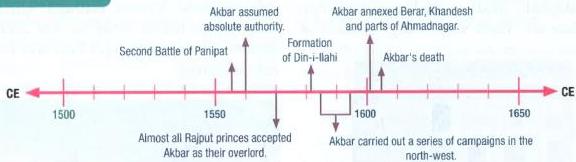
1556 CE: Death of Humayun; Akbar crowned at age 13; Second Battle of Panipat defeats Hemu.1560 CE: Akbar assumes absolute authority and dismisses Bairam Khan.1561 CE: Annexation of Malwa.1564 CE: Conquest of Gondwana.

Share
Explore
 Self Study
Prepared by: learnloophq@gmail.com
Chapter: 09. Akbar
The Mughal Empire: Akbar (1556–1605 CE)
1. Akbar’s Early Years and Expansion
The Accession and Regent Rule
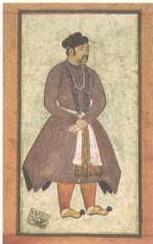
Portrait of Akbar, who took the Mughal empire to its greatest heights.
Portrait of Akbar, who took the Mughal empire to its greatest heights.
Immediate Threats to the Empire
The Second Battle of Panipat (November 1556 CE)
End of the Regency (1560 CE)
2. Conquests, Rajput Alliances, and Territorial Expansion
Akbar launched campaigns to bring the entire Indian subcontinent under a single administration.
Central India and the East
Subjugation and Integration of the Rajputs
Akbar recognized that securing Delhi and Agra required neutralizing or befriending the Rajputs. Rather than relying solely on warfare, he sought their friendship and matrimonial cooperation.
Conflict with Mewar
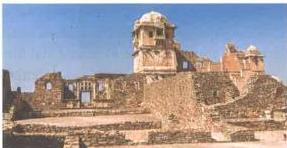
Ruins of the Chittorgarh Fort.
Ruins of the Chittorgarh Fort.
Battle of Haldighati (1576 CE)
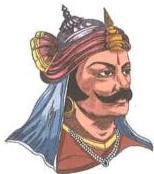
Portrait of Rana Pratap Singh.
Portrait of Rana Pratap Singh.
Did You Know? During the Battle of Haldighati, both Rana Pratap and his horse, Chetak, were severely wounded. Chetak carried Rana Pratap safely away from the battlefield to safety before dying of his wounds. A splendid memorial stands at the spot where Chetak died.
Expansion in the North-West and Deccan
The empire eventually stretched from the Hindu Kush mountains in the west to the Brahmaputra in the east, and from the Himalayas in the north to the Godavari in the south.
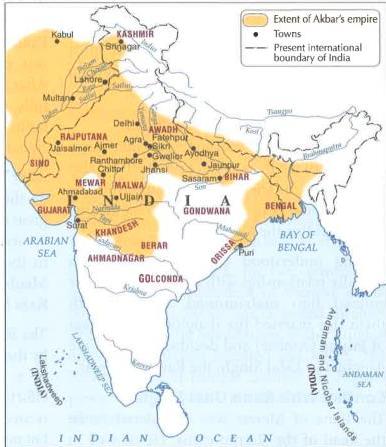
Akbar’s Empire: India in 1605 CE.
Akbar’s Empire: India in 1605 CE.
3. Administration, Mansabdari, and Revenue Systems
Akbar established a systematic and highly centralized administrative framework that formed the backbone of the Mughal State.
Central Administration
The Emperor held absolute authority over military, political, administrative, and judicial matters. His word was law.
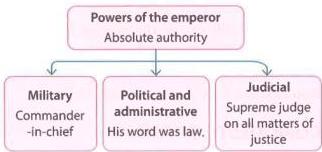
Akbar’s powers as the Mughal emperor.
Akbar’s powers as the Mughal emperor.
To manage this vast power, he was assisted by a council of ministers:
Akbar held regular administrative meetings in two designated spaces:
Provincial Administration
The empire was divided hierarchically to ensure effective governance:
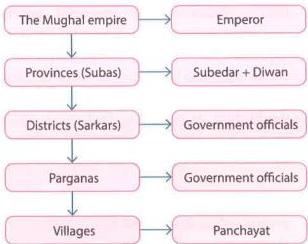
Structure of the Mughal provincial administration.
Structure of the Mughal provincial administration.
Administrative Level
Governing Authority / Description
Empire
Led by the Emperor
Subas (Provinces)
15 provinces governed by a Subedar (civil/military affairs) and a Diwan (revenue records). They kept a mutual check on each other.
Sarkars (Districts)
Overseen by government officials.
Parganas (Sub-Districts)
Smaller administrative units managed by a team of reporting officials.
Villages
Governed locally by the village Panchayats.
The Mansabdari System
The civil and military administration was structured under the Mansabdari system:
Revenue and Trade Reforms
Akbar built on Sher Shah’s revenue structure with the help of his brilliant revenue minister, Raja Todar Mal, introducing Todar Mal’s Bandobast:
4. Religious Policies, Din-i-Ilahi, and Rajput Policy
Akbar sought to transform the Islamic Mughal state into a secular one, uniting India’s diverse populations under a unified national identity.
Measures for Religious Tolerance
The Ibadat Khana
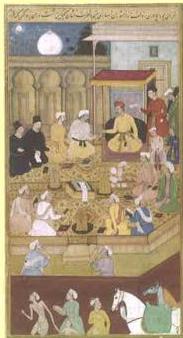
Akbar holding discussions on religious matters in the Ibadat Khana.
Akbar holding discussions on religious matters in the Ibadat Khana.
Din-i-Ilahi (1582 CE)
Rooted in the principle of Sulh-i-Kul (universal peace or harmony with all), Akbar formulated a new ethical code in 1582 CE called Din-i-Ilahi (Divine Faith):
The Rajput Policy
Akbar realized that the physical stability of the empire depended on Rajput loyalty.
5. Social, Educational, and Cultural Achievements
Akbar’s long, stable reign produced significant advancements in literature, painting, music, and architecture, blending Persian and Indian traditions.
Social Reforms
Educational and Literary Reforms
Fine Arts and Music
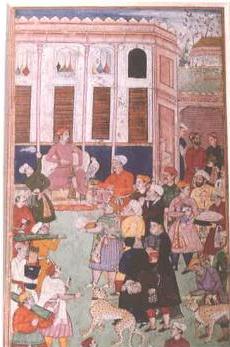
A Mughal miniature painting depicting Akbar receiving gifts and attending to petitions.
A Mughal miniature painting depicting Akbar receiving gifts and attending to petitions.
Architecture
Akbar’s architectural style evolved from classical Persian (such as Humayun’s Tomb) to a synthesis reflecting regional Rajput styles, featuring red sandstone, square pillars, balconies, and delicate stone screens.
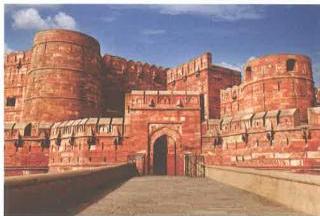
The Agra Fort, built in red sandstone.
The Agra Fort, built in red sandstone.
The Nine Gems (Navratnas)
Akbar’s court was adorned by an elite circle of nine highly accomplished individuals:
Gem
Contribution / Role
Abul Fazl
Court historian, politician, and author of the Akbarnama and Ain-i-Akbari.
Faizi
Persian poet laureate and brother of Abul Fazl.
Birbal
Close companion, wit, and court’s Hindi Kavi Raj.
Raja Todar Mal
Brilliant revenue minister who designed the land tax system.
Raja Man Singh
Great military commander and provincial viceroy.
Raja Birbal Das
Prominent courtier and administrator.
Fakir Aziao-Din
Mystic and trusted advisor.
Mullah Do Piyaza
Renowned court wit and advisor.
Tansen
Legendary musician who pioneered Hindustani classical fusion.
Biography: Abul Fazl
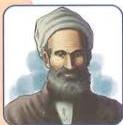
Portrait of Abul Fazl.
Portrait of Abul Fazl.
Abul Fazl was a key writer, historian, and politician in Akbar’s court, serving as one of the Navratnas. His works, the Akbarnama and the Ain-i-Akbari, provide detailed historical insights into Akbar’s administration and policies and remain the primary historical sources for studying this era.
6. Comprehensive Chapter Summary
Timeline of Key Events
Want to print your doc?
This is not the way.
This is not the way.

Try clicking the ··· in the right corner or using a keyboard shortcut (
CtrlP
) instead.