Skip to content
The space occupied by an object is called its _ _ _ _ _ _ _ _ _ _ _ _ _ _.A small drop of water contains about _ _ _ _ _ _ _ _ _ _ _ _ _ _ molecules of water.The force of attraction between the same kind of particles is called _ _ _ _ _ _ _ _ _ _ _ _ _ _ force.Liquids and gases can flow, and therefore they are collectively called _ _ _ _ _ _ _ _ _ _ _ _ _ _.The process of change of a gas directly into a solid on cooling is called _ _ _ _ _ _ _ _ _ _ _ _ _ _.
The mass of an object remains the same at all places, but its weight changes from place to place. (True / False)Atoms usually have an independent existence in nature. (True / False)The kinetic energy of particles decreases with an increase in temperature. (True / False)Solids have negligible intermolecular space and very strong intermolecular forces of attraction. (True / False)Liquids like oil and diesel are completely soluble (miscible) in water. (True / False)
MatterBrownian motionInterconversion of states of matterSublimation
Mass and Weight (On the basis of definition and constancy at different places)Cohesive force and Adhesive force (On the basis of the types of particles involved)
In which of the three states shown is the intermolecular force of attraction the strongest? Why?Which of the three states has the maximum intermolecular space?Explain the movement of molecules in the ‘Solid’ state as depicted in the diagram.
What happens to the movement of particles of matter when the temperature is increased? Why?Why is it difficult to swim in fast-flowing water? Which property of matter does this demonstrate?What is the difference between an atom and a molecule regarding their independent existence?Why do molecules of a gas occupy all the available space?
Describe an experiment (with method, observation, and discussion) to show that particles of matter have spaces between them.Compare solids, liquids, and gases in detail by drawing a table based on the following parameters:ShapeVolumeCompressibilityFluidity (tendency to flow)Position of molecules
Ram takes a cold bottle of water out of the refrigerator, wipes it completely dry, and leaves it on the table. A few minutes later, he notices water droplets forming on the outer surface of the bottle. Explain which process is responsible for this observation and why it occurs.LPG (cooking gas) is stored in cylinders as a liquid but comes out as a gas when the regulator valve is opened. Explain why this happens based on the effect of pressure on states of matter.

Share
Explore
 Question Paper
Prepared by: learnloophq@gmail.com
Chapter: 01. Matter And Its Composition
Practice Exam Paper: Matter and Its Composition
Class: VII
Subject: Chemistry
Time Allowed: 2 Hours
SECTION A: Multiple Choice Questions (MCQs)
1. An Indian philosopher who proposed that matter is composed of very small particles called parmanu was:
(a) John Dalton
(b) Maharishi Kanad
(c) Isaac Newton
(d) Albert Einstein
2. The force of attraction between different kinds of particles is called:
(a) Cohesive force
(b) Adhesive force
(c) Repulsive force
(d) Intermolecular space
3. The continuous zigzag motion of the particles of matter is termed as:
(a) Linear motion
(b) Curvilinear motion
(c) Brownian motion
(d) Vibrational motion
4. Which of the following substances changes directly from a solid to a gas on heating?
(a) Ice
(b) Wax
(c) Naphthalene
(d) Common salt
5. Which state of matter is highly compressible and has no definite volume or shape?
(a) Solid
(b) Liquid
(c) Gas
(d) Fluid
SECTION B: Fill in the Blanks
SECTION C: True or False Questions
SECTION D: Explanations of Terms
Define and explain the following terms in one or two sentences:
SECTION E: Differentiate the Concepts
Distinguish between the following pairs based on the chapter:
SECTION F: Diagram-Based Questions
A diagram representing the molecular arrangement in three states of matter: solid, liquid, and gas.
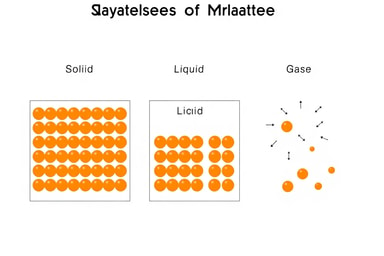
Based on the diagram above, answer the following questions:
SECTION G: Short Answer Questions
SECTION H: Long Answer Questions
SECTION I: Observation-Based / Everyday Use Questions
Want to print your doc?
This is not the way.
This is not the way.

Try clicking the ··· in the right corner or using a keyboard shortcut (
CtrlP
) instead.