Skip to content
The process of converting ammonia from the soil into nitrates by Nitrobacter bacteria is called _ _ _ _ _ _ _ _ _ _ _ _ _ _.Bryophytes stick to the moist surfaces with the help of thread-like structures called _ _ _ _ _ _ _ _ _ _ _ _ _ _ which absorb water and minerals.In ferns, the undersurface of the leaves bears small rounded bodies called _ _ _ _ _ _ _ _ _ _ _ _ _ _ which produce spores.Organisms belonging to Kingdom Monera are unicellular and _ _ _ _ _ _ _ _ _ _ _ _ _ _.Fungi are distinct from green plants because their cell walls are made up of _ _ _ _ _ _ _ _ _ _ _ _ _ _ rather than cellulose.
Gymnosperms produce true flowers and fruits.The bacterium Escherichia coli is found in the human intestine and synthesizes vitamin B-complex.Yeast is a multicellular eukaryotic fungus used in bakeries.Pseudomonas is a free-living bacterium involved in the process of denitrification.Monocotyledonous plants produce seeds containing two cotyledons.
CryptogamsTaxonomyMycelium
Chlamydomonas : Unicellular alga :: Spirogyra : _ _ _ _ _ _ _ _ _ _ _ _ _ _Cocci : Spherical bacteria :: Bacilli : _ _ _ _ _ _ _ _ _ _ _ _ _ _Yeast : Unicellular fungus :: Mushroom : _ _ _ _ _ _ _ _ _ _ _ _ _ _
Why are gymnosperms called “naked seed” plants?Why can’t human beings digest cellulose, whereas cows and buffaloes can?How does Amoeba exchange respiratory gases?
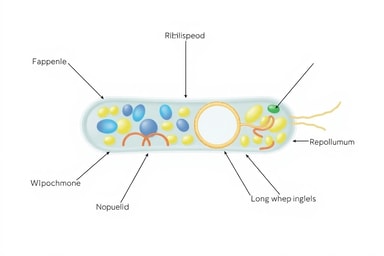
Name the genetic material present nakedly at the center of the bacterial cell.What structure does the bacterium use for locomotion (movement)?Why are bacteria classified as prokaryotes? Support your answer using the features shown in the diagram.
Algae and Fungi (Mode of nutrition & Cell wall composition)Gymnosperms and Angiosperms (Type of reproductive structures & Seed enclosure)Monocots and Dicots (Number of cotyledons in seeds & Examples)
Rohan moistens a slice of bread and leaves it in a warm, dark cupboard for three days. When he checks it, he finds a bluish-green, cottony, fluffy mass growing on it.(a) Identify the organism that has grown on the bread.(b) Explain how this organism digests and absorbs its food.Mention two ways in which bacteria are used in the food industry to prepare daily consumable items.
Explain the Five-Kingdom Classification system proposed by R. H. Whittaker in 1969. Name the five kingdoms and list their characteristic cell type (prokaryotic/eukaryotic) and cellular organization (unicellular/multicellular).

Share
Explore
 Question Paper
Prepared by: learnloophq@gmail.com
Chapter: 02. Kingdom Classification
Practice Exam Paper: Kingdom Classification
Subject: Biology
Class: VII
Time Allowed: 2 Hours
Max Marks: 50
Section A: Multiple Choice Questions (5 Marks)
Choose the most appropriate option for each of the following questions.
1. Who is known as the ‘Father of Taxonomy’?
(a) Aristotle
(b) R. H. Whittaker
© Ernst H. Haeckel
(d) Carl von Linnaeus
2. Which taxonomic category is the basic unit of biological classification?
(a) Kingdom
(b) Genus
© Species
(d) Phylum
3. Which bacterium is present in the root nodules of legumes and is responsible for nitrogen fixation?
(a) Pseudomonas
(b) Rhizobium
© Nitrobacter
(d) Lactobacillus
4. Bryophytes are commonly referred to as:
(a) Naked-seeded plants
(b) Amphibians of the plant kingdom
© Non-vascular flowering plants
(d) Simplest thalloid plants
5. Penicillin, the first wonder drug, was discovered in 1929 from which fungal source?
(a) Penicillium notatum
(b) Penicillium chrysogenum
© Penicillium griseofulvin
(d) Mucor
Section B: Fill in the Blanks (5 Marks)
Fill in the blanks using the clues provided. Use the exact blank format as indicated.
Section C: True or False (5 Marks)
State whether the following statements are True or False. If false, write down the correct statement.
Section D: Explanations of Terms (6 Marks)
Define or explain the following terms in 1-2 sentences:
Section E: Complete the Series (3 Marks)
Analyze the relationship in the first pair and complete the second pair.
Section F: Short Answer Questions (6 Marks)
Answer the following questions briefly:
Section G: Diagram-Based Question (5 Marks)
Study the diagram below and answer the questions that follow.
A clean, labeled diagram displaying the internal and external structure of a typical rod-shaped bacterial cell.
Section H: Identifying and/or Differentiate Concepts (6 Marks)
Differentiate between the following pairs based on the criteria provided in the brackets:
Section I: Environmental Awareness / Everyday Use (4 Marks)
Apply your knowledge to solve the following everyday situations:
Section J: Long Answer Question (5 Marks)
Answer the following question in detail:
Want to print your doc?
This is not the way.
This is not the way.

Try clicking the ··· in the right corner or using a keyboard shortcut (
CtrlP
) instead.