Skip to content

Share
Explore
 Question Paper
Chapter: 07. Air And Atmosphere
AIR AND ATMOSPHERE - PRACTICE EXAM
Grade: 7
Subject: Chemistry
Time Allowed: 2 Hours
Total Marks: 80
SECTION A: MULTIPLE CHOICE QUESTIONS (MCQs)
(5 × 1 = 5 Marks)
Q1. Who conducted experiments in the 18th century to prove that air is a mixture of many gases rather than a single substance?
(a) Carl Wilhelm Scheele
(b) Joseph Priestley
(c) Antoine Lavoisier
(d) Daniel Rutherford
Q2. During the fractional distillation of liquid air, at what temperature does nitrogen boil and transition into its gaseous form?
(a) -183°C
(b) -195.5°C
(c) -300°C
(d) 0°C
Q3. Which of the following diseases is specifically caused by the presence of mercury particles in the air?
(a) Bronchitis
(b) Asthma
(c) Minamata
(d) Paralysis
Q4. What is the approximate ratio of nitrogen to oxygen in the air by volume, as concluded from Lavoisier’s experiment?
(a) 1:4
(b) 1:1
(c) 2:1
(d) 4:1
Q5. When oxygen gas is passed through an alkaline pyrogallol solution, the solution turns:
(a) Milky white
(b) Brown
(c) Blue
(d) Light green
SECTION B: FILL IN THE BLANKS
(5 × 1 = 5 Marks)
Q1. The active portion of air that supports burning was named _ _ _ _ _ _ _ _ _ _ _ _ _ _ by Antoine Lavoisier.
Q2. In the nitrogen cycle, bacteria like _ _ _ _ _ _ _ _ _ _ _ _ _ _ present in the roots of leguminous plants convert atmospheric nitrogen into soluble nitrates.
Q3. Solid carbon dioxide is commonly known as _ _ _ _ _ _ _ _ _ _ _ _ _ _ and is extensively used as a refrigerant.
Q4. The process of converting ammonium salts in the soil first into nitrites and then into nitrates is called _ _ _ _ _ _ _ _ _ _ _ _ _ _.
Q5. In the laboratory preparation of oxygen, hydrogen peroxide decomposes rapidly at room temperature in the presence of _ _ _ _ _ _ _ _ _ _ _ _ _ _ which acts as a catalyst.
SECTION C: TRUE OR FALSE
(5 × 1 = 5 Marks)
Q1. Oxygen is a highly combustible gas that catches fire easily when exposed to a flame.
Q2. Approximately 50% of the earth’s crust is made up of oxygen in combined forms like oxides, carbonates, and silicates.
Q3. Rusting is a fast oxidation process that releases a massive amount of heat and light energy.
Q4. Nitrogen is highly soluble in water, making it much more soluble than oxygen.
Q5. Carbon dioxide is a greenhouse gas that helps maintain the earth’s temperature by trapping solar radiation.
SECTION D: EXPLAIN THE TERMS
(4 × 2 = 8 Marks)
Q1. Nitrogen Fixation
Q2. Humidity
Q3. Precipitation
Q4. Ignition Temperature
SECTION E: COMPLETE THE SERIES
(3 × 1 = 3 Marks)
Q1. Sand : 56% oxygen :: Human Body : _ _ _ _ _ _ _ _ _ _ _ _ _ _ (by weight)
Q2. Fast oxidation : Burning :: Slow oxidation : _ _ _ _ _ _ _ _ _ _ _ _ _ _
Q3. Limestone : CaCO₃ :: Gypsum : _ _ _ _ _ _ _ _ _ _ _ _ _ _
SECTION F: SHORT ANSWER QUESTIONS
(5 × 3 = 15 Marks)
Q1. Write any three distinct reasons why air is classified as a mixture and not a chemical compound.
Q2. Why does a magnesium ribbon gain weight after it is completely burnt in the presence of air?
Q3. What is the role of catalytic converters installed in modern automobile exhaust systems?
Q4. Why must the use of potassium chlorate be avoided for the routine preparation of oxygen gas in a school laboratory? State two safety reasons.
Q5. Name the mixture of gases used as a local anaesthetic in dentistry.
SECTION G: DIAGRAM-BASED QUESTION
(1 × 6 = 6 Marks)
A diagram of a laboratory experimental setup containing a test tube filled with limewater. The test tube is sealed with a two-hole rubber stopper. A long bent glass tube is submerged deep into the limewater, labeled ‘Air from air pump’. A short bent glass tube remains in the empty space above the liquid. The limewater inside the test tube is turning cloudy and milky, with bubbles emerging from the bottom of the long tube.
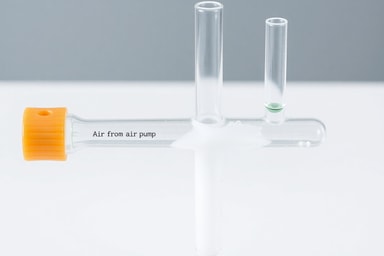
Based on the diagram above, answer the following questions:
(a) What chemical component of air is being tested in this experiment? (1 Mark)
(b) Explain why the limewater turns milky. Name the chemical compound that precipitates out of the solution to cause this appearance. (2 Marks)
(c) Write the complete, balanced chemical equation representing this chemical reaction. (3 Marks)
SECTION H: LONG ANSWER & DIFFERENTIATING QUESTIONS
(3 × 5 = 15 Marks)
Q1. Describe the Nitrogen Cycle by outlining the five major steps involved in the continuous circulation of nitrogen through living and non-living components.
Q2. Create two distinct comparison tables to differentiate between the following:
(a) Combustion (of carbon compounds) and Respiration (on the basis of: Nature of reaction, Release of energy, and Temperature requirement). (3 Marks)
(b) Rusting and Burning (on the basis of: Necessary conditions and Nature of oxidation). (2 Marks)
Q3. Explain how pure oxygen gas is prepared on a large scale from atmospheric air. Describe the steps from filtration to fractional distillation, noting the respective boiling points.
SECTION I: OBSERVATION & APPLICATION-BASED QUESTIONS
(2 × 4 = 8 Marks)
Q1. Case Study: Damage to Monuments
The Taj Mahal, a historic monument made of white marble (calcium carbonate), is located in an area with high industrial emissions. Over time, the marble has begun to corrode and change its chemical composition.
(a) Identify the atmospheric phenomenon responsible for this destruction. (1 Mark)
(b) Explain how industrial gases like sulphur dioxide lead to this phenomenon. (1 Mark)
(c) Write the balanced chemical equation showing how the acid reacts with the marble monument. (2 Marks)
Q2. Laboratory Practice
A student is preparing oxygen gas in the laboratory using hydrogen peroxide and manganese dioxide.
(a) Identify the physical method used to collect the oxygen gas in the jar. Why is this specific method suitable for oxygen? (2 Marks)
(b) Why can oxygen not be collected over air despite being heavier than air? (2 Marks)
Want to print your doc?
This is not the way.
This is not the way.

Try clicking the ··· in the right corner or using a keyboard shortcut (
CtrlP
) instead.