Skip to content
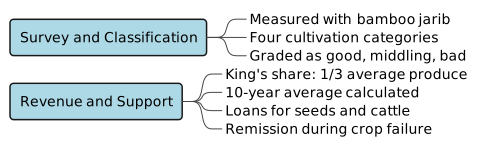
Under the guidance of his revenue minister Raja Todar Mal, Akbar introduced a structured land revenue system where land was systematically surveyed and measured using a bamboo jarib. The surveyed land was classified into four categories based on cultivation frequency, and further graded as good, middling, or bad. Revenue was calculated as one-third of the average produce, determined from the average yield and prices over the preceding ten years. To support the agricultural sector, revenue officers were directed to treat peasants well, and loans were advanced for purchasing seeds and cattle, with provisions for revenue remission during droughts or floods.
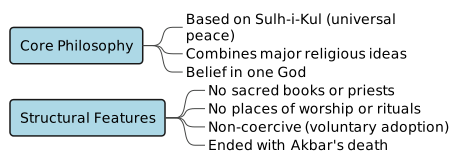
 In 1582 CE, Akbar introduced a new religious order called Din-i-Ilahi, which combined the ethical concepts of major religions to promote universal brotherhood and national unity. This system was based on the principle of Sulh-i-Kul, representing universal peace, and recognized belief in one God with the emperor as His representative on earth. Unlike traditional religions, Din-i-Ilahi was a code of moral conduct that lacked sacred books, priestly classes, places of worship, or rigid rituals. Akbar never forced his subjects to convert, and the order remained largely unpopular outside his court, eventually coming to an end with his death.
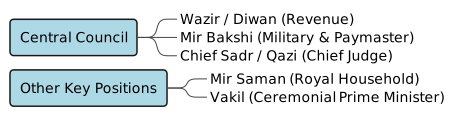
 Akbar’s central administration was supported by a strong council of ministers to assist him in governing the vast empire. The revenue department was headed by the wazir or diwan, while the military department and the paymaster of all mansabdars was managed by the mir bakshi. Judicial matters were overseen by the chief sadr or the qazi, who acted as the chief judge of the empire. The supervisor of the royal household was the mir saman, and the vakil served as a ceremonial prime minister with advisory powers.
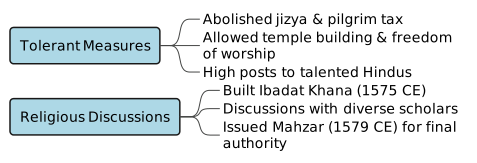
 Akbar adopted a policy of religious tolerance to transform the Islamic Mughal state into a secular one and unite his diverse subjects. To foster mutual understanding, he built the Ibadat Khana at Fatehpur Sikri in 1575 CE, where scholars from various religions, including Hinduism, Islam, Christianity, and Jainism, assembled to discuss theological principles. He abolished highly resented taxes like the jizya and the pilgrim tax, while allowing his Hindu subjects and Rajput wives complete freedom of worship. Furthermore, Akbar issued the Mahzar declaration in 1579 CE, which established him as the supreme and final authority on Islamic laws over the traditional ulemas.
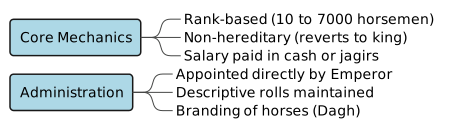
 The Mansabdari system was a unique administrative and military framework where every official in the imperial service was assigned a specific rank or mansab. These ranks, ranging from an officer of ten horsemen to seven thousand horsemen, determined the official’s status, salary, and military obligations. The mansabdars were appointed, promoted, or dismissed directly by the emperor, and their ranks were not hereditary, meaning their jagirs reverted to the king upon death. Akbar also implemented strict measures under this system, such as branding horses and maintaining descriptive rolls of soldiers, to ensure military efficiency.

Share
Explore
 Answer key
Prepared by: learnloophq@gmail.com
Chapter: 09. Akbar
Answer Key
1. Describe the land revenue system known as Todar Mal’s Bandobast.
2. Explain the principles, objectives, and features of the new religious order, Din-i-Ilahi.
3. Explain the administrative structure and responsibilities of Akbar’s council of ministers.
4. Analyze Akbar’s religious policy and the establishment of the Ibadat Khana.
5. Discuss the features of the Mansabdari system introduced by Akbar.
Want to print your doc?
This is not the way.
This is not the way.

Try clicking the ··· in the right corner or using a keyboard shortcut (
CtrlP
) instead.